 CryptoChain Blog
Introduction to Ethereum's 2027 Layer 2 Vision
As Ethereum matures beyond its 2026 capabilities, the 2027 roadmap places strong emphasis on Layer 2 scaling solutions. This comprehensive examination explores the anticipated enhancements designed to deliver faster transaction speeds, reduced operational costs, and seamless interoperability across networks while preserving decentralization and security. Readers interested in forward-looking ETH developments will discover detailed expert forecasts, phased milestone timelines, and direct comparisons against 2026 performance baselines. The focus remains on actionable insights that help developers optimize dApps and enable everyday users to navigate an evolving ecosystem with confidence.
Layer 2 technologies have already transformed Ethereum by offloading computation from the mainnet. In 2027, refinements will build upon these foundations to address remaining pain points such as data fragmentation and inconsistent user experiences. By understanding these upcoming changes early, stakeholders can position themselves advantageously for the next wave of adoption in decentralized finance, gaming, and enterprise applications.
2026 Baseline: Current Layer 2 Landscape
Throughout 2026, prominent Layer 2 platforms including Optimism, Arbitrum, and zkSync delivered substantial throughput gains via optimistic and zero-knowledge rollups. Transaction fees on these networks dropped dramatically compared to Ethereum mainnet, empowering wider participation in DeFi protocols and NFT marketplaces. Despite these advances, ecosystem fragmentation persisted, with users frequently managing separate bridges, wallets, and liquidity pools across different rollups. Developers also faced challenges when attempting to port applications between environments due to varying standards and tooling.
These 2026 achievements established critical infrastructure but highlighted the need for protocol-level improvements. Data availability remained a bottleneck for many rollup operators, while cross-chain communication required manual interventions that introduced security risks. The 2027 roadmap directly targets these limitations through targeted upgrades.
Expected Danksharding Refinements in 2027
Danksharding represents a cornerstone of Ethereum's scaling strategy, and 2027 is expected to bring meaningful refinements to its implementation. Enhanced data blobs will allow rollups to store and retrieve transaction data more efficiently, supporting higher throughput without compromising security. Analysts project that these optimizations could push network capacity toward several thousand transactions per second when combined with existing rollup architectures.
Further advancements may include improved data availability sampling methods and tighter integration with proto-danksharding features already deployed. These changes will benefit both optimistic and zk-rollups by lowering operational overhead for sequencers and provers. In practice, projects handling high-volume use cases such as decentralized exchanges or real-time gaming will notice smoother performance and more predictable fee structures.
Cross-L2 Standardization Efforts
Cross-L2 standardization stands out as one of the most transformative areas in the 2027 roadmap. Unified bridging protocols and standardized messaging formats will enable direct asset transfers and smart contract calls between different Layer 2 networks without relying on centralized intermediaries. This development promises to eliminate much of the friction users currently experience when moving funds or interacting with applications across ecosystems.
Standardization efforts will likely incorporate shared approaches to account abstraction and interoperability frameworks. Developers can anticipate new libraries and testing environments that simplify multi-rollup deployments. For instance, a DeFi protocol could offer liquidity on multiple L2s while presenting users with a single, unified interface. Early adopters who experiment with testnet versions of these standards will gain valuable experience ahead of mainnet activation.
Ethereum Foundation resources offer detailed specifications on proposed interoperability standards.
Sustainability Gains and Environmental Impact
Layer 2 refinements scheduled for 2027 will also contribute to improved network sustainability. By optimizing data handling and reducing redundant mainnet interactions, the upgrades will lower overall energy consumption per transaction. Building on Ethereum's established proof-of-stake consensus mechanism, these changes reinforce the network's position as an environmentally responsible blockchain platform suitable for large-scale applications.
Concrete examples include enterprise solutions migrating workloads to standardized Layer 2 environments to meet corporate ESG targets. Compared with 2026 baselines, measurable reductions in aggregate energy usage are anticipated across the ecosystem. Developers focused on green finance applications can leverage these improvements to create more compelling value propositions for environmentally conscious users and institutions.
Expert Forecasts and Milestone Timelines
Industry experts anticipate a phased rollout of 2027 enhancements beginning in the first quarter with initial danksharding upgrades. Cross-L2 standardization features are projected to reach broader maturity by the third quarter, following extensive community testing and governance reviews. These timelines align with ongoing proposal cycles and build incrementally on 2026 infrastructure rather than introducing disruptive overhauls.
Forecasts stress the importance of iterative deployment, allowing existing Layer 2 projects to adapt gradually. Regular updates from core developers and research teams will provide visibility into progress, helping teams plan migrations and feature integrations accordingly.
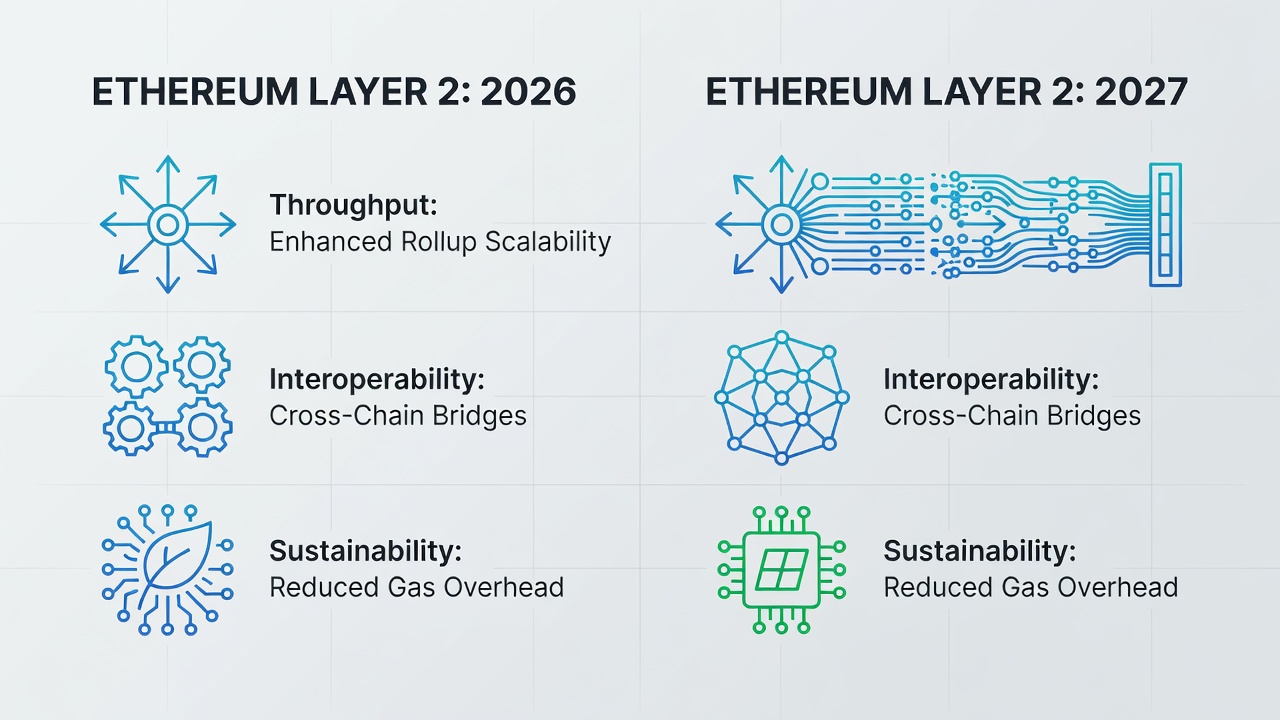
Side-by-Side Comparison: 2026 vs 2027
- Throughput: 2026 delivered hundreds of transactions per second on leading L2s; 2027 aims for multi-thousand TPS through refined sharding techniques.
- Interoperability: Fragmented bridging solutions in 2026 transition to standardized, trust-minimized protocols by 2027.
- Transaction Fees: Further reductions driven by optimized data availability and blob storage improvements.
- Sustainability Metrics: Incremental efficiency gains layered on top of proof-of-stake foundations.
- Developer Experience: More unified tooling and reduced need for custom bridge implementations.
Preparation Steps for Developers and Users
Developers preparing for 2027 should begin by auditing smart contracts for compatibility with emerging standards and participating in relevant Ethereum Improvement Proposal discussions. Testing early implementations on public testnets will reveal potential integration challenges before mainnet deployment. Users can start diversifying across multiple Layer 2 networks that align with upcoming interoperability goals to minimize future migration friction.
Recommended practical steps include:
- Reviewing official documentation and EIP drafts related to danksharding and cross-rollup messaging.
- Joining community testnet initiatives focused on standardized bridges and account abstraction.
- Monitoring governance forums and developer calls for the latest milestone updates.
- Experimenting with multi-chain deployment frameworks that support future standards.
- Educating teams on new security considerations introduced by enhanced interoperability features.
Monitoring Resources and FAQs
Reliable information sources include the Ethereum Foundation blog and official research channels. Staying engaged with these platforms ensures timely awareness of testing phases and final specifications.
Frequently Asked Questions
When will 2027 upgrades become available on mainnet? Initial danksharding components are expected in early 2027, with broader cross-L2 features following later in the year after rigorous testing.
How will these changes affect existing dApp users? Most users should experience faster transactions and lower fees with minimal disruption, though wallet providers may release updates to support new standards.
What security considerations should developers evaluate? Enhanced interoperability introduces new attack surfaces; thorough audits and gradual rollouts are advised.
Which Layer 2 networks are best positioned for 2027 adoption? Networks actively participating in standardization efforts, such as those contributing to Ethereum core development, are likely frontrunners.
Real-World Impact Examples
Consider a decentralized exchange expanding across multiple L2s. With standardized bridges, it can aggregate liquidity pools automatically, offering users better prices and reduced slippage. Similarly, NFT marketplaces could enable seamless transfers of assets between rollups, increasing secondary market activity and creator royalties without additional user friction.
Conclusion
Ethereum's 2027 Layer 2 roadmap marks a significant advancement toward a more scalable, interoperable, and sustainable blockchain environment. Through targeted danksharding refinements and cross-L2 standardization, the network will support greater adoption across diverse use cases. Taking proactive steps today positions developers and users to fully capitalize on these transformative developments as they unfold.

No comments yet. Be the first!