 CryptoChain Blog

Introduction to Ethereum L2 CBDC Integrations in 2026
As central banks worldwide accelerate digital currency initiatives, Ethereum Layer 2 solutions are emerging as critical infrastructure for scalable and efficient CBDC deployments. In 2026, forward-looking projects focus on leveraging L2 networks to handle high-volume transactions while maintaining the security and decentralization principles inherent to Ethereum. This article examines the latest ETH news and trends shaping these integrations, with emphasis on regulatory alignment, technical advantages, and real-world implementations. The convergence of public blockchain technology with sovereign monetary systems represents a major shift in how digital currencies could function at national and international scales, offering both opportunities and complexities that require careful navigation by policymakers and technologists alike.
Regulatory Alignment Driving 2026 CBDC Strategies
Regulatory frameworks in 2026 emphasize interoperability between public blockchains and sovereign digital currencies. Central banks are aligning with standards from international bodies to ensure compliance without compromising innovation. Bank for International Settlements guidelines highlight the need for transparent audit trails and anti-money laundering controls, which L2 solutions can embed directly into smart contract logic. Ethereum's ecosystem benefits from these alignments as developers build permissioned modules that satisfy jurisdictional requirements while preserving user privacy through zero-knowledge proofs. Additional guidance from organizations such as the International Monetary Fund further shapes these strategies, encouraging hybrid models that blend centralized control with decentralized execution. This regulatory evolution helps mitigate risks associated with cross-border flows and ensures that CBDC systems remain resilient against financial crimes while fostering innovation in programmable money features.
Technical Benefits of L2 Scalability for CBDC Transactions
Layer 2 networks address the throughput limitations of base-layer Ethereum, enabling thousands of transactions per second essential for nationwide CBDC rollouts. Optimistic rollups and zk-rollups reduce gas costs dramatically and provide near-instant finality, making them ideal for retail payments and interbank settlements. These technical gains allow CBDCs to operate at scale without congesting the mainnet, while inheriting Ethereum's robust security model. Forward-looking updates in 2026 include enhanced data availability layers that further improve reliability for mission-critical financial systems. In practice, this means a single L2 chain could process peak retail volumes during economic events without latency spikes, supporting features like programmable transfers that execute automatically based on predefined conditions such as time or recipient verification. The result is a more inclusive financial infrastructure capable of handling micropayments and large settlements alike with minimal overhead.
Real-World Pilot Examples from Polygon and Optimism
Several 2026 pilots demonstrate practical L2-CBDC convergence. Polygon has partnered with multiple monetary authorities to test programmable CBDC wallets on its zkEVM, focusing on cross-border remittances with built-in compliance hooks. Optimism, meanwhile, is advancing its OP Stack for custom CBDC chains that support atomic swaps between digital fiat and tokenized assets. These initiatives showcase how L2 environments can isolate sensitive transaction data while maintaining public verifiability where required. 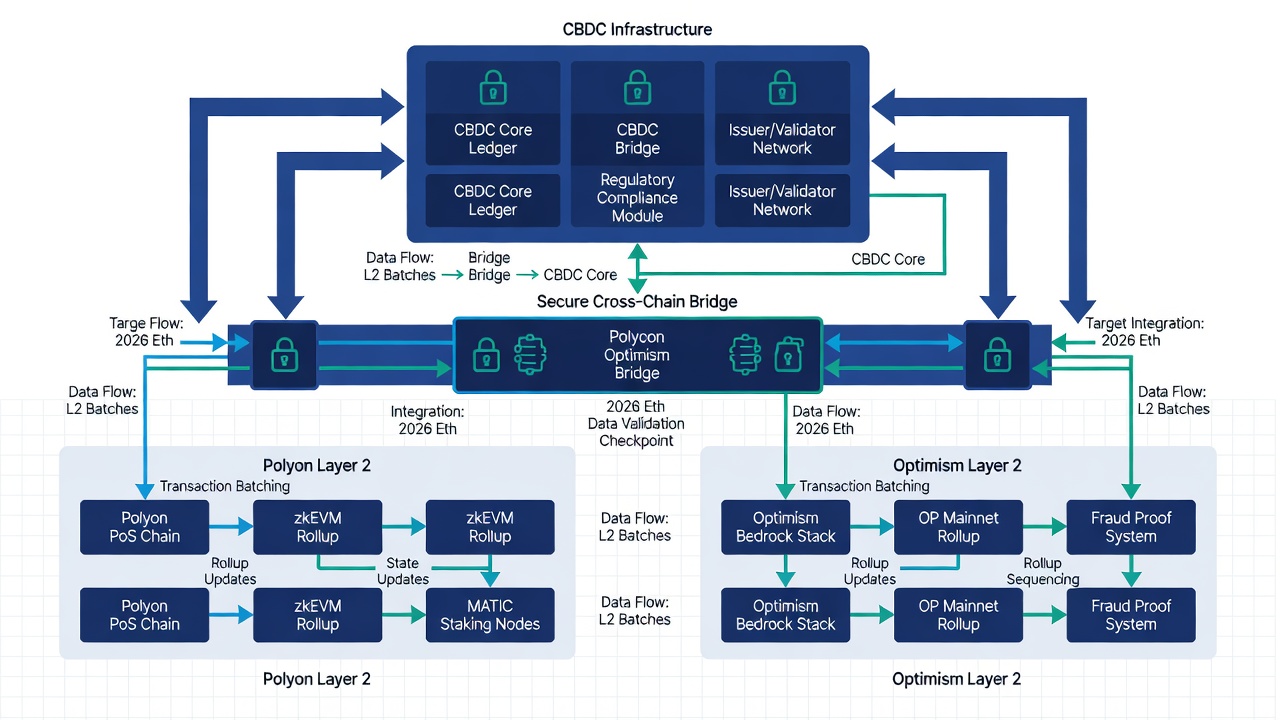
Security Considerations for L2-Based CBDC Systems
Security remains paramount when integrating CBDCs with public L2 infrastructure. Key measures include multi-signature governance for upgrade contracts, formal verification of bridge protocols, and continuous monitoring for oracle manipulation. In 2026, projects incorporate hardware security modules and threshold signature schemes to protect validator sets. Ethereum's evolving roadmap further strengthens these defenses through danksharding proposals that enhance data sampling and fraud detection on L2s. Beyond technical safeguards, operational security protocols involve regular penetration testing and incident response simulations tailored to financial use cases. These layered approaches help address potential vulnerabilities unique to CBDC environments, such as targeted attacks on issuance mechanisms or attempts to exploit bridge contracts for unauthorized fund movements.
Interoperability Challenges and Solutions
Connecting disparate CBDC networks requires standardized messaging protocols and cross-chain bridges that preserve atomicity. Challenges include differing regulatory perimeters and varying privacy models. Solutions emerging in 2026 involve Ethereum-based identity layers and universal asset standards that facilitate seamless transfers. Developers are also exploring account abstraction to simplify user onboarding across multiple L2 environments without exposing private keys. Practical implementations often rely on middleware solutions that translate between different chain-specific formats, ensuring that a CBDC issued on one L2 can interact fluidly with another jurisdiction's system. This interoperability layer is essential for global trade and remittances, reducing friction that currently plagues traditional cross-border payments.
Comparing L2 Solutions Best Suited for High-Volume CBDC Use
- Polygon zkEVM: Excels in EVM compatibility and low-latency finality, making it suitable for high-frequency retail CBDC payments with strong developer tooling and proven mainnet stability.
- Optimism: Offers flexible OP Stack customization ideal for sovereign chains requiring unique compliance modules and governance structures tailored to central bank oversight.
- Arbitrum Orbit: Provides strong fraud-proof mechanisms and growing ecosystem support for institutional-grade deployments, particularly in environments prioritizing dispute resolution efficiency.
- Base: Leverages established infrastructure partnerships for potential fiat on-ramps and enterprise-grade integrations that simplify connectivity with legacy banking systems.
Each option presents trade-offs in cost, speed, and regulatory flexibility that central banks evaluate through rigorous pilot testing and performance benchmarking against real-world transaction volumes.
Step-by-Step Overview of Potential Integration Processes
- Assess regulatory requirements and define CBDC issuance policies with legal stakeholders, including detailed risk assessments for each jurisdiction involved.
- Select an L2 platform based on throughput benchmarks, security audits, and alignment with existing technical standards used by the central bank.
- Develop custom smart contracts for minting, burning, and transfer logic with embedded KYC hooks and automated compliance checks.
- Implement privacy-preserving features using zk-SNARKs or similar technologies to balance transparency needs with user confidentiality requirements.
- Conduct phased testing on testnets followed by controlled mainnet pilots that simulate peak loads and edge cases such as network partitions.
- Establish monitoring dashboards and incident response protocols for ongoing operations, including regular audits and upgrade procedures.
Economic Implications and Future Outlook
Beyond technical and regulatory aspects, L2 CBDC integrations carry significant economic implications. They could lower transaction costs for consumers and businesses while enabling new monetary policy tools, such as targeted stimulus distributions executed directly on-chain. In 2026, analysts project increased adoption in emerging markets where traditional banking penetration remains low, potentially accelerating financial inclusion. Looking ahead, continued Ethereum protocol improvements are expected to further enhance L2 capabilities, positioning these networks as foundational layers for next-generation digital economies. Collaboration between public and private sectors will be key to realizing these benefits while managing associated risks.
FAQ: Addressing Privacy, Compliance, and Common Concerns
How do L2 CBDC integrations protect user privacy?
Privacy is achieved through selective disclosure mechanisms and zero-knowledge proofs that verify transactions without revealing full details to the public ledger, allowing users to maintain confidentiality while meeting regulatory reporting needs.
What compliance features are typically included?
Smart contracts often embed transaction limits, blacklisting capabilities, and automated reporting to satisfy AML and sanctions screening requirements, providing real-time oversight without manual intervention.
Are these integrations secure against quantum threats in 2026?
Current implementations rely on post-quantum cryptography research and hybrid signature schemes to future-proof against emerging computational risks, with ongoing upgrades planned as standards mature.
Can L2 solutions support offline CBDC functionality?
Yes, several pilots incorporate secure element hardware that enables offline payments with eventual reconciliation on the L2 network, ensuring usability in areas with intermittent connectivity.
What are the main barriers to widespread adoption?
Key barriers include legacy system integration complexities, varying global regulatory timelines, and the need for robust public education on digital currency usage and security best practices.
Conclusion
Ethereum L2 integrations with CBDCs represent a pivotal development in 2026 digital finance. By combining regulatory foresight, technical scalability, and proven pilot successes from networks like Polygon and Optimism, stakeholders can build resilient systems that meet both innovation and compliance demands. Continued collaboration between central banks, developers, and the broader Ethereum community will determine the pace of adoption in the years ahead, paving the way for more efficient and inclusive monetary systems worldwide.


No comments yet. Be the first!