 CryptoChain Blog
Introduction to Quantum Computing Risks in Ethereum L2 Networks
Quantum computing represents a significant long-term threat to the cryptographic foundations of Ethereum and its Layer 2 scaling solutions. As quantum machines advance, algorithms like ECDSA used in current Ethereum transactions could become vulnerable to attacks that break elliptic curve cryptography. In 2026, developers are actively preparing L2 networks such as Optimism, Arbitrum, and zkSync for post-quantum security to maintain the integrity of smart contracts and bridges. The shift is driven by rapid progress in quantum hardware from companies like IBM and Google, which have demonstrated qubits scaling toward fault-tolerant systems capable of running Shor's algorithm at relevant scales. This article provides an in-depth examination of the risks, emerging standards, migration steps, performance data, and compatibility considerations to help Ethereum stakeholders future-proof their infrastructure.
The urgency stems from the fact that quantum computers, once sufficiently powerful, could solve discrete logarithm problems far faster than classical systems. This article examines the risks, emerging standards, migration steps, and performance comparisons to help Ethereum stakeholders future-proof their infrastructure. Beyond theory, real-world testnet data from 2026 shows early hybrid deployments already underway on multiple L2s, highlighting both opportunities and implementation hurdles.
Why Quantum Threats Target Ethereum Layer 2 Cryptography
Ethereum L2 solutions rely heavily on digital signatures for transaction validation, rollup proofs, and cross-chain bridges. Current implementations use ECDSA and similar schemes that quantum algorithms like Shor's can theoretically compromise. While large-scale quantum computers capable of breaking 256-bit ECC are not yet available, the "harvest now, decrypt later" strategy means adversaries may already be storing encrypted data for future attacks. L2 networks amplify exposure because they process high volumes of transactions and manage substantial value through bridges. A compromised signature scheme could allow unauthorized fund movements or invalid state transitions in optimistic and zero-knowledge rollups.
Additional risks arise from the composability of DeFi protocols on L2s, where a single weak signature verification in a bridge contract can cascade across lending platforms and liquidity pools. Historical examples from classical cryptography breaks, such as the 2010s MD5 collisions, underscore why proactive migration is critical before quantum supremacy arrives in production environments.
Post-Quantum Cryptography Standards Tested on L2 Networks
In 2026, several post-quantum standards are undergoing testing on Ethereum L2 testnets. The primary candidates come from NIST's post-quantum cryptography project, focusing on algorithms resistant to both classical and quantum attacks.
Lattice-Based Signatures
Lattice-based schemes such as CRYSTALS-Dilithium and Falcon offer strong security with reasonable signature sizes. These are being integrated into L2 sequencers for transaction signing. Dilithium, in particular, provides efficient verification suitable for high-throughput L2 environments. Developers are experimenting with parameter sets that balance security level 2 and level 3, achieving verification speeds close to classical methods while resisting known quantum attacks.
Hash-Based Schemes
Hash-based signatures like SPHINCS+ provide stateless alternatives with proven security based on hash function resistance. While larger in size, they are ideal for long-term archival security in bridge contracts where state management is complex. SPHINCS+ variants are being tested specifically for optimistic rollup fraud proofs, where the stateless nature reduces the risk of key reuse vulnerabilities.
Testing on L2 networks involves hybrid approaches that combine classical and post-quantum signatures during transition periods to ensure backward compatibility. Additional candidates such as multivariate and code-based schemes are also under evaluation on select zk-rollup testnets for specialized use cases like zero-knowledge proof aggregation.
Implementation Steps for Developers Migrating Smart Contracts and Bridges
Migrating to quantum-resistant cryptography requires careful planning. Developers should follow these practical steps:
- Audit existing contracts for all ECDSA usage in signature verification functions, including libraries like OpenZeppelin and custom implementations.
- Integrate post-quantum libraries such as those from the Open Quantum Safe project into Solidity or Vyper environments via precompiles or external calls, testing gas limits on mainnet-forked environments first.
- Update bridge contracts to support hybrid signature verification, allowing both ECDSA and lattice-based methods during rollout while maintaining replay protection across chains.
- Test on L2 testnets like Sepolia-based Optimism or Arbitrum deployments to measure gas costs and latency, documenting edge cases such as signature malleability in multi-sig setups.
- Deploy upgradeable proxy patterns so contracts can switch signature schemes without full redeployment, including fallback mechanisms if post-quantum verification fails under load.
- Conduct third-party audits focused on side-channel resistance and integration with existing oracles and wallet providers.
Real-world examples include experimental integrations on zkSync Era where Dilithium signatures are being benchmarked for proof verification overhead, and similar pilots on Base network test environments exploring hash-based schemes for cross-rollup messaging.
Performance Trade-offs Versus Traditional ECDSA Methods
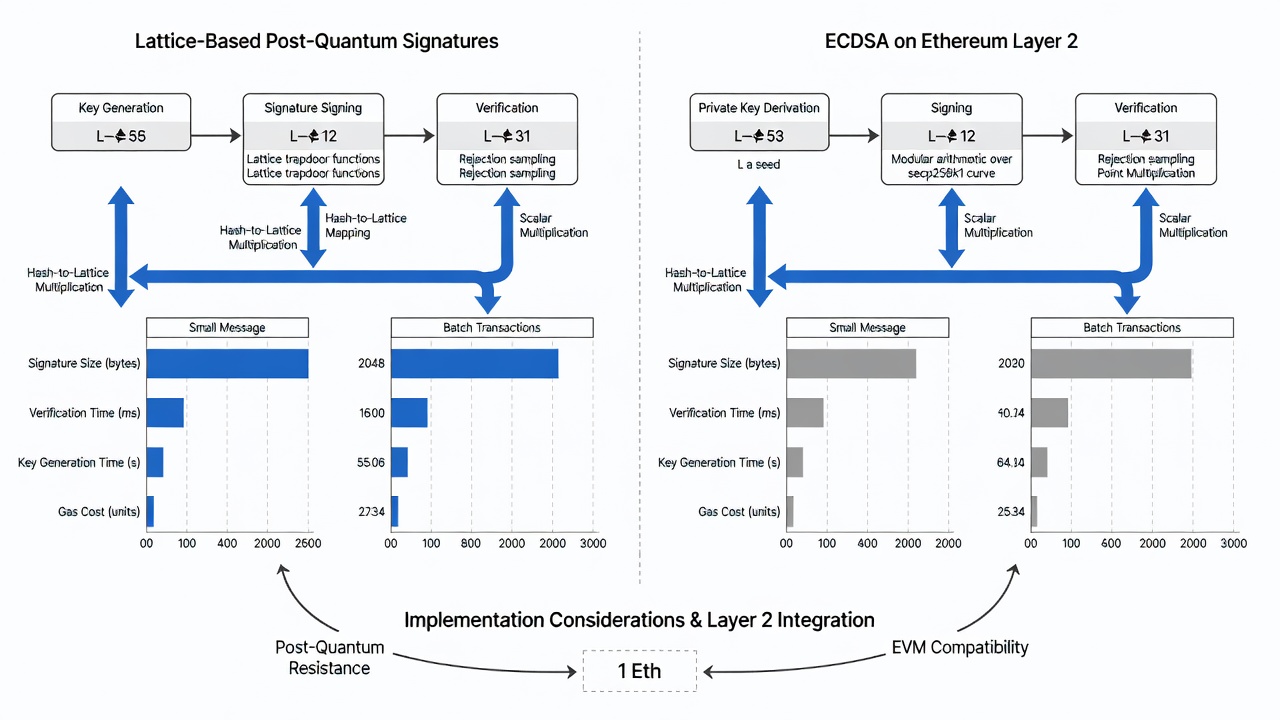
Switching to post-quantum signatures introduces measurable trade-offs. Lattice-based signatures are typically 2-3 times larger than ECDSA signatures, increasing calldata costs on L2 networks. Hash-based options can be 10 times larger, impacting storage in bridge relays. Benchmarks from 2026 L2 test environments show Dilithium verification taking approximately 1.8x longer than ECDSA on average hardware, while maintaining similar throughput in optimistic rollups. Falcon offers smaller signatures but higher computational demands during key generation, making it suitable for less frequent operations like contract deployments.
Developers must weigh these factors against security needs. For most DeFi protocols, hybrid schemes offer the best balance in the near term. Additional considerations include memory footprint on validator nodes and the impact on mobile wallet transaction signing times, which have shown 15-25% increases in controlled 2026 benchmarks.
Compatibility with Existing Ethereum Infrastructure
Quantum-resistant updates must integrate seamlessly with current Ethereum clients and L2 frameworks. Most implementations use wrapper contracts that abstract signature logic, allowing gradual adoption without disrupting user wallets or oracles. Key considerations include EIP compatibility for new precompiles and ensuring that gas metering accounts for larger signature payloads. Existing infrastructure like MetaMask and Ledger hardware wallets will require firmware updates to support post-quantum key generation. Interoperability with Layer 1 Ethereum remains intact through standardized message formats, and tools like Hardhat and Foundry now include plugins for simulating post-quantum gas usage during local development.
Practical FAQs on Timelines, Costs, and Compatibility
- What are the expected timelines for full L2 quantum resistance? Initial hybrid deployments are targeted for late 2026, with broader adoption by 2028 as NIST standards mature further and more L2 teams complete audits.
- How do migration costs compare? Early estimates indicate moderate increases in deployment and verification overhead, primarily driven by larger data sizes rather than fixed fees, with most projects reporting manageable adjustments within existing gas budgets.
- Will existing smart contracts remain compatible? Yes, through upgradeable patterns and optional post-quantum modules that do not break current ECDSA flows, preserving backward compatibility for at least two years post-migration.
- Are there risks during the transition? Hybrid schemes mitigate risks by maintaining dual verification until full migration is verified, though teams should monitor for potential increases in transaction failure rates on congested networks.
- What resources are available for developers? Official documentation from L2 teams and NIST provides sample contracts and test vectors to accelerate safe adoption.
Conclusion
Preparing Ethereum L2 networks for quantum resistance in 2026 is essential for long-term security. By adopting lattice-based and hash-based post-quantum standards, developers can safeguard smart contracts and bridges against future threats while managing performance impacts. Proactive migration using the outlined steps ensures compatibility and positions projects at the forefront of secure blockchain evolution. Continued collaboration with standards bodies like NIST will accelerate reliable implementations across the ecosystem. For the latest developments, refer to Ethereum.org and NIST resources.

No comments yet. Be the first!