 CryptoChain Blog

Introduction to Ethereum L2 Data Availability in 2026
Ethereum's Layer 2 ecosystem continues to evolve rapidly in 2026, with data availability (DA) emerging as a critical factor for scalability and cost efficiency. New DA mechanisms are enabling L2 networks to handle higher transaction volumes while maintaining security and decentralization. This comprehensive guide explores these developments in depth, covering leading providers, integration approaches, real-world impacts, and actionable advice for developers and network operators.
Data availability ensures that transaction data is accessible for verification by network participants. Without robust DA, L2s face bottlenecks that limit throughput and increase fees. Recent advancements focus on modular solutions that separate execution from data storage, allowing the ecosystem to scale beyond previous limitations. As Ethereum transitions further into a rollup-centric roadmap, understanding these changes is essential for anyone building or using decentralized applications.
Understanding Data Availability and Its Role in L2 Scalability
Data availability refers to the guarantee that all transaction data is published and retrievable by anyone who needs to verify state transitions. On Ethereum, this traditionally relied on the base layer, but high demand led to congestion and elevated costs. By 2026, dedicated DA layers offload this burden, allowing L2s to achieve massive throughput gains without sacrificing the security inherited from Ethereum mainnet.
Key benefits include reduced gas costs for data posting and improved finality times. For instance, rollups can now process thousands of transactions per second. The modular approach separates concerns: execution happens on L2s, settlement on Ethereum, and data availability on specialized layers. This architecture reduces the load on the Ethereum consensus layer while preserving verifiability through techniques like data availability sampling. Developers benefit from greater flexibility, but they must understand trade-offs in latency, security assumptions, and operational complexity.
Comparisons of Leading DA Providers
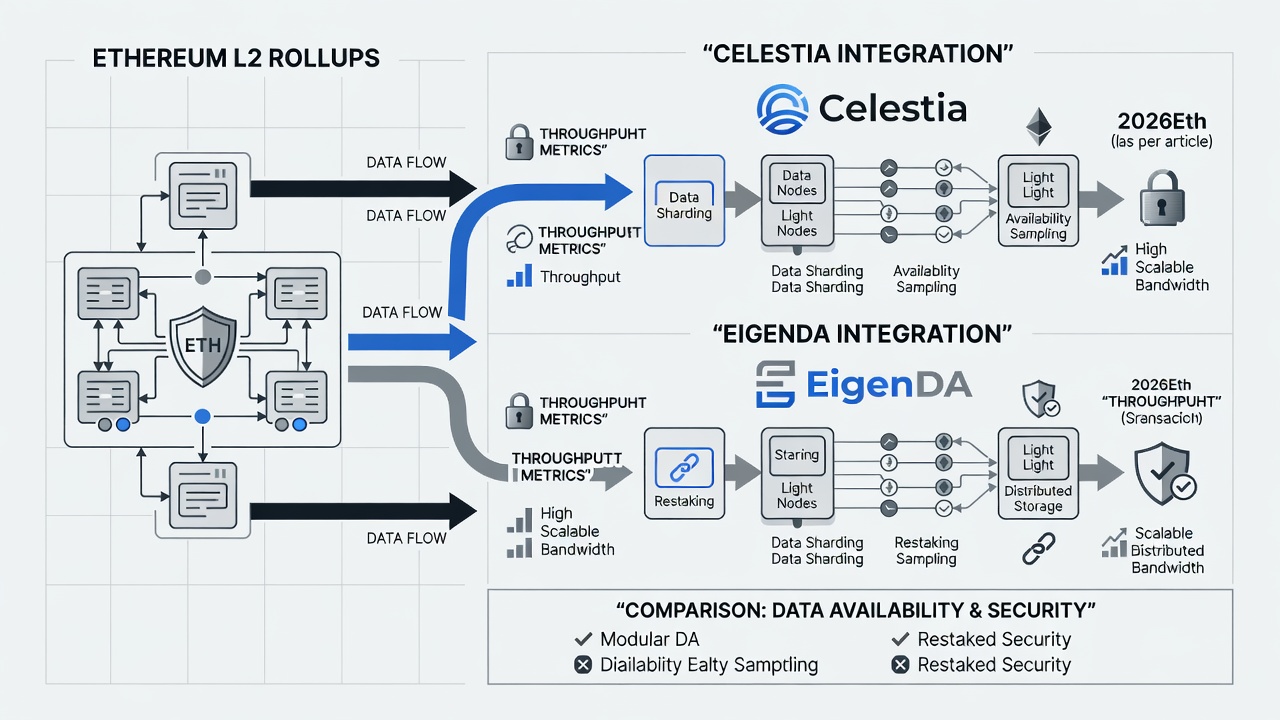
Several providers dominate the 2026 landscape. Celestia offers a modular blockchain focused solely on DA, using data availability sampling for efficiency. EigenDA leverages restaking mechanisms on Ethereum for secure data storage. Other notable options include Avail, which emphasizes sovereign rollups, and Near's DA solution that integrates with its sharded architecture.
- Celestia vs EigenDA: Celestia emphasizes independent verification through light nodes and data sampling, making it highly decentralized. EigenDA integrates deeply with Ethereum's staking ecosystem for economic security via restaked ETH.
- Throughput Impact: Celestia supports large block sizes with sampling, enabling higher L2 capacities compared to on-chain posting. EigenDA focuses on high-throughput blobs with strong Ethereum alignment.
- Cost Efficiency: Off-chain DA options typically lower expenses significantly versus Ethereum calldata, though exact savings depend on network conditions and data volume.
- Security Models: Each provider balances different assumptions; Celestia relies on honest majority sampling while EigenDA uses slashing conditions tied to Ethereum validators.
Developers should evaluate based on security models, latency requirements, ecosystem compatibility, and long-term roadmap alignment when choosing a provider.
Integration Strategies for Existing L2 Networks
Integrating new DA solutions requires careful planning to avoid disruptions. Existing L2s like Optimism, Arbitrum, and zkSync are adopting hybrid approaches that combine multiple DA options for resilience. Detailed steps include:
- Assess current DA usage and identify bottlenecks through on-chain analytics and performance monitoring tools.
- Select a provider matching security and performance needs, considering factors like node requirements and client support.
- Update rollup contracts to post data to the new DA layer using provider-specific APIs and smart contract interfaces.
- Implement data sampling or verification logic in client software, ensuring light clients can efficiently check availability.
- Test on testnets extensively, including fault injection scenarios to validate recovery mechanisms.
- Monitor post-deployment metrics such as retrieval success rate, latency, and user transaction costs.
- Plan for fallback options in case of provider outages or upgrades.
Practical examples include Optimism's integration with Celestia for certain chains, enhancing blob availability without full migration. Arbitrum has explored EigenDA for specific high-volume use cases, demonstrating measurable improvements in throughput.
Impacts on Transaction Throughput and Ecosystem Costs
Enhanced DA directly boosts transaction throughput, with some L2s reporting significant improvements in 2026 deployments. This reduces congestion on Ethereum mainnet and lowers overall fees for users. The shift enables new categories of applications, such as high-frequency trading protocols and large-scale gaming ecosystems, that were previously constrained by data costs.
Security remains paramount, as DA layers must prevent data withholding attacks. Trends in Ethereum news highlight growing adoption of modular stacks combining execution, settlement, and DA layers. Networks that successfully integrate these solutions often see increased developer activity and user retention due to smoother experiences and predictable performance.
Practical Examples from Major Protocols
Base and zkSync have piloted EigenDA for cost savings on data posting, resulting in smoother scaling during peak periods. Starknet explores Celestia for its validity proofs ecosystem, allowing more efficient handling of complex zero-knowledge computations. Polygon CDK chains have experimented with Avail to support sovereign rollup deployments. These cases demonstrate measurable gains in user adoption and dApp performance, with some protocols achieving higher daily active addresses after DA upgrades.
Implementation Steps for Developers
Start by reviewing documentation from providers like Ethereum.org. Prototype integrations using official SDKs, then monitor metrics such as data retrieval times and verification success rates. Collaborate with communities on Celestia and EigenLayer forums for best practices. Consider running validator or light client nodes during testing phases to gain operational insight. Always conduct security audits before mainnet launches and document any custom modifications for future maintenance.
Conclusion
As Ethereum scales in 2026, data availability solutions will define competitive L2 performance. By understanding providers, integrations, and impacts, developers and users can leverage these advancements effectively and contribute to a more scalable decentralized future.
FAQ
How secure are new DA layers compared to Ethereum mainnet?
Modern DA solutions use cryptographic sampling and economic incentives to match or exceed mainnet security guarantees while improving efficiency and reducing load on the base layer.
What Ethereum news trends influence DA adoption?
Key trends include modular blockchain designs, restaking innovations, and the continued rollout of danksharding elements, driving faster L2 evolution and broader ecosystem experimentation.
Are there risks in switching DA providers?
Potential risks include compatibility issues and temporary throughput dips during migration, mitigated by thorough testing, phased rollouts, and maintaining fallback mechanisms.
How does DA affect finality and user experience?
Improved DA reduces confirmation times for L2 transactions, leading to faster finality and a more responsive feel for end users interacting with dApps.
What should teams consider when evaluating multiple DA options?
Teams should weigh decentralization levels, integration complexity, long-term sustainability, community support, and alignment with their specific rollup architecture before committing to a provider.

No comments yet. Be the first!