 CryptoChain Blog
Introduction to Ethereum L2 Data Availability in 2026
As Ethereum continues its evolution into a highly scalable ecosystem, Layer 2 solutions have become essential for handling increased transaction volumes. Data availability stands at the core of this scalability challenge. In 2026, developers must navigate a landscape of competing DA solutions that influence everything from user fees to network security. This comprehensive guide examines Celestia, EigenDA, and Ethereum-native approaches, providing detailed comparisons on costs, security models, throughput capabilities, and real adoption data drawn from sources like L2Beat and Dune Analytics.
The demand for efficient data availability stems from the need to support rollups that process thousands of transactions per second while maintaining trustlessness. Without robust DA, optimistic and zero-knowledge rollups risk data withholding attacks that undermine their security guarantees. Ethereum's ongoing upgrades have addressed some of these issues, yet external modular solutions offer compelling alternatives for specific use cases.
Understanding Data Availability in Ethereum L2 Context
Data availability refers to the assurance that all transaction data required to reconstruct the state of a rollup is published and accessible to network participants. This differs from data storage or execution, focusing instead on verifiability. In practice, rollup sequencers must post compressed transaction data to a DA layer so that anyone can download and verify it during disputes or for state reconstruction.
Historically, Ethereum mainnet served as the sole DA layer, but high gas costs prompted innovation. The Dencun upgrade introduced blob-carrying transactions, offering cheaper temporary data storage. However, for high-throughput applications, developers increasingly explore specialized DA networks. Understanding the trade-offs between these options helps teams align their architecture with project goals and user expectations.
Leading 2026 DA Solutions Overview
Three primary categories dominate discussions in 2026: modular external networks like Celestia, restaked solutions such as EigenDA, and Ethereum-native implementations. Each brings unique design philosophies that affect integration effort and long-term viability.
Celestia: Modular Data Availability
Celestia pioneered the modular blockchain approach by decoupling consensus from execution and focusing exclusively on data availability. Its light nodes use data availability sampling to confirm data publication without downloading full blocks. This architecture enables high scalability while keeping node requirements low. Real-world deployments show Celestia supporting multiple Orbit chains and custom rollups that prioritize cost efficiency over maximum Ethereum alignment.
EigenDA: Restaked Security Model
EigenDA operates as a data availability service built atop EigenLayer's restaking framework. Operators restake ETH to secure the network, inheriting Ethereum's economic security without requiring a separate token or validator set. This model appeals to projects seeking strong cryptoeconomic guarantees while achieving higher data throughput than current blob limits allow. Integration examples include several emerging zk-rollups that batch data submissions to EigenDA for improved performance.
Ethereum-Native Options
Ethereum's built-in DA relies on EIP-4844 blobs introduced after the Dencun hard fork. These blobs provide dedicated, short-lived data space priced separately from execution gas. Future danksharding promises to expand this capacity dramatically through data availability sampling at the protocol level. Teams choosing native options benefit from seamless security inheritance and simplified tooling but may face capacity constraints during peak demand periods.
Cost, Security Trade-offs and Throughput Comparison
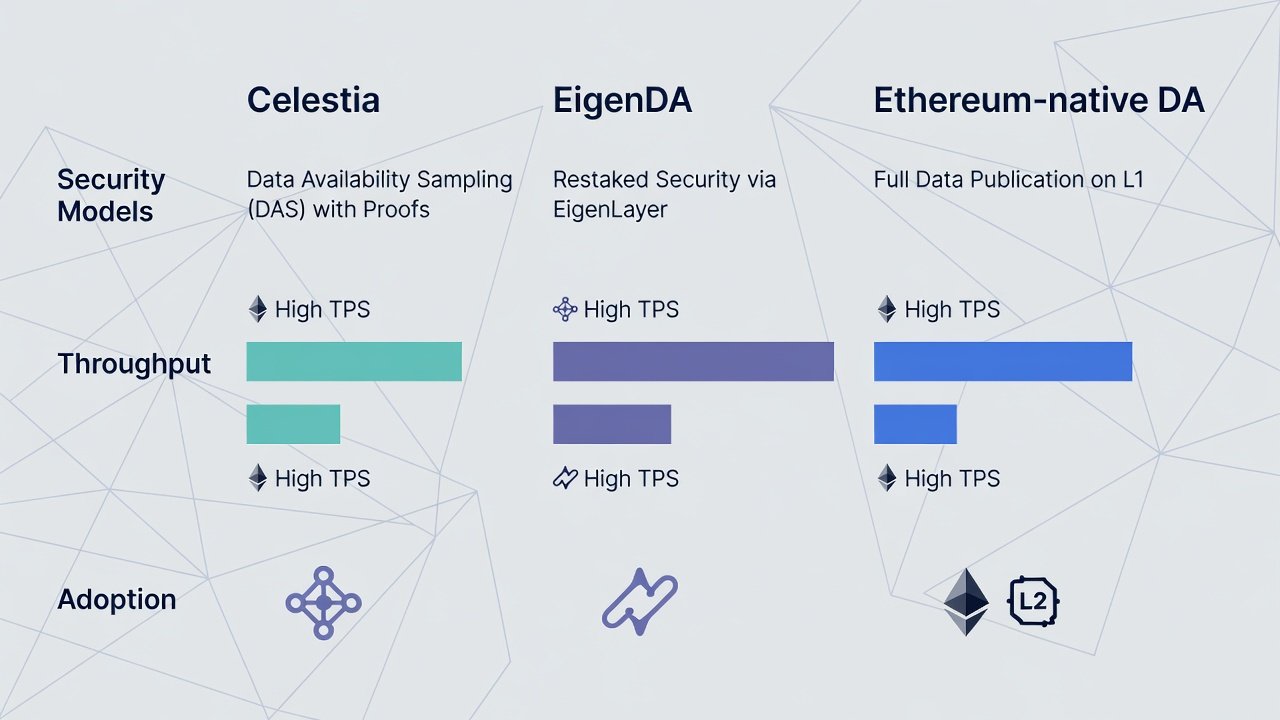
Security assumptions form the foundation of any DA choice. Celestia maintains an independent validator set with its own consensus mechanism, introducing a separate trust boundary. EigenDA ties security directly to restaked ETH, reducing the attack surface but exposing users to slashing risks on EigenLayer. Ethereum-native blobs inherit the full security of the beacon chain, making them the most conservative option for security-focused applications.
Throughput varies significantly across solutions. Celestia and EigenDA currently support higher sustained data rates suitable for gaming or social applications that generate large volumes of state changes. Native blobs offer competitive pricing for moderate usage but require careful monitoring of blob gas markets. Cost trade-offs appear most clearly in user-facing fees, where external DA can reduce per-transaction expenses for data-intensive rollups while adding operational overhead for monitoring multiple networks.
TVL and Adoption Metrics from L2Beat and Dune Analytics
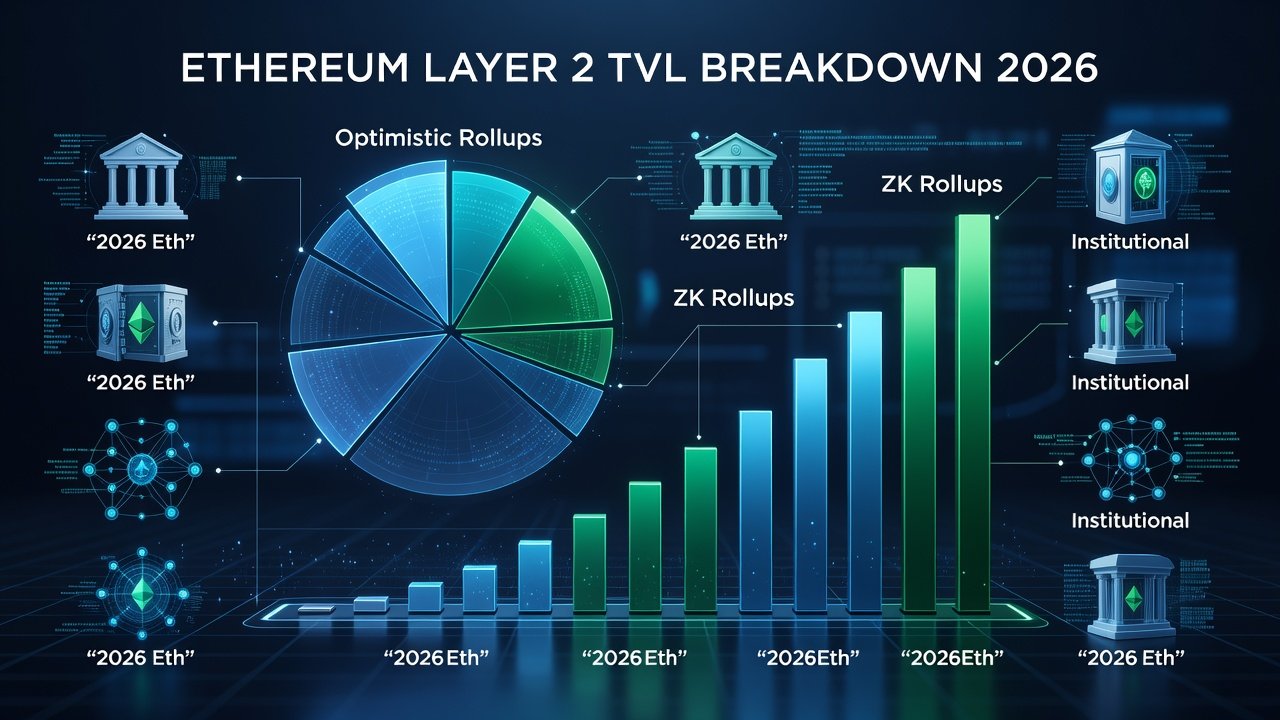
Tracking real adoption requires reliable on-chain data. L2Beat provides detailed TVL breakdowns that reveal which Layer 2 projects have adopted external DA layers and the resulting capital flows. In recent months, several Arbitrum Orbit deployments and custom zk-rollups have shifted portions of their activity to Celestia, correlating with measurable TVL growth in those ecosystems.
Dune Analytics dashboards offer granular insights into blob versus external DA usage patterns. These visualizations show increasing adoption of EigenDA among projects prioritizing restaked security, alongside steady growth in Celestia-integrated chains. Protocol examples include Base-adjacent experiments and emerging gaming rollups that publish high-frequency data to Celestia for reduced latency. Monitoring these metrics helps developers anticipate network congestion and plan capacity accordingly.
Practical Decision Criteria for Developers
Selecting a data availability layer demands careful evaluation across multiple dimensions. Begin by assessing your application's security requirements and the tolerance of your user base for additional trust assumptions. High-value DeFi protocols often default to Ethereum-native options, while consumer applications may accept modular solutions for better economics.
Next, project your throughput needs based on expected transaction patterns. Applications handling media uploads or complex state updates benefit from the higher bandwidth of Celestia or EigenDA. Cost sensitivity represents another key factor; teams should model end-user fees under different DA scenarios using current network conditions.
Integration complexity also matters. Review existing SDKs and documentation for each option, then test compatibility with your chosen rollup framework such as Arbitrum Nitro or OP Stack. Finally, consider long-term roadmap alignment with Ethereum upgrades to minimize future migration costs.
- Map security model to user expectations and regulatory environment
- Simulate throughput under peak load using historical data from Dune Analytics
- Calculate fee impact across user segments before final selection
- Prototype integrations on testnets for at least two candidate solutions
- Review governance and upgrade processes of the chosen DA network
Consult resources on Ethereum.org for native DA guidance and cross-reference with EigenLayer documentation when evaluating restaked alternatives.
FAQ on Implementation Steps
How do I integrate Celestia with an existing rollup?
Start by configuring your sequencer to submit data batches to Celestia light nodes. Update your fraud-proof or validity-proof verifier to include Celestia data availability sampling checks. Test the full flow on a devnet before mainnet deployment, monitoring for any latency introduced by the external network.
What are the steps to use EigenDA?
Deploy the necessary EigenLayer contracts for operator registration and restaking. Configure your rollup to route data submissions through the EigenDA API, ensuring proper authentication with restaked operators. Conduct security audits focused on slashing conditions before scaling usage.
When should I stick with Ethereum-native DA?
Choose native blobs when your application demands maximum security alignment and operates within current blob capacity limits. This approach simplifies operations and avoids external dependencies, making it ideal for early-stage projects or those handling high-value assets.
What common pitfalls occur during DA migration?
Teams often underestimate monitoring requirements across multiple networks. Another frequent issue involves mismatched data formats between the rollup and chosen DA layer, leading to verification failures. Always run extended test periods with simulated mainnet traffic.
Conclusion
Navigating Ethereum L2 data availability options in 2026 requires balancing security guarantees, performance needs, and operational realities. By examining detailed comparisons, adoption metrics from L2Beat and Dune Analytics, and practical decision frameworks, developers can select solutions that support sustainable growth. Staying informed about protocol updates ensures architectures remain adaptable as Ethereum continues scaling.
No comments yet. Be the first!