 CryptoChain Blog

Introduction to Ethereum L2 and DePIN Synergies in 2026
As Ethereum continues to evolve, Layer 2 solutions are emerging as critical enablers for Decentralized Physical Infrastructure Networks (DePIN) in 2026. These integrations combine the scalability of L2 rollups with real-world hardware deployments, driving measurable network growth and fresh ETH news. Developers and projects are leveraging these advancements to create efficient, incentivized ecosystems that connect physical devices to blockchain oracles. The search intent around this topic focuses on practical adoption, technical hurdles, and forward-looking Ethereum updates. This article dives deep into emerging use cases, comparisons across major L2s, and live project examples to provide actionable insights for developers and stakeholders seeking to understand how these technologies intersect and deliver tangible results.
With Ethereum's ongoing upgrades enhancing rollup performance, DePIN networks can now handle thousands of daily micro-transactions from sensors and edge devices without prohibitive costs. This creates opportunities for broader participation in infrastructure projects ranging from environmental monitoring to decentralized connectivity solutions.
Understanding DePIN and Its Reliance on Ethereum L2
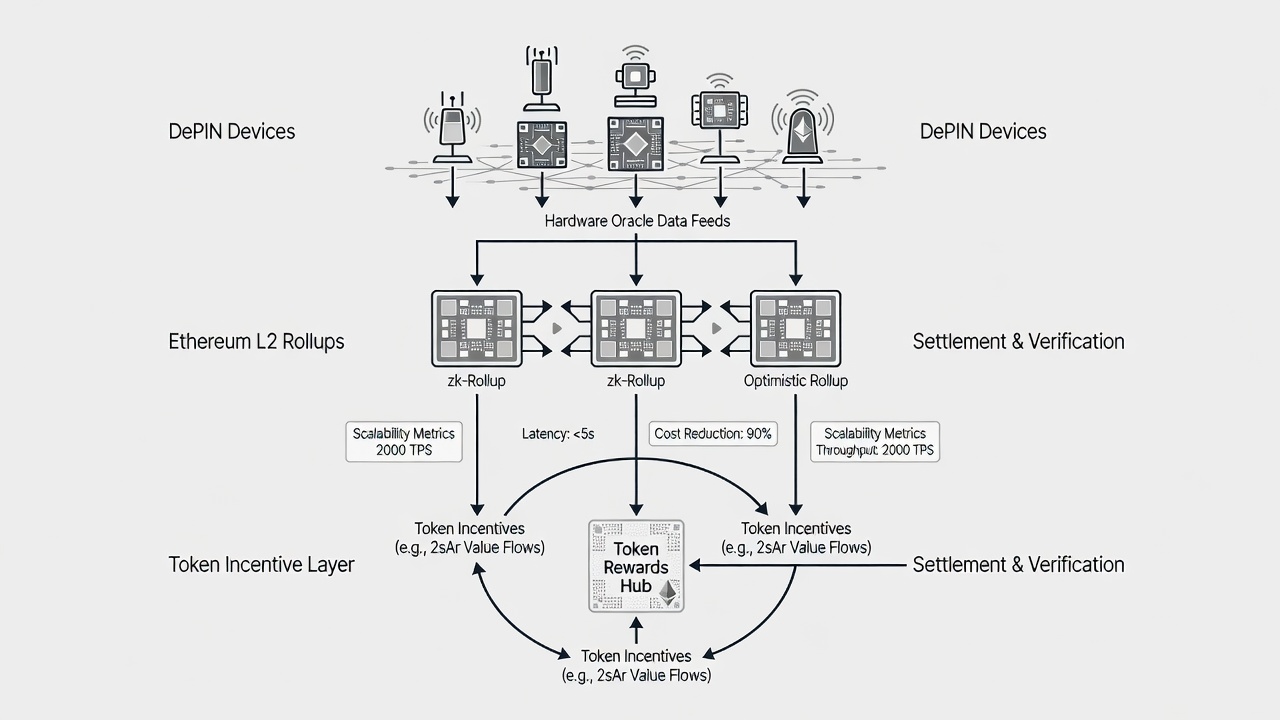
DePIN projects decentralize infrastructure like wireless networks, sensors, and compute resources by rewarding participants with tokens. Ethereum L2s address the high costs and slow speeds of L1, making micro-transactions for hardware oracles feasible. In 2026, this synergy supports scalable data flows from IoT devices directly into smart contracts. Key benefits include reduced gas fees and higher throughput, essential for real-time DePIN operations. Recent Ethereum developments, such as enhanced rollup interoperability, are accelerating these integrations by allowing seamless data verification across optimistic and zero-knowledge based systems.
DePIN operators benefit from L2's ability to process high-frequency updates from physical hardware while maintaining Ethereum's security guarantees. This foundation enables projects to scale from hundreds to tens of thousands of nodes without compromising on decentralization or incentive alignment.
Emerging Use Cases for L2-Powered DePIN
Use cases span environmental monitoring, decentralized 5G alternatives, and distributed energy grids. For instance, sensor networks on L2 can stream data to oracles for automated incentives, fostering global participation without central bottlenecks. Another growing application involves mobility networks where vehicles contribute data to L2-secured ledgers, enabling tokenized rewards for contributors. These cases highlight how L2 scalability unlocks DePIN beyond theoretical pilots into production environments, such as real-time air quality tracking in urban areas or peer-to-peer energy trading facilitated by hardware oracles.
Additional examples include agricultural DePIN deployments that monitor soil conditions across remote farms and feed verified data into L2 contracts for crop insurance payouts. These practical scenarios demonstrate measurable improvements in efficiency and cost savings for participants.
Technical Integration Challenges and Solutions
Integrating DePIN hardware with Ethereum L2 involves bridging physical data to on-chain oracles while managing latency and security. Challenges include ensuring reliable off-chain computations and handling variable device connectivity. Solutions often rely on hybrid architectures using zero-knowledge proofs for data verification on L2. Developers must also navigate cross-chain messaging for multi-L2 deployments. Addressing these through standardized oracle frameworks improves reliability and adoption rates, particularly when combined with secure multi-party computation techniques that protect sensitive device data during transmission.
Latency issues can be mitigated by deploying edge computing nodes that preprocess data before submitting batches to L2, reducing overall costs and improving response times for time-sensitive applications like traffic management systems.
Token Incentives Driving DePIN Participation
Token models on L2 DePIN projects reward hardware operators with native tokens or ETH derivatives. These incentives align economic interests, encouraging sustained network contributions. Effective designs incorporate staking mechanisms and slashing for poor performance, boosting overall ecosystem health. Comparisons show that L2-native tokens often yield faster reward distributions compared to L1 equivalents, enhancing user retention. Projects frequently implement dynamic reward curves that adjust based on network demand, ensuring operators remain motivated even during periods of high competition or fluctuating token values.
Successful incentive programs also include governance rights, allowing hardware contributors to vote on protocol upgrades and oracle parameters, which increases long-term engagement and community ownership.
Hardware Oracle Connections in Practice
Hardware oracles link physical devices to Ethereum L2 smart contracts, enabling verifiable data inputs. Integration typically uses secure enclaves or trusted execution environments to prevent tampering. In 2026, advancements in these connections are supporting more robust DePIN deployments with lower failure rates. Practical setups involve API gateways that batch oracle feeds for cost efficiency on L2 networks. Teams often combine multiple oracle providers to achieve redundancy, ensuring continuous operation even if one source experiences temporary outages.
Scalability Comparisons Across Major L2s
Arbitrum leads in DePIN throughput with optimistic rollup tech, offering high TPS for oracle-heavy workloads. Optimism provides strong developer tooling for quick integrations, while Base emphasizes user-friendly onboarding for hardware operators. zkSync stands out for privacy-focused DePIN applications via zero-knowledge scalability. These comparisons help teams select the optimal L2 based on specific DePIN requirements like latency tolerance and incentive complexity. For example, Arbitrum's ecosystem has demonstrated superior handling of concurrent device connections in production settings, while Optimism excels in environments requiring rapid smart contract iterations.
- Arbitrum: Superior for high-volume data streams, with proven metrics in live networks.
- Optimism: Balanced for cost-sensitive projects emphasizing token utility.
- Base: Ideal for rapid prototyping and community-driven DePIN growth.
- zkSync: Best suited for applications prioritizing data privacy and cryptographic proofs.
Real-World Case Studies from Live DePIN Projects
Projects like decentralized wireless networks demonstrate L2 success, migrating operations to Arbitrum for improved economics and faster settlements. Compute-sharing DePIN initiatives on Optimism showcase step-by-step oracle integrations that have scaled to thousands of nodes. Another example involves energy DePIN on Base, where hardware oracles track contributions in real time, resulting in measurable ETH ecosystem expansion through increased transaction volumes. These case studies reveal common patterns such as phased migrations that begin with testnet pilots before full mainnet deployment, allowing teams to refine incentive structures based on early performance data.
Common Mistakes to Avoid in L2 DePIN Integration
One frequent error is underestimating oracle latency, which can lead to stale data and incorrect incentive distributions. Another mistake involves choosing an L2 without sufficient DePIN tooling support, resulting in extended development timelines. Teams should also avoid overly complex token models that confuse operators and reduce participation rates. Thorough testing with simulated device failures helps prevent these issues before launch.
Step-by-Step Integration Overview for Developers
- Choose an L2 based on scalability needs and audit its DePIN compatibility.
- Set up oracle infrastructure using established frameworks for hardware data ingestion.
- Design token incentive smart contracts with L2-optimized gas patterns.
- Test integrations in staging environments simulating physical device variability.
- Deploy and monitor with analytics tools tracking adoption metrics and network growth.
- Iterate on incentive parameters based on real-world usage feedback and adjust oracle redundancy as needed.
This structured approach minimizes risks and accelerates time-to-production for new DePIN initiatives while ensuring long-term sustainability.
Measurable Impact on Ethereum Network Growth
L2 DePIN integrations contribute to rising ETH activity through increased rollup usage and oracle calls. Adoption metrics indicate sustained growth in active addresses and transaction counts tied to physical infrastructure projects. Forward-looking Ethereum news suggests continued expansion as more hardware ecosystems migrate to L2 environments, supporting broader ecosystem vitality and developer activity.
FAQ: Common Developer Questions on L2 DePIN Integration
How do L2s improve DePIN scalability compared to Ethereum mainnet?
L2 rollups batch transactions, drastically cutting costs and enabling high-frequency oracle updates essential for DePIN hardware.
What are the main risks in hardware oracle setups?
Data integrity and connectivity issues top the list; mitigation involves redundant oracles and cryptographic verification on L2.
Which L2 offers the best token incentive tools for DePIN?
Arbitrum and Optimism provide mature tooling, with recent updates enhancing staking and reward distribution features.
Can existing DePIN projects migrate to L2 easily?
Yes, via bridge protocols and phased rollouts, many have achieved successful migrations with minimal downtime.
What future Ethereum updates will further benefit DePIN?
Upcoming interoperability improvements and enhanced zk-rollup capabilities are expected to simplify cross-L2 data flows and boost overall efficiency.
Conclusion
Ethereum L2 DePIN integrations in 2026 represent a pivotal shift toward practical, scalable decentralized infrastructure. By addressing challenges, leveraging incentives, and comparing L2 options, developers can drive meaningful network growth. Staying updated with ETH news ensures projects remain at the forefront of this evolving space. For authoritative resources, explore ethereum.org, l2beat.com, and arbitrum.io for ongoing developments and tooling guidance.

No comments yet. Be the first!