 CryptoChain Blog
Introduction to Ethereum L2 Restaking in 2026
As Ethereum's Layer 2 ecosystem matures in 2026, restaking has emerged as a powerful tool for ETH holders seeking enhanced yields. Restaking allows users to leverage their staked ETH across multiple protocols and networks, amplifying returns while contributing to network security. This approach builds on Ethereum's core staking model but extends it to L2s like Arbitrum and Optimism, where fee markets and application-specific incentives create unique opportunities. The evolution of L2s has shifted focus from simple bridging to sophisticated yield strategies. Holders can now restake assets to secure additional services such as oracles, bridges, and data availability layers. However, this comes with added complexities around slashing risks and liquidity management. In this comprehensive guide, we examine how restaking on L2s differs from traditional mainnet staking, providing actionable insights for optimizing ETH returns amid evolving network dynamics.
Understanding Restaking Mechanics on L2s
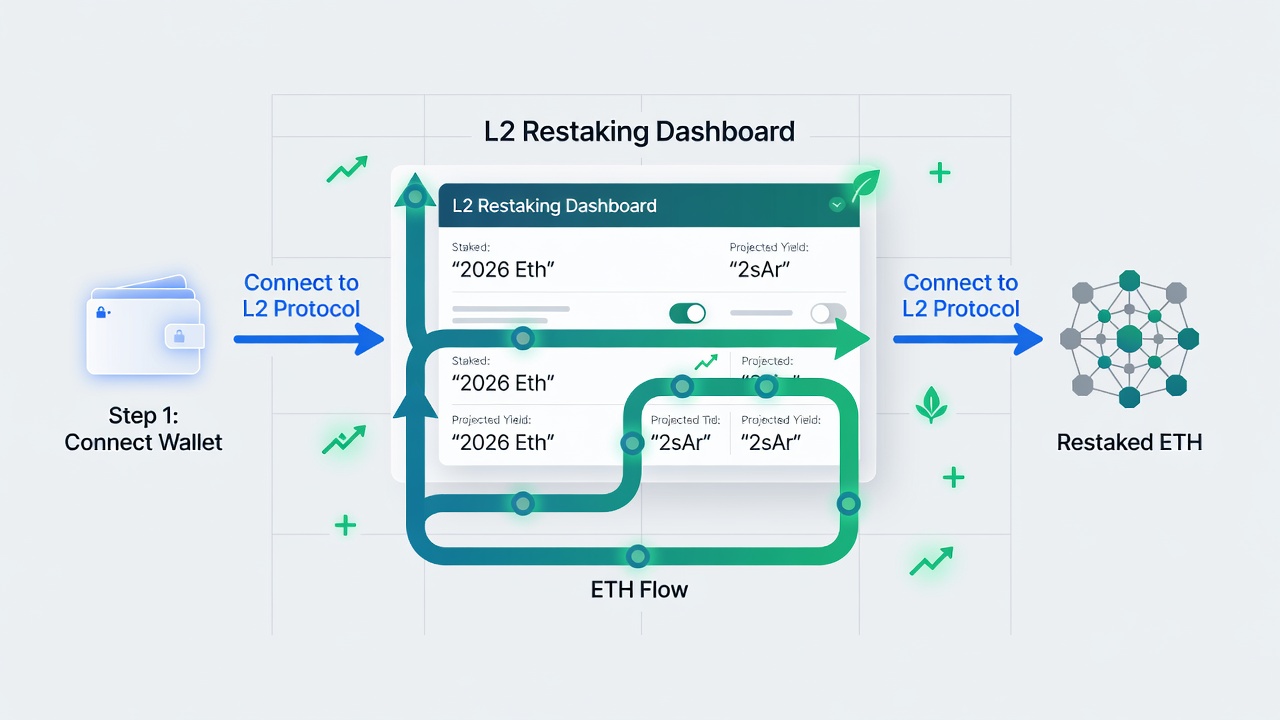
Restaking fundamentally involves reusing staked ETH to validate additional services beyond the base Ethereum consensus. On Layer 2 networks, this process integrates with rollup architectures, where sequencers and provers benefit from extra economic security provided by restakers. In 2026, L2 restaking typically occurs through liquid staking tokens (LSTs) that represent your underlying ETH position. These tokens are then deposited into restaking contracts that distribute validation duties across actively validated services (AVSs). The mechanism enables ETH holders to earn base staking rewards plus supplemental yields from AVS fees, creating a compounded return profile. Key to this is the separation of validation logic: while the beacon chain handles core consensus, L2-specific modules allow restakers to opt into tasks like fraud proof verification or cross-chain messaging security without moving assets off the L2 environment.
Key Protocols Enabling L2 Restaking
Several protocols have adapted restaking frameworks for L2 environments by 2026. EigenLayer extensions on L2s enable operators to validate multiple AVSs while earning combined rewards. Platforms like Kelp DAO and Pendle have integrated L2-specific restaking pools, allowing users to deposit ETH derivatives and receive liquid restaking tokens. Leading L2s such as Arbitrum and Base now host native restaking modules that interact directly with Ethereum's beacon chain. These integrations reduce latency and gas costs compared to mainnet-only approaches. For real-world examples, Arbitrum's ecosystem has seen restaking TVL growth through partnerships with decentralized sequencers. Additional protocols include Symbiotic and new L2-native entrants that focus on modular security layers, each offering distinct AVS marketplaces. Users should review protocol documentation on ethereum.org to understand compatibility requirements before committing funds.
Risk Factors: Slashing and Beyond
Restaking introduces heightened slashing risks, where misbehavior or downtime can lead to partial loss of staked assets. On L2s, these risks are compounded by sequencer centralization and bridge vulnerabilities. Users must evaluate operator performance metrics and diversify across multiple AVSs. Other considerations include smart contract risks in L2 restaking contracts and impermanent loss in liquidity provision. Mitigation strategies involve using audited protocols and monitoring via dashboards on L2Beat. In practice, historical slashing events on mainnet have informed L2 implementations, leading to stricter operator bonding requirements and real-time alerting systems. Diversification across three or more AVSs and regular position reviews are recommended to limit exposure. Additionally, liquidity risks arise during high-volatility periods when exiting restaking positions may incur delays due to unbonding periods that can extend up to several weeks on certain L2 modules.
L2 vs Mainnet Restaking: A Practical Comparison
When deciding between L2 and mainnet restaking, consider these key dimensions:
- Yield Potential: L2 restaking often provides higher combined APRs due to native token incentives and lower fees, though mainnet offers more established security.
- Accessibility: L2s enable faster entry and exit with reduced costs, ideal for smaller holders seeking to experiment with yield strategies.
- Risk Profile: Mainnet benefits from Ethereum's full economic security, while L2s introduce additional layers of trust assumptions around sequencers and data availability.
- Liquidity: L2 positions may face fragmentation across chains, requiring cross-chain tools for management and rebalancing.
- Operational Overhead: Mainnet restaking demands higher technical knowledge for node operation, whereas L2 options often include user-friendly dashboards and automated delegation features.
Step-by-Step Guide to Initiating Restaking Positions
- Acquire ETH and bridge to your chosen L2 via official bridges, verifying transaction finality on both layers.
- Stake ETH on the L2's native staking contract or a compatible liquid staking token provider to obtain an LST representation.
- Deposit the staked position into a restaking protocol like an EigenLayer L2 fork, selecting preferred AVSs during the deposit flow.
- Monitor operator performance and AVS health through on-chain analytics, adjusting allocations if performance metrics decline.
- Claim rewards periodically, reinvest them to compound yields, or withdraw positions after respecting unbonding timelines.
- Implement tax tracking from the outset using portfolio tools to log reward accruals across chains.
Always start with small test transactions and review protocol documentation on ethereum.org. Advanced users may also integrate restaking with DeFi lending protocols on the same L2 to further leverage positions.
Real-World Examples from Leading L2s
Arbitrum has pioneered restaking through its decentralized sequencer initiatives, where restakers secure transaction ordering and earn a share of priority fees. Optimism's OP Stack integrations allow restaking for fault proof enhancements, providing examples of how restaking stabilizes rollup operations during network stress. Base has seen rapid adoption of restaking pools tied to its growing DeFi ecosystem, with users reporting diversified yields from both staking and AVS participation. These cases illustrate how L2-specific incentives align restaker interests with overall network health.
Fee Market Incentives and Analysis
L2 fee markets in 2026 reward restakers through priority fees and MEV redistribution. Protocols that align restaking with sequencer operations capture additional value from transaction ordering. Analysis shows that L2s with robust restaking see stabilized fee revenue, benefiting long-term ETH holders through ecosystem growth. This dynamic encourages sustained participation as fee burns and redistribution mechanisms create ongoing yield streams beyond base staking rewards.
Practical Yield Strategies and Optimization
To maximize returns, combine restaking with yield-bearing LSTs and periodic rebalancing based on AVS performance. Strategies include allocating across low-risk AVSs for stability and higher-risk ones for premium yields, while maintaining reserves for gas and unexpected events. Monitoring tools that aggregate data from multiple L2s help identify optimal entry points and avoid over-concentration in any single protocol.
Common Pitfalls and FAQ
What is the primary difference between L2 and mainnet restaking?
L2 restaking leverages faster settlement and lower costs but adds chain-specific risks not present on mainnet, such as sequencer dependency.
How can I minimize slashing exposure?
Diversify operators, use insurance wrappers where available, and track performance via on-chain analytics tools on platforms like L2Beat.
Are there tax implications for restaking rewards?
Rewards are typically treated as income in most jurisdictions; consult a tax professional for your region and maintain detailed records.
What happens if an L2 experiences downtime?
Restaking positions may face temporary reward pauses, but underlying ETH remains secured on Ethereum mainnet; always confirm L2 health metrics before large allocations.
In conclusion, Ethereum L2 restaking offers compelling yield opportunities in 2026 when approached with diligence. By understanding protocols, risks, and strategies, ETH holders can optimize returns while supporting network security across the expanding L2 landscape.

No comments yet. Be the first!