 CryptoChain Blog
Introduction to Ethereum L2 Governance in 2026
Ethereum Layer 2 solutions continue to evolve rapidly in 2026, with governance models playing a central role in how protocols upgrade, allocate resources, and maintain security. This guide breaks down the key structures, from DAO voting mechanisms to token holder rights, using real examples from leading networks. Whether you are new to the space or an ETH holder looking to engage, understanding these systems helps navigate protocol changes effectively. As Layer 2 networks process the majority of Ethereum transactions, their governance frameworks directly influence scalability, fees, and innovation velocity across the ecosystem.
Governance determines everything from fee adjustments to major upgrades. As L2 adoption grows, transparent decision-making becomes essential for trust and decentralization. In 2026, many protocols have refined their models based on lessons from earlier years, incorporating hybrid approaches that balance efficiency with community input. ETH holders benefit from staying informed because governance outcomes can affect asset security and network value.
Core Components of L2 Governance Models
Most Ethereum L2s rely on decentralized autonomous organizations (DAOs) for decision-making. Token holders typically vote on proposals, but the exact mechanics vary. Key elements include proposal creation, voting periods, quorum requirements, and execution processes. These components ensure that changes reflect community consensus while preventing hasty or malicious alterations.
DAO Voting Mechanisms
Voting often uses token-weighted systems where influence scales with holdings. Some networks implement delegation, allowing users to assign votes to trusted representatives. Timelocks add security by delaying execution after a vote passes, giving the community time to react to controversial decisions. Quadratic voting and reputation-based systems appear in select L2s to reduce whale dominance and encourage broader participation.
Token Holder Rights and Responsibilities
ETH and L2-native token holders gain rights to propose changes, vote, and sometimes claim rewards for participation. However, rights come with risks, such as smart contract vulnerabilities during upgrades. Holders must stay informed to avoid supporting harmful proposals and understand how their tokens interact with governance contracts.
Protocol Upgrade Processes Across L2 Networks
Upgrades represent one of the most critical governance functions. Proposals typically undergo discussion on forums, formal voting, and then execution via multisig or timelock contracts. In 2026, many L2s require multiple approval stages to enhance security. For instance, sequencer changes or bridge modifications often demand higher thresholds to protect user funds. These processes ensure Ethereum compatibility while allowing L2-specific optimizations like improved data availability or fraud proof enhancements.
Real-World Examples from Leading L2s
Arbitrum uses a multi-step governance process involving the Arbitrum DAO for treasury and protocol decisions. Token holders can delegate votes and participate in on-chain ratification after off-chain signaling. Optimism employs a two-house system with the Token House and Citizens House to balance token-weighted and reputation-based voting, allowing non-token holders to influence certain decisions. Base, built on Optimism technology, participates in the broader Optimism Collective governance framework while maintaining its own operational parameters. zkSync and Polygon zkEVM have introduced progressive decentralization roadmaps in 2026, gradually shifting control from foundations to community DAOs with detailed upgrade calendars published on their sites. These examples illustrate how different L2s tailor models to their communities while remaining anchored to Ethereum principles.
On-Chain vs Off-Chain Decision Making
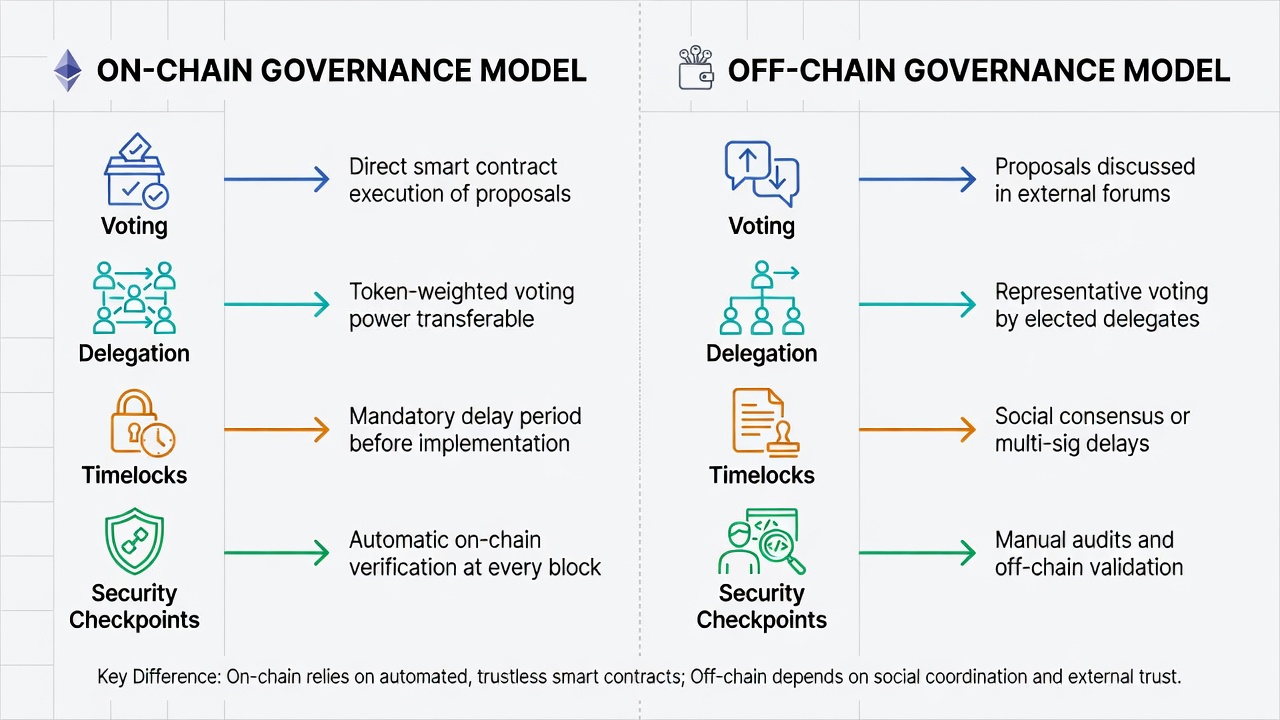
On-chain governance executes votes directly on the blockchain for transparency and immutability. Off-chain approaches, such as Snapshot voting, reduce gas costs and allow broader participation but require separate execution steps. In 2026, many L2s combine both: off-chain signaling followed by on-chain ratification. This hybrid reduces costs while preserving security. On-chain methods provide stronger guarantees but can exclude smaller holders due to fees, whereas off-chain options increase accessibility at the cost of requiring trusted executors.
Ethereum Foundation resources provide foundational context on scaling and governance evolution.
Security Implications for ETH Holders
Governance decisions can introduce risks if they alter bridges, sequencers, or upgrade keys. Malicious proposals or low participation may lead to centralization concerns. ETH holders should monitor upgrade processes closely and consider using hardware wallets for any delegated voting. Security audits and timelock periods serve as critical safeguards. Real incidents from prior years, such as disputed upgrade proposals on major L2s, highlight the need for active oversight. Holders can mitigate risks by reviewing proposal code diffs and participating in security councils where available.
Practical Steps for Participating in Governance
- Acquire and hold the relevant governance token for your chosen L2 by bridging ETH or purchasing on supported exchanges, then verify token contract addresses on official documentation.
- Connect a wallet to the official DAO portal and delegate votes if desired, researching delegate track records through community forums and dashboards.
- Review proposals on forums and voting dashboards, reading detailed rationales, technical specifications, and potential impacts on fees or security.
- Cast votes during active periods using gas-efficient methods where available and verify execution on-chain through block explorers.
- Stay updated via official channels to react to security notices, participating in temperature checks and signaling votes before final decisions.
Arbitrum documentation offers detailed participation guides for its DAO.
Challenges and Future Trends in 2026
Despite progress, L2 governance faces challenges including voter apathy, coordination across multiple chains, and balancing speed with decentralization. Future trends point toward more sophisticated tools like AI-assisted proposal analysis and cross-L2 governance coordination. As Ethereum continues its roadmap updates, L2 models are expected to align more closely with mainnet standards for seamless interoperability.
Common Mistakes to Avoid
- Delegating to inactive or untrustworthy addresses without research, which can dilute your influence on critical upgrades.
- Ignoring quorum thresholds that can invalidate votes even when majority support exists.
- Participating without understanding proposal impacts on security parameters such as bridge contracts or validator sets.
- Using centralized exchanges for voting instead of self-custody wallets, exposing assets to additional custodial risks.
- Failing to monitor timelock periods, missing opportunities to exit positions before unfavorable changes take effect.
FAQ
What is the difference between L2 governance and Ethereum mainnet governance?
L2 governance focuses on rollup-specific parameters while inheriting security from Ethereum. Mainnet changes require broader consensus through Ethereum Improvement Proposals and client team coordination.
How do I start voting on L2 proposals?
Begin by bridging assets to the L2, acquiring governance tokens, and accessing the DAO interface through a compatible wallet after reviewing the official participation guide.
Are governance tokens required for all L2 participation?
No, basic usage like transactions does not require tokens, but active governance involvement typically does to ensure aligned incentives.
What security measures protect against bad governance decisions?
Timelocks, multi-sig controls, and community veto mechanisms help mitigate risks before changes are finalized and executed on-chain.
Can governance proposals affect transaction fees on L2s?
Yes, many proposals directly target fee parameters, sequencer rewards, and data posting costs to Ethereum mainnet, influencing user experience and economics.
Optimism Collective site details their unique two-house governance approach.
Conclusion
Ethereum L2 governance in 2026 balances innovation with security through diverse DAO structures. By understanding voting systems, comparing on-chain and off-chain methods, and following practical participation steps, ETH holders can contribute meaningfully while protecting their assets. Continuous education remains key as these models mature and integrate further with Ethereum's evolving ecosystem.
No comments yet. Be the first!