 CryptoChain Blog
Introduction to Ethereum L2 Modular Designs in 2026
As Ethereum continues its evolution into a more scalable and developer-friendly ecosystem, 2026 stands out as a transformative year for Layer 2 solutions embracing modular architectures. By decoupling core functions such as execution, settlement, and data availability, these designs deliver superior scalability and allow developers to tailor infrastructure precisely to their application needs. This modular approach moves beyond the limitations of monolithic Layer 2 stacks, enabling parallel optimization of individual components while maintaining Ethereum's core security guarantees. The result is a more resilient network capable of handling surging demand from decentralized finance, gaming, and enterprise applications.
Modular L2s address long-standing bottlenecks in transaction throughput and cost efficiency. Developers no longer need to compromise on one aspect to improve another, fostering innovation across the Ethereum ecosystem. This article explores the technical foundations, leading frameworks, recent integrations, evaluation strategies, and practical considerations for teams planning to adopt these designs in 2026 and beyond.
Understanding Modular Architectures: Execution, Settlement, and Data Availability
Traditional monolithic Layer 2 solutions bundled execution, settlement, and data availability into a single tightly coupled system. In contrast, modular architectures treat these as independent layers that can be mixed and matched. The execution layer processes smart contract logic and user transactions, often using custom virtual machines optimized for speed. Settlement occurs on Ethereum mainnet, where transactions achieve finality and inherit its security. Data availability ensures that all transaction data remains accessible for verification by nodes or light clients, preventing hidden fraud.
This separation creates flexibility. For example, a project might choose a high-performance execution environment while relying on Ethereum for settlement and a specialized data availability committee for cost-effective storage. Such combinations reduce congestion on the base layer and support higher transaction volumes. In 2026, this modularity also facilitates easier upgrades, as teams can swap one layer without rebuilding the entire stack.
Key Benefits for Scalability and Developer Customization
Modular frameworks unlock substantial scalability improvements through parallel processing and specialized data layers. Transaction costs drop as data availability solutions handle bulk storage more efficiently than posting everything directly to Ethereum. Developers gain customization by selecting proof systems, virtual machines, or settlement mechanisms that align with their use case. Gaming projects might prioritize low-latency execution, while DeFi protocols emphasize strong validity proofs for security.
Additional benefits include improved interoperability between chains and easier migration paths. Teams can future-proof their infrastructure by designing for incremental upgrades rather than full migrations. Real-world testing in 2026 shows modular L2s supporting thousands of transactions per second in production environments, far exceeding earlier monolithic limits.
Comparisons of Leading Modular Frameworks
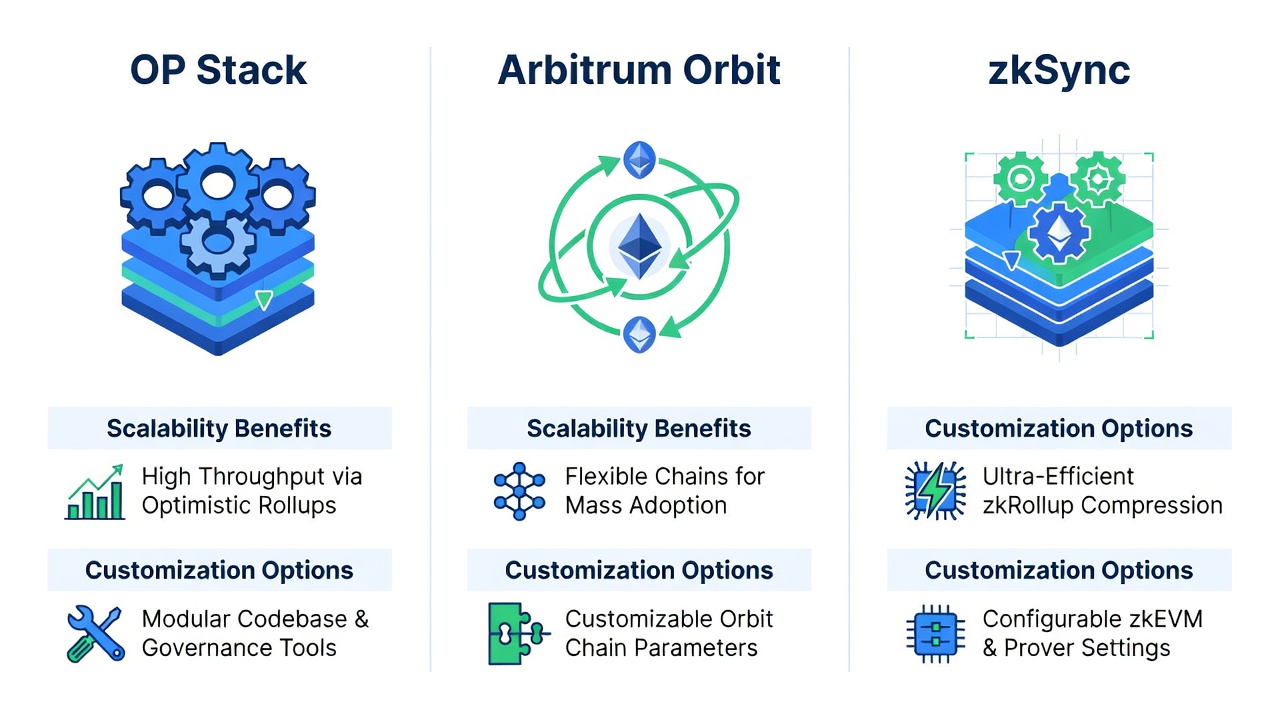
Several frameworks dominate the 2026 landscape. The OP Stack from Optimism emphasizes optimistic rollups with flexible data availability options, making it suitable for projects seeking simplicity and strong community support. Arbitrum Orbit enables custom chain deployments where developers control settlement choices and execution environments, offering high configurability for enterprise use. zkSync prioritizes zero-knowledge proofs within modular setups, delivering enhanced security and fast finality for applications requiring rigorous verification.
Each framework presents distinct trade-offs. Optimistic approaches generally offer lower computational overhead but introduce challenge periods before finality. ZK-based solutions provide immediate security assurances at the cost of higher proving complexity. Teams evaluating options should consider their tolerance for latency, desired security model, and existing tooling compatibility. Ethereum's official documentation provides foundational context for these comparisons.
Recent Ethereum Updates and Integration Examples
Ethereum Improvement Proposals in 2026 have strengthened support for modular stacks through better data availability sampling and cross-layer communication standards. Projects such as Optimism and Polygon CDK showcase seamless integrations, with bridges that maintain liquidity across mainnet and modular L2s. Gaming platforms have deployed custom execution layers on Arbitrum Orbit to achieve sub-second transaction confirmations while settling on Ethereum.
These examples illustrate practical adoption. One DeFi protocol integrated zkSync's modular components to reduce gas costs by over 90 percent compared to earlier implementations. Another enterprise solution combined OP Stack execution with a third-party data availability provider, achieving reliable performance during peak network activity. Arbitrum's developer resources and Optimism's documentation offer detailed integration guides for similar projects.
Practical Steps for Evaluating Modular L2 Options
Selecting the right modular L2 requires systematic evaluation. Begin by mapping your application's throughput, latency, and security requirements. Next, review framework documentation for smart contract compatibility and available tooling. Test security models thoroughly, comparing fraud proofs against validity proofs in simulated environments. Assess ecosystem support, including wallet integrations, oracle availability, and developer community activity. Finally, run load tests to measure real-world performance and estimate operational costs under varying conditions.
- Define clear success metrics such as transactions per second and maximum acceptable latency.
- Prototype with multiple frameworks to compare developer experience and debugging tools.
- Verify data availability provider reliability through historical uptime data.
- Plan for bridge security and liquidity management across layers.
- Document upgrade paths to accommodate future Ethereum protocol changes.
Following these steps minimizes risks and ensures the chosen architecture aligns with long-term project goals.
Real-World Case Insights
Production deployments in 2026 reveal tangible advantages. A popular blockchain game built on a modular L2 reported handling 50,000 daily active users with consistent sub-second confirmations. DeFi platforms using customized execution layers introduced novel yield strategies previously limited by throughput constraints. Enterprise pilots demonstrated successful integration of modular designs with existing compliance tools, highlighting adaptability for regulated environments. These cases emphasize the importance of matching framework strengths to specific workload characteristics.
Mistakes to Avoid When Implementing Modular L2s
Common pitfalls include over-optimizing a single layer while neglecting interoperability or underestimating the complexity of cross-layer security audits. Teams sometimes choose frameworks without sufficient testing of data availability solutions, leading to verification delays. Another frequent error is ignoring ecosystem maturity, resulting in limited wallet or oracle support. Careful planning and phased rollouts help avoid these issues.
FAQ on Common Implementation Hurdles
What are the main challenges in adopting modular L2s?
Integration complexity across independent layers and ensuring consistent security guarantees represent frequent hurdles. Comprehensive testing and phased deployments mitigate these risks effectively.
How do modular designs impact transaction finality?
Settlement on Ethereum provides robust finality, though execution-layer choices may introduce brief delays depending on the proof system selected.
Are there risks with data availability solutions?
Selecting established providers aligned with Ethereum security standards minimizes risks, as they undergo rigorous audits and maintain transparent operations.
Can existing dApps migrate easily to modular L2s?
Migration is feasible with proper planning, though smart contract audits and bridge configurations require dedicated resources and testing cycles.
Conclusion
Modular L2 designs represent a significant advancement for Ethereum scalability and customization in 2026. By understanding their layered components, comparing leading frameworks, and following structured evaluation processes, developers can build more efficient and adaptable applications. Real-world examples and careful avoidance of common pitfalls further support successful implementation. Staying current with Ethereum updates ensures infrastructure remains competitive and ready for future growth.

No comments yet. Be the first!