 CryptoChain Blog
Introduction to Ethereum L2 Regulatory Shifts in 2026
The Ethereum ecosystem continues to evolve rapidly in 2026, with Layer 2 solutions playing a central role in scaling the network while maintaining security and decentralization. As global regulators refine their approaches to blockchain technology, developers and users of Ethereum L2s face new compliance requirements that touch on transaction monitoring, data privacy, and cross-border operations. This guide examines the latest ETH news on these shifts, providing actionable insights for staying ahead in an increasingly regulated environment.
Regulatory changes are influencing everything from transaction privacy features to the design of decentralized finance protocols. Projects must balance innovation with adherence to emerging rules, which often require technical upgrades and governance adjustments. Understanding these developments is essential for anyone involved in Ethereum updates, whether building applications or participating in the ecosystem as an end user.
Key Global Standards Emerging in 2026
International bodies are working toward harmonized standards for blockchain operations that prioritize anti-money laundering measures, consumer protection, and interoperability requirements. Ethereum L2 networks must adapt to frameworks that emphasize transparency without stifling innovation, including standardized reporting protocols for on-chain activity and clearer definitions of decentralized autonomous organization responsibilities. These standards often reference core principles from established organizations and aim to reduce fragmentation across jurisdictions.
Developers are now integrating compliance modules directly into rollup architectures to handle real-time data sharing with authorities when required. This shift represents a maturation of the space, moving from experimental phases toward institutional-grade infrastructure. For more foundational information on blockchain technology, refer to Ethereum.org.
Effects on DeFi Protocols
Decentralized finance protocols built on Ethereum L2s encounter heightened scrutiny as regulators examine how liquidity provision and lending mechanisms interact with traditional financial systems. Compliance now involves implementing robust KYC processes where applicable and ensuring smart contracts meet audit standards that verify resistance to exploits while supporting regulatory reporting. This can affect liquidity pools and yield farming mechanisms across major networks, potentially reducing anonymity in certain transaction types.
Protocols that proactively integrate compliance tools gain a competitive edge, while others risk operational restrictions or reduced access in key markets. The impact extends to oracle integrations and cross-chain bridges, where data accuracy becomes critical for meeting disclosure obligations. Overall, these changes encourage more sustainable DeFi growth by attracting institutional capital that demands regulatory clarity.
Regional Comparisons of Regulatory Approaches
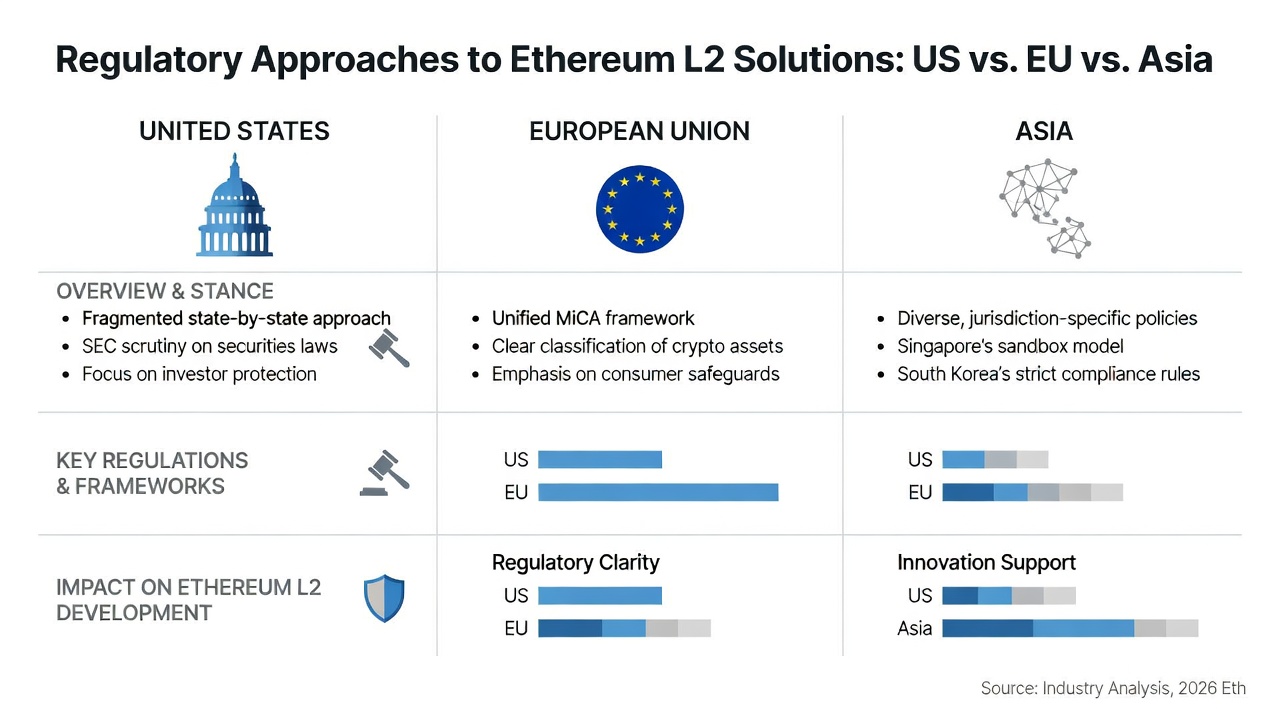
Different regions adopt varied strategies that create both challenges and opportunities for Ethereum L2 projects operating globally:
- United States: Emphasis on enforcement actions and clear guidelines from agencies focused on securities classification, leading projects to implement enhanced disclosure mechanisms.
- European Union: Comprehensive frameworks like MiCA promote innovation within structured rules, encouraging L2s to adopt standardized licensing pathways.
- Asia-Pacific: A mix of supportive policies in some jurisdictions and stricter controls in others, often prioritizing financial stability while fostering local innovation hubs.
- Latin America and Africa: Emerging markets focus on financial inclusion, resulting in lighter-touch regulations that still require basic anti-fraud safeguards.
These differences create challenges for global projects seeking uniform compliance, often necessitating region-specific deployment strategies and legal teams.
Real-World Case Studies from Major L2 Networks
Leading Ethereum L2s provide valuable lessons through their responses to regulatory developments. Arbitrum and Optimism have introduced features to support regulatory reporting, including optional transaction tagging for compliance audits. Base has focused on user education around compliance through transparent governance forums and developer resources. zkSync and Polygon have explored zero-knowledge proofs to balance privacy with verifiable compliance data, demonstrating how advanced cryptography can address regulatory demands.
These examples highlight successful adaptations that maintain user experience while meeting oversight expectations. Smaller L2 projects are now studying these implementations to avoid common pitfalls such as delayed feature releases or community backlash over sudden policy changes.
Practical Steps for Projects to Stay Compliant
Developers should follow these detailed steps to navigate the evolving landscape effectively:
- Conduct regular legal audits of smart contracts with specialized blockchain attorneys to identify potential classification issues early.
- Implement modular compliance layers that can update with new rules, such as dynamic oracle feeds for sanctions list checks.
- Engage with regulators through industry associations to provide input on proposed rules and stay informed about upcoming changes.
- Monitor on-chain analytics for suspicious activity detection using tools that integrate seamlessly with L2 sequencers.
- Establish clear user communication channels explaining any compliance-related feature changes to maintain trust.
Users can protect themselves by choosing L2s with transparent governance and strong security track records, while also diversifying across networks to mitigate single-jurisdiction risks.
Expert Insights on Risks and Opportunities
Industry experts note that while regulatory shifts introduce risks like increased operational costs and potential fragmentation if standards diverge significantly across borders, they also open opportunities for institutional adoption. Projects that view compliance as a feature rather than a burden are positioned for long-term growth, particularly those that leverage regulatory alignment to secure partnerships with traditional finance entities.
Potential risks include legal uncertainties around decentralized governance and the possibility of enforcement actions against non-compliant bridges or oracles. On the opportunity side, clearer rules can accelerate mainstream integration of Ethereum L2 technology into payment systems and asset tokenization platforms, expanding the overall market.
Frequently Asked Questions
What are the main regulatory concerns for Ethereum L2 in 2026?
Primary concerns center on AML compliance, data privacy protections, and the classification of tokens as securities under varying national laws.
How do regulations affect DeFi users on L2s?
Users may see new verification requirements or limitations on certain anonymous transactions, alongside improved protections against fraud.
Which regions offer the most favorable environments?
Regions with clear, innovation-friendly rules tend to attract more development activity and user growth compared to heavily restrictive jurisdictions.
What technical changes might L2 projects need to implement?
Common updates include enhanced logging capabilities, integration of compliance oracles, and support for selective disclosure mechanisms using zero-knowledge technology.
Are there risks of network fragmentation due to regulations?
Yes, if standards diverge too far, projects may need to create region-specific instances, potentially complicating user experiences across borders.
Conclusion
Navigating Ethereum L2 regulatory shifts in 2026 requires vigilance and proactive strategies from all participants in the ecosystem. By understanding global standards, regional nuances, and implementing practical compliance measures, projects and users can thrive amid change while contributing to a more mature and trusted blockchain landscape. Stay informed through reliable ETH news sources for ongoing updates and emerging best practices.


No comments yet. Be the first!