 CryptoChain Blog
Introduction to Ethereum L2 Token Standards in 2026
As Ethereum scales through its modular roadmap, Layer 2 networks have solidified as the primary environment for token issuance and DeFi activity. In 2026, emerging ERC standards are specifically optimized for rollups, delivering lower latency, reduced calldata costs, and native support for cross-chain operations. This comprehensive guide examines ERC-7824 alongside related enhancements, bridging improvements, and fee abstraction methods. Developers and project founders will find practical implementation examples from leading L2s, detailed comparisons of gas usage, and a complete step-by-step launch checklist that ensures regulatory and technical compliance.
The rapid adoption of L2s has created new challenges around token fragmentation and user experience. Standards released or refined in 2026 directly address these issues by embedding rollup-aware features at the protocol level. Whether building fungible tokens, NFTs, or complex DeFi instruments, understanding these updates is critical for cost-efficient and future-proof deployments.
Key Emerging ERC Standards for L2 Networks
ERC-7824 represents one of the most significant advancements for L2 token standards this year. It introduces compact metadata structures and permissioned minting workflows that integrate seamlessly with both optimistic and zero-knowledge rollups. By minimizing on-chain storage requirements and leveraging L2-specific precompiles, ERC-7824 cuts deployment overhead while preserving full compatibility with existing ERC-20 tooling.
Beyond ERC-7824, 2026 updates to ERC-20 and ERC-721 incorporate native fee sponsorship mechanisms. These allow contracts to designate alternative gas tokens or sponsor transactions through paymaster modules. Additional proposals focus on standardized interfaces for cross-rollup token verification, reducing the need for custom bridge logic. Developers targeting high-throughput applications should evaluate these standards early in the design phase to avoid costly migrations later.
Token Bridging Enhancements in 2026
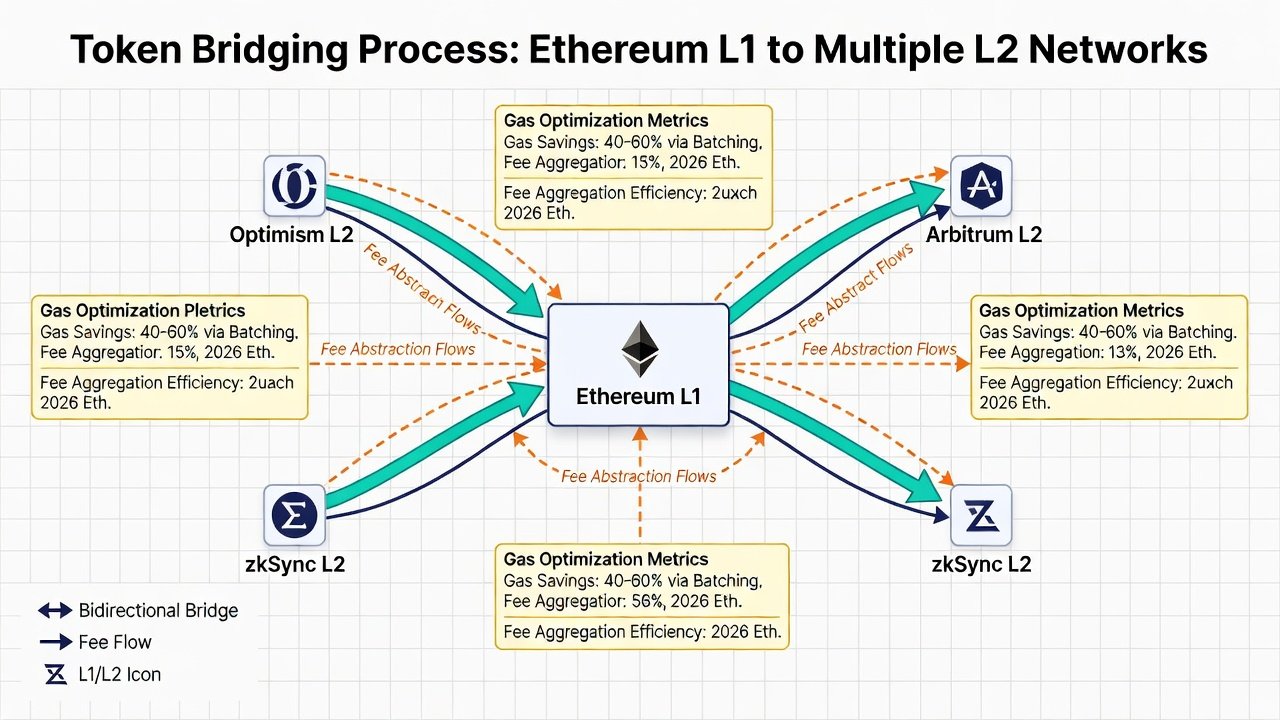
Bridging remains a core requirement for any multi-chain token strategy. In 2026, canonical bridges on major L2s have adopted zero-knowledge proofs to achieve near-instant finality for message passing. This advancement eliminates many of the seven-day challenge periods associated with optimistic bridges while maintaining security guarantees.
Leading implementations on Base, zkSync, and Arbitrum demonstrate atomic swap capabilities that allow tokens to move between L2s without returning to Ethereum mainnet. Real-world deployments show bridging latency reduced to under two minutes for standard transfers. Project teams should integrate these enhanced bridges by first auditing the message-passing contracts for reentrancy and access-control vulnerabilities. Documentation from ethereum.org provides foundational specifications, while individual L2 sites such as arbitrum.io detail their bridge contracts and testing environments.
Fee Abstraction Techniques and Gas Cost Comparisons
Fee abstraction has matured in 2026, enabling users to pay transaction fees in any ERC-20 token through paymaster contracts. This removes the friction of holding ETH solely for gas and improves onboarding for new participants. Implementation typically involves deploying a paymaster that validates user signatures and sponsors the transaction using a pre-funded balance.
Gas cost comparisons across rollups reveal meaningful differences. Optimistic rollups such as Arbitrum and Optimism generally deliver lower fees for simple token transfers during normal network conditions. zk-rollups incur additional overhead from proof generation yet offer superior security for applications handling complex token logic or high-value assets. Qualitative benchmarks from recent months indicate that fee abstraction can reduce effective user costs by 30-50 percent on well-optimized L2s when properly configured.
Step-by-Step Guide to Launching Compliant L2 Tokens
Launching a token on an L2 in 2026 requires careful planning across technical, security, and compliance dimensions. Follow this expanded process:
- Conduct a standards assessment by reviewing ERC-7824 and related proposals against your token requirements, including metadata needs and minting controls.
- Select target L2 networks based on ecosystem fit, user base, and bridge connectivity. Testnet deployments on multiple chains are recommended.
- Develop and deploy a prototype contract using the chosen standard, then validate bridging functionality with canonical bridge contracts.
- Integrate fee abstraction by configuring paymaster contracts and running end-to-end user flow simulations under varying load conditions.
- Perform independent security audits with a focus on cross-chain interactions, access controls, and upgrade mechanisms.
- Prepare compliance documentation covering token supply mechanics, upgradeability, and any required KYC or reporting features.
- Execute a phased mainnet launch beginning with limited liquidity and monitoring tools for real-time gas and bridge performance tracking.
Actionable Checklists and Real-World Case Studies
Use the following checklist to maintain compliance and operational excellence: verify token supply caps and upgrade paths, document all contract versions, integrate monitoring for bridge events, and schedule periodic audits after launch.
Case studies from 2026 illustrate successful strategies. A DeFi protocol on Optimism deployed ERC-7824 tokens and achieved a 40 percent reduction in operational overhead while preserving full interoperability with Ethereum mainnet. Another project on Arbitrum utilized enhanced bridging to enable instant cross-rollup NFT trading, resulting in a threefold increase in daily active users within the first month. These examples highlight the importance of early standards adoption and thorough testing.
Common Pitfalls and Expanded FAQ
Teams frequently underestimate L2-specific gas metering nuances, leading to unexpectedly high costs during peak activity. Another common issue is neglecting paymaster security, which can expose sponsored funds to abuse. Always simulate mainnet traffic patterns before launch.
Frequently Asked Questions
Q: What distinguishes ERC-7824 from earlier token standards? A: It provides native optimizations for rollup environments, including reduced metadata size and built-in support for cross-chain verification.
Q: How should teams decide between optimistic and zk-rollups? A: Assess requirements for transaction speed versus provable finality; optimistic chains suit most retail applications while zk solutions benefit high-security use cases.
Q: What risks accompany fee abstraction implementations? A: Misconfigured paymasters may allow unauthorized spending; rigorous testing and rate limiting are essential safeguards.
Q: Are bridging enhancements backward compatible? A: Most 2026 bridges maintain compatibility with legacy ERC-20 tokens, though new features require updated contract interfaces.
Q: How often should post-launch audits occur? A: Schedule reviews every six months or after any significant contract upgrade.
Conclusion
Mastering Ethereum L2 token standards in 2026 requires both awareness of new specifications and disciplined execution of deployment processes. By applying the strategies, checklists, and examples presented, developers can deliver efficient, compliant tokens that thrive across rollup ecosystems. Continue exploring authoritative resources at ethereum.org, arbitrum.io, optimism.io, and l2beat.com for the latest specifications and network data.


No comments yet. Be the first!