 CryptoChain Blog

Introduction to Validity Proofs in Ethereum Layer 2 Solutions
As Ethereum continues its evolution in 2026, validity proofs have emerged as a cornerstone technology for Layer 2 scaling. These cryptographic mechanisms allow rollups to verify transaction batches efficiently without relying on fraud proofs, enhancing both security and throughput. Developers and analysts tracking fresh ETH updates will find that validity proofs reduce on-chain data requirements while maintaining Ethereum's core security guarantees. The technology builds directly on zero-knowledge cryptography principles that have matured rapidly since the initial mainnet deployments of zk-rollups several years ago.
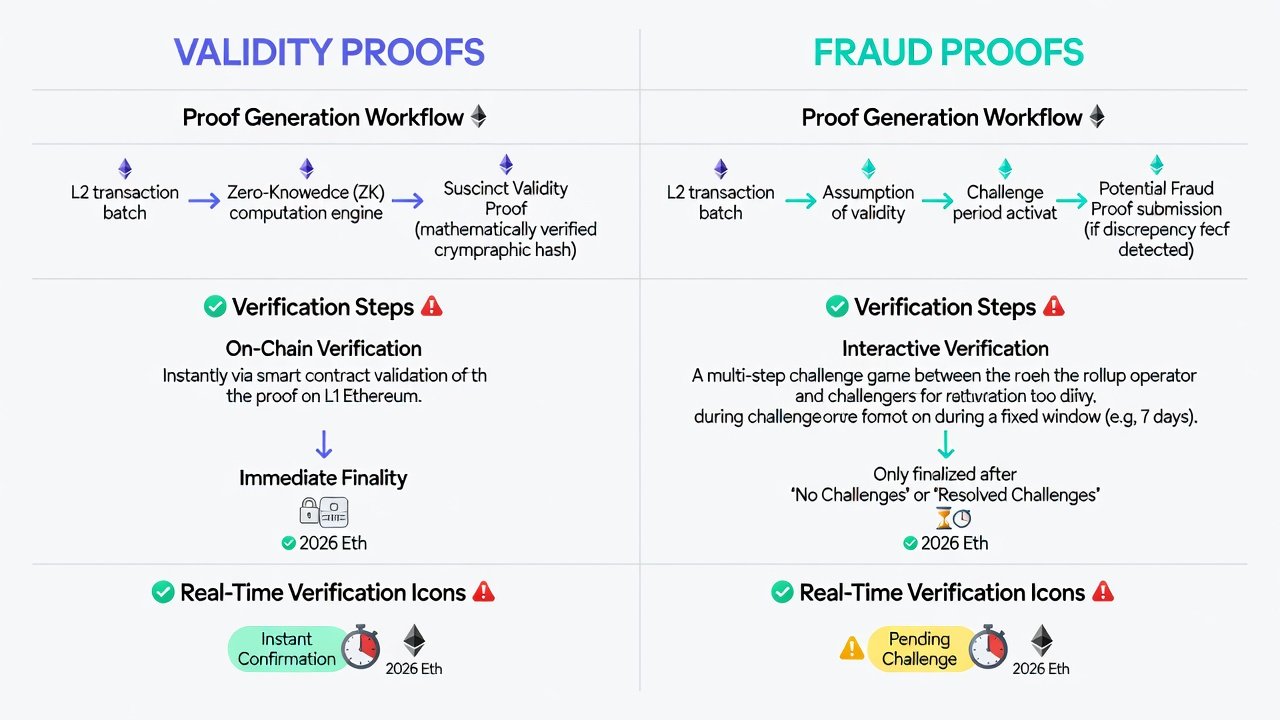
Unlike traditional optimistic rollups that assume transactions are valid until challenged, validity proofs provide immediate finality through mathematical verification. This shift addresses key scalability bottlenecks, enabling higher transaction volumes and lower costs for decentralized applications. In practice, this means that users no longer need to wait for challenge periods that could last days, opening the door to more responsive DeFi protocols and gaming experiences built on Ethereum infrastructure.
How Validity Proofs Enhance Security and Scalability
Validity proofs fundamentally improve upon older methods by eliminating the dispute window associated with fraud proofs. In a validity proof system, every state transition is accompanied by a succinct proof that can be verified on the Ethereum mainnet in constant time. This approach mitigates risks such as delayed finality and economic attacks common in earlier optimistic designs. Security is further strengthened because the proof itself encodes the correctness of the computation, leaving no room for invalid state transitions to slip through undetected.
Scalability benefits include support for real-time verification, where proofs are generated and checked almost instantaneously. Compared to fraud-proof systems, validity proofs require less data availability on L1, freeing up block space for other uses. Analysts note that these advancements position Ethereum L2s to handle enterprise-grade workloads by 2026. For instance, high-frequency trading applications and supply-chain tracking solutions can now operate with near-instant settlement guarantees while still inheriting Ethereum's settlement security.
zk-STARK Improvements and Real-Time Verification Techniques
Zero-knowledge STARKs (zk-STARKs) have seen notable refinements in 2026, particularly in proof size reduction and prover efficiency. New polynomial commitment schemes allow for faster generation of proofs while maintaining post-quantum resistance. Real-time verification techniques leverage parallel processing on GPUs and specialized hardware to cut verification times dramatically. These hardware optimizations have lowered the barrier for smaller teams to run their own provers without relying exclusively on centralized services.
These improvements enable L2 solutions to process thousands of transactions per second with sub-second finality. For example, recursive proof aggregation now combines multiple batch proofs into a single succinct proof, minimizing gas costs on Ethereum. Additional enhancements include better memory management in circuit compilers and support for dynamic proof sizes that adapt to the complexity of the underlying transactions.
Comparisons of Leading Implementations Across Major Rollups
Several prominent Ethereum rollups have adopted validity proofs with distinct implementations. Each project has optimized different aspects of the proving pipeline to suit specific use cases:
- zkSync Era: Focuses on zk-STARKs for account abstraction and high-throughput DeFi, offering seamless developer tooling and native support for smart contract wallets. Its architecture emphasizes ease of migration from Ethereum mainnet contracts.
- Polygon zkEVM: Emphasizes EVM equivalence with optimized STARK circuits for complex smart contracts. This makes it particularly attractive for projects that require minimal code changes when moving from L1 to L2.
- Starknet: Pioneers Cairo language integration alongside advanced STARK proofs for custom scalability needs. The language allows developers to write highly optimized circuits that reduce proving time for specialized applications such as machine learning inference on-chain.
- Scroll: Combines validity proofs with zk-EVM for broad compatibility and rapid proof generation. Scroll has prioritized developer experience by maintaining close parity with existing Ethereum tooling and debugging workflows.
Each implementation trades off proof generation speed against verification costs, with ongoing benchmarks showing Starknet leading in certain recursive proof scenarios. Teams evaluating these options should consider their specific throughput requirements and the maturity of available SDKs before committing to a particular stack.
Practical Examples of Proof Generation Workflows
A typical proof generation workflow begins with transaction batching on the L2 sequencer. The batch is then fed into a proving circuit that computes the state transition and generates the zk-STARK proof. Developers can use libraries like those from the Ethereum Foundation to integrate this into custom rollups. In a concrete example, a DeFi protocol might batch 500 swaps and liquidity adjustments, execute them inside a virtual machine emulator, then invoke the prover to create a compact proof representing the net state change.
For instance, a workflow might involve: 1) Collecting user transactions from the mempool, 2) Executing them in a virtual machine while tracking state deltas, 3) Generating the proof via GPU-accelerated provers that distribute work across multiple cards, and 4) Submitting the proof and state root to the L1 verifier contract through a dedicated relayer. This process ensures atomic updates with cryptographic assurance. Additional monitoring tools can alert operators if proof generation latency exceeds predefined thresholds, allowing proactive scaling of hardware resources.
Step-by-Step Guidance on Auditing a Validity Proof System
Auditing validity proof systems requires methodical evaluation to ensure robustness. A thorough audit typically spans several weeks and involves both automated tooling and manual review:
- Review the circuit code for soundness and completeness using formal verification tools such as those based on Coq or Lean.
- Simulate edge cases including malformed inputs, maximum batch sizes, and adversarial transaction ordering.
- Assess prover performance under load to identify bottlenecks and potential denial-of-service vectors.
- Verify on-chain verifier contracts for gas efficiency and resistance to reentrancy attacks or integer overflows.
- Conduct independent third-party reviews focusing on cryptographic assumptions and side-channel leakage risks.
- Perform penetration testing on the entire pipeline, including the interface between the L2 sequencer and the proving cluster.
Following these steps helps mitigate integration risks and aligns with best practices from the broader Ethereum community.
Challenges and Limitations of Current Validity Proof Systems
Despite their advantages, validity proof systems still face practical hurdles. Prover hardware requirements remain significant, often necessitating specialized GPUs or ASICs that increase operational costs for smaller teams. Additionally, the complexity of writing and debugging circuits can slow development cycles compared to traditional smart contract programming. Interoperability between different zk-rollups is another area requiring further standardization to enable seamless asset transfers and message passing across ecosystems.
Future Implications for the Ethereum Ecosystem
Looking ahead, widespread adoption of validity proofs will drive further decentralization of sequencers and enable new use cases like real-time oracles and cross-rollup composability. As Ethereum.org outlines in its roadmap, these technologies support the network's long-term vision of mass adoption. Analysts anticipate enhanced interoperability between L2s, fostering a more unified ecosystem by late 2026. Continued research into proof aggregation and hardware acceleration is expected to further lower barriers to entry for new projects.
FAQ: Common Integration Challenges
What are the main hurdles when integrating validity proofs?
Common challenges include high initial hardware requirements for provers and the need for specialized cryptographic expertise. Teams often start with open-source frameworks to accelerate development and reduce learning curves.
How do validity proofs compare to fraud proofs in terms of latency?
Validity proofs provide instant finality, whereas fraud proofs require a challenge period, making validity systems preferable for time-sensitive applications such as payments and derivatives trading.
Are there compatibility issues with existing EVM tools?
Modern zk-EVM implementations minimize these issues, but custom circuits may require adjustments for full compatibility. Testing on testnets is strongly recommended before mainnet deployment.
What resources are available for developers?
Official documentation from projects like zkproof.org and community forums provide tutorials and reference implementations that cover everything from circuit design to on-chain verification.
How should teams plan for future upgrades to proof systems?
Modular architectures that separate the proving layer from the execution layer allow for easier upgrades. Regular participation in Ethereum improvement proposal discussions helps teams stay ahead of protocol changes.
Conclusion
The advancements in Ethereum L2 validity proofs in 2026 represent a pivotal step toward scalable, secure decentralized infrastructure. By understanding zk-STARK enhancements, implementation comparisons, proof generation workflows, and auditing practices, developers can effectively contribute to and benefit from these innovations. As the ecosystem matures, staying informed on these ETH updates will be essential for long-term success in building the next generation of decentralized applications.

No comments yet. Be the first!