 CryptoChain Blog
Introduction to Ethereum L2 TVL Growth in 2026
Ethereum's Layer 2 solutions have become the backbone of scalable blockchain activity, with total value locked (TVL) serving as a key indicator of ecosystem health. In 2026, L2 networks continue to drive innovation through improved throughput, lower fees, and seamless integrations with traditional finance. This growth reflects broader shifts in decentralized finance (DeFi) and user behavior, positioning Ethereum as a leader in Web3 infrastructure. As the base layer matures, L2s handle the majority of transaction volume, allowing Ethereum to support everything from high-frequency trading to complex decentralized applications without congestion.
Understanding these trends requires examining concrete metrics, real-world implementations, and forward-looking analyses. Developers and investors tracking ETH updates can leverage this data to identify opportunities in scaling solutions and emerging protocols. The expansion also highlights how L2s address long-standing challenges like high gas costs on the mainnet, creating more accessible entry points for new participants worldwide.
Latest Metrics on Total Value Locked and User Adoption
TVL across Ethereum L2s has shown consistent expansion, fueled by enhanced rollup technologies and ecosystem incentives. Key metrics highlight increased capital inflows alongside rising daily active users, demonstrating both institutional and retail engagement. Adoption rates have accelerated due to better user experiences, such as account abstraction and cross-chain bridging. TradFi integrations, including tokenized assets and institutional custody solutions, further bolster these figures by bridging conventional markets with on-chain liquidity.
Analysts observe that user growth often correlates with reduced transaction costs and faster confirmation times. Real-time dashboards reveal shifts in capital distribution, with certain rollups capturing larger shares through targeted incentives and application launches. This data provides a clear picture of which networks are gaining traction in specific sectors like payments, lending, and derivatives trading.
Infrastructure Projects Driving Expansion
Several foundational projects underpin this momentum. Optimistic and zero-knowledge rollups form the core architecture, with upgrades focused on data availability and interoperability. Projects like those enhancing Ethereum's base layer through danksharding contribute indirectly by reducing costs for L2 operators. Additional infrastructure includes shared sequencing layers that improve fairness and reduce centralization risks across multiple chains.
Emerging protocols emphasize modular designs, allowing specialized chains for gaming, DeFi, or AI applications. These developments create a more resilient network capable of handling diverse workloads without compromising security. Teams are also advancing fraud-proof systems and validity proofs to enhance trust minimization, making L2 environments more attractive for large-scale deployments.
Real-World Case Studies from Top L2s
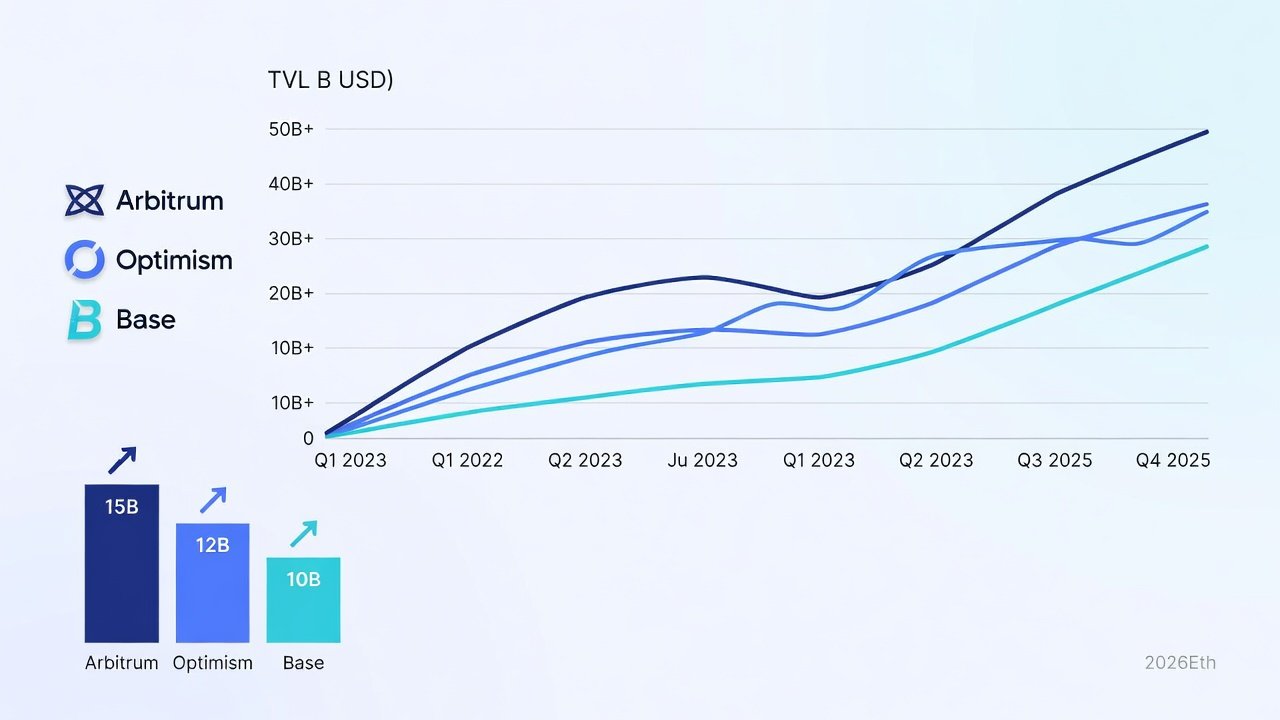
Leading L2s provide tangible examples of growth strategies. Arbitrum has expanded its ecosystem through developer grants and partnerships that attract high-volume applications in DeFi and gaming. Optimism emphasizes governance innovations via its collective model, fostering community-driven scaling initiatives that distribute decision-making power among token holders.
Base, built on Optimism technology, demonstrates rapid user onboarding through integrations with major platforms, showcasing how consumer-facing apps can drive TVL. Additional case studies include zkSync, which focuses on zkEVM compatibility to support seamless migration of existing Ethereum contracts, and Starknet, which leverages STARK proofs for enhanced scalability in computational-heavy use cases. Comparisons reveal varying adoption curves: ZK-based solutions often excel in privacy-focused use cases, while optimistic rollups lead in general-purpose DeFi activity.
These examples illustrate how different technical choices influence market positioning and user retention over time.
Comparisons of Adoption Trends Across Rollups
Rollup comparisons underscore distinct strengths. Metrics typically track TVL distribution, transaction volumes, and bridge inflows. For instance, some L2s prioritize speed for payments, while others focus on composability for complex DeFi protocols. Optimistic rollups generally offer stronger EVM compatibility, making them easier for developers to port applications from the mainnet.
- Optimistic rollups: Strong in EVM compatibility and developer tooling, leading to faster time-to-market for new projects.
- ZK-rollups: Superior in finality and security guarantees, appealing to applications requiring immediate settlement.
- App-specific chains: Targeted efficiency for niche markets like NFTs or social applications, often achieving higher throughput in specialized environments.
- Hybrid approaches: Combine elements of multiple architectures to balance speed, cost, and security for broader use cases.
These trends help stakeholders evaluate which ecosystems align with specific investment or development goals, revealing patterns in capital allocation and user migration between networks.
Expert Predictions on Future Scaling
Analysts anticipate continued maturation through 2026 and beyond, with emphasis on unified liquidity layers and enhanced cross-L2 communication. Predictions include broader adoption of shared sequencers to minimize fragmentation risks and improve overall network efficiency. Long-term, Ethereum L2s are expected to support hybrid models combining on-chain and off-chain computations, enabling enterprise-grade applications that meet regulatory and performance requirements.
Further forecasts point to increased standardization around interoperability protocols, allowing assets and data to move fluidly without excessive bridging costs. Monitoring tools from authoritative sources provide ongoing visibility into these shifts, helping participants stay informed about technological milestones and ecosystem milestones.
Practical Takeaways for Investors and Developers
Investors should prioritize L2s with transparent governance and proven security audits when allocating capital. Diversification across multiple rollups can mitigate concentration risks while capturing growth in different verticals. Regular portfolio reviews based on on-chain activity and partnership announcements help maintain alignment with evolving market conditions.
Developers benefit from focusing on interoperability standards and user-centric features like gasless transactions. Practical steps include starting with testnet deployments to validate smart contract behavior, integrating with established SDKs for faster development cycles, and participating in ecosystem grant programs to access funding and visibility. Tracking ecosystem health involves regular review of on-chain data, community activity, and integration announcements. Resources such as ethereum.org, defillama.com, and l2beat.com offer reliable dashboards for these insights.
Conclusion
The trajectory of Ethereum L2 TVL growth in 2026 underscores the network's adaptability and expanding utility. By combining robust infrastructure with targeted protocol innovations, the ecosystem continues to attract diverse participants and capital. Staying informed through data-driven analysis positions both investors and developers to navigate this dynamic landscape effectively.
FAQ: Monitoring L2 Ecosystem Health
What is TVL and why does it matter for L2s?
TVL measures the total capital deposited in protocols on a given L2, indicating liquidity and user confidence in the network's stability and utility. Higher TVL often signals stronger network effects and more opportunities for yield generation.
How can I track real-time adoption rates?
Use on-chain analytics platforms and official L2 dashboards to monitor active addresses, transaction counts, and bridge volumes for up-to-date adoption signals. Combining these with social sentiment analysis provides a fuller view of community engagement.
Are TradFi integrations impacting L2 growth?
Yes, partnerships with traditional institutions introduce new capital flows and compliance frameworks that accelerate mainstream acceptance of L2 technologies. These integrations often bring institutional-grade security and reporting standards.
What risks should investors consider in 2026?
Key risks include smart contract vulnerabilities, regulatory changes, and liquidity fragmentation across competing rollups; thorough due diligence is essential before committing resources.
How do different rollup types affect developer choices?
Optimistic rollups favor rapid iteration due to simpler tooling, whereas ZK-rollups demand more specialized knowledge but deliver stronger cryptographic assurances for sensitive applications.
No comments yet. Be the first!