 CryptoChain Blog
Ethereum L2 zkEVM Advancements 2026: Key ETH Updates
In 2026, Ethereum Layer 2 zkEVM solutions are reshaping blockchain scalability by combining zero-knowledge proofs with full EVM compatibility. These advancements allow developers to deploy smart contracts on Layer 2 networks that inherit the security of Ethereum mainnet while achieving dramatically higher throughput. Performance gains in proof generation and verification have made zkEVMs viable for high-volume applications such as decentralized exchanges, lending protocols, and gaming platforms. Developer adoption has accelerated as tooling matures and migration paths simplify. The ecosystem now supports everything from simple token transfers to sophisticated decentralized applications, positioning zkEVMs as a cornerstone of Ethereum's long-term scaling strategy.
Technical Breakthroughs in Proof Systems and Compatibility
Recent technical progress centers on recursive proof systems and optimized circuit designs. Recursion enables multiple proofs to be aggregated into a single succinct proof, reducing on-chain verification costs and latency. Compatibility enhancements now support nearly all Solidity opcodes and precompiles, minimizing the need for custom rewrites. Projects have introduced better support for account abstraction via EIP-4337, allowing seamless wallet integrations and gasless transactions. These improvements stem from iterative research shared across the Ethereum ecosystem and have led to faster finality times compared to earlier zk-rollup generations. Additional breakthroughs include enhanced parallelization of proof computations and integration with data availability layers that further compress transaction data without sacrificing verifiability.
Detailed Comparisons of Leading zkEVM Implementations
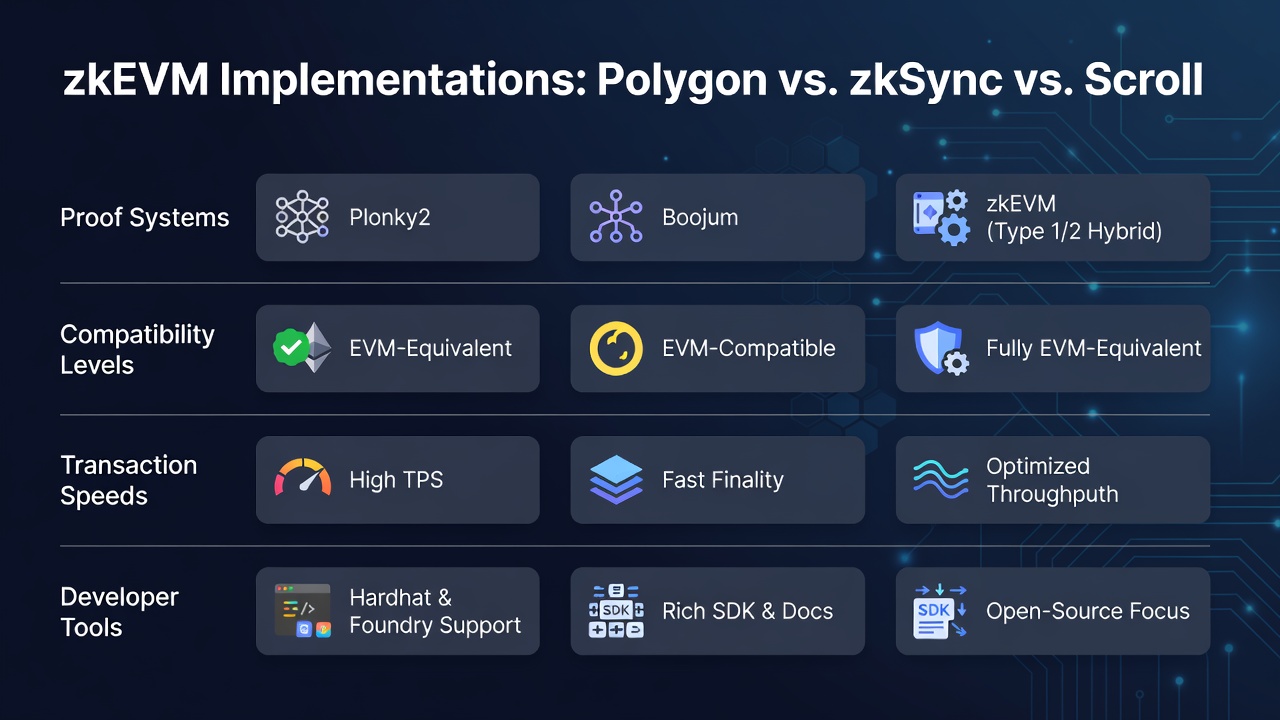
Polygon zkEVM prioritizes EVM equivalence, meaning existing developer tools like Hardhat and Foundry work with minimal adjustments. Its focus on decentralized proving networks aims to distribute computation across validators for greater resilience. In contrast, zkSync emphasizes user experience through native account abstraction and paymasters that let users pay fees in any token. Scroll takes an open-source-first approach, fostering community audits and rapid iteration on its zkEVM stack. Other notable implementations include Starknet's zkEVM variant and emerging solutions from ConsenSys. Trade-offs typically involve proof generation speed versus hardware requirements, with each project publishing benchmarks showing transaction finality under different network loads. Teams evaluating options often weigh factors such as ecosystem grants, community size, and long-term decentralization roadmaps before committing resources.
Real-World Impacts on Transaction Costs and DeFi Integration
Lower transaction costs on zkEVM Layer 2s have enabled new DeFi strategies previously uneconomical on mainnet. Complex operations such as multi-hop swaps or leveraged yield farming now execute with minimal overhead, improving capital efficiency. Leading protocols like Aave have deployed liquidity pools on multiple zkEVM chains, preserving composability through canonical bridges back to Ethereum. Uniswap has integrated zkEVM deployments to offer deeper liquidity without congestion. These integrations demonstrate how zkEVMs maintain atomic execution across layers while cutting fees substantially. Broader ecosystem effects include increased total value locked in Layer 2 DeFi and more retail participation due to predictable, low-cost interactions. Institutional players are also exploring zkEVM-based settlement for tokenized assets, further validating the technology's maturity.
Case Studies of Leading Project Deployments
Several high-profile deployments illustrate zkEVM potential in 2026. A major decentralized exchange migrated its core matching engine to a zkEVM environment, resulting in sub-second confirmations and expanded order types. A lending protocol implemented privacy-enhanced borrowing features using zk-proofs to shield user positions while remaining fully auditable on-chain. Gaming studios have launched play-to-earn titles with on-chain asset ownership verified through zkEVM circuits, attracting thousands of daily active users. These examples highlight how different sectors leverage the same underlying technology for distinct advantages, from speed in trading to confidentiality in finance.
Practical Steps for Developers Testing zkEVM Features
Developers can follow a structured approach to evaluate zkEVM environments. First, select a testnet aligned with the target implementation, such as Polygon Cardona or zkSync Sepolia. Install the official SDKs and configure local environments using Docker for reproducible setups. Deploy sample contracts written in Solidity or Vyper, then run benchmarks measuring proof generation time and gas consumption. Integrate with frontend libraries supporting EIP-712 and wallet connect for end-to-end testing. Monitor metrics through explorer dashboards and optimize by reducing circuit complexity or batching operations. Participate in public testnet programs that reward early adopters with points or tokens. Finally, conduct security reviews using formal verification tools before mainnet deployment to catch edge cases in proof circuits. Additional tips include joining ecosystem-specific Discord channels for real-time support and documenting performance baselines to compare across multiple zkEVM providers.
Common Challenges and Effective Mitigation Strategies
Despite progress, challenges persist around proof latency under peak load and the learning curve for circuit optimization. Mitigation strategies include hybrid architectures that use optimistic execution for immediate confirmations followed by zk-proofs for settlement. Developers should adopt modular designs that separate computation-heavy logic into verifiable sub-circuits. Tooling gaps are addressed by contributing to open-source repositories and leveraging community forums for shared best practices. Security concerns around new proof systems are mitigated through multiple independent audits and bug bounty programs. Scalability of the prover network itself is tackled by incentivizing hardware participation and exploring hardware acceleration via GPUs or ASICs. Teams that invest early in education and tooling see faster iteration cycles and fewer deployment setbacks.
Future Roadmap and Role in Broader ETH Ecosystem Growth
Looking ahead, zkEVM roadmaps emphasize prover efficiency gains, improved cross-rollup communication, and expanded support for privacy-preserving features. These developments will further embed Layer 2 solutions into Ethereum's overall scaling vision, supporting rollup-centric roadmaps outlined by core researchers. As adoption grows, zkEVMs are expected to handle the majority of Ethereum's transaction volume, freeing mainnet for settlement and data availability. This evolution strengthens Ethereum's position as the settlement layer for a multi-chain world while fostering innovation in decentralized applications. Continued collaboration across projects ensures interoperability standards that benefit the entire ecosystem.
FAQ
What is zkEVM and why does it matter for Ethereum in 2026?
zkEVM merges zero-knowledge proofs with Ethereum Virtual Machine compatibility, delivering scalable, secure execution environments on Layer 2 that inherit mainnet guarantees.
How do zkEVMs compare to optimistic rollups in practice?
zkEVMs provide cryptographic finality without challenge periods, whereas optimistic rollups offer lower upfront costs but require fraud proofs and longer withdrawal times.
What are the next milestones in zkEVM roadmaps?
Key focuses include faster provers, standardized bridges, and advanced DeFi primitives, as discussed on Ethereum.org.
Can existing DeFi protocols integrate zkEVMs without major refactoring?
Many protocols achieve this via standardized interfaces and canonical bridges, with production examples available on Polygon Technology.
What testing resources are recommended for new zkEVM developers?
Official testnets, SDK documentation, and community Discord servers provide the most current guidance and incentive programs for hands-on evaluation.
How might zkEVM advancements influence Ethereum's overall market position?
By enabling cheaper and more private transactions, zkEVMs help Ethereum compete with alternative Layer 1 chains while reinforcing its role as the primary settlement hub, as noted on zksync.io and scroll.io.

No comments yet. Be the first!