 CryptoChain Blog

Introduction to ZKML on Ethereum L2s
In 2026, the fusion of zero-knowledge proofs and machine learning is reshaping Ethereum Layer 2 ecosystems. Developers now leverage ZKML to enable verifiable AI computations while preserving data privacy on scalable L2 networks. This synergy addresses key limitations in decentralized applications, offering enhanced throughput without sacrificing security. Ethereum's transition to a rollup-centric roadmap has created fertile ground for these innovations, allowing projects to process complex machine learning tasks off-chain while anchoring results to the mainnet with cryptographic assurances.
The growing interest stems from Ethereum's continued evolution toward rollup-centric architecture. Privacy-preserving AI unlocks new possibilities for sensitive use cases like on-chain analytics and autonomous agents. As adoption accelerates, teams are exploring how ZKML can mitigate data leakage risks that have historically plagued on-chain computations. This article examines the technical foundations, practical implementation paths, and emerging trends that define this space in 2026.
ZKML Fundamentals Explained
Zero-knowledge machine learning combines zk-SNARKs or zk-STARKs with neural network inference. Models execute off-chain, yet proofs confirm correctness on-chain. This approach ensures outputs are accurate without revealing inputs or model weights. At its core, ZKML transforms machine learning operations into arithmetic circuits that can be proven efficiently. zk-SNARKs provide succinct proofs ideal for resource-constrained environments, while zk-STARKs offer quantum resistance and faster setup at the cost of larger proof sizes.
Core components include circuit compilation of ML operations and efficient proof generation. Recent advancements in 2026 have reduced proof sizes significantly, making integration with L2s more practical. Developers typically start by converting model layers into constraint systems using tools like circom or halo2. The resulting proofs allow any verifier to confirm that inference followed the exact trained parameters without exposing proprietary data or intermediate activations.
Implementation Challenges on Layer 2 Networks
Deploying ZKML on Ethereum L2s involves hurdles like computational overhead and circuit complexity. Developers must optimize for gas costs while maintaining model accuracy. Latency in proof verification remains a bottleneck for real-time applications. Additional challenges include memory constraints during proof generation and the need for specialized hardware accelerators to handle large neural networks.
Interoperability between different L2 frameworks adds another layer of difficulty. Teams often face trade-offs between proof speed and security guarantees. For instance, custom circuits may require extensive audits to prevent subtle soundness bugs, while general-purpose zkVMs introduce abstraction overhead that can inflate verification times on chains like Optimism or Base. Security considerations also encompass side-channel attacks during proof creation and ensuring that model updates do not invalidate existing proofs without proper versioning mechanisms.
Performance Benefits for Ethereum Scalability
ZKML enhances L2 scalability by offloading heavy computations while keeping verification lightweight. This leads to higher transaction throughput and lower fees compared to on-chain ML alternatives. Benefits include improved privacy for DeFi protocols and verifiable AI in gaming dApps. By batching multiple inferences into a single proof, networks achieve greater efficiency, enabling thousands of AI-driven transactions per block without congesting the base layer.
Compared to traditional optimistic rollups, ZKML provides stronger guarantees against fraud, accelerating finality times. Scalability gains become especially evident in high-volume scenarios such as real-time fraud detection or personalized recommendation engines running atop decentralized infrastructure. These improvements position Ethereum L2s as viable platforms for enterprise-grade AI applications that demand both confidentiality and auditability.
Real-World Protocol Examples and Comparisons
Protocols such as those built on zkSync and Arbitrum have begun experimenting with ZKML integrations. One approach uses specialized zkVMs for model inference, while another relies on custom circuits for specific neural architectures. In practice, projects like those exploring verifiable oracles combine ZKML with existing L2 sequencers to deliver private yet provable market predictions.
- Approach A: Full zk-SNARK circuits – high security, slower generation, suited for smaller models.
- Approach B: Hybrid STARK systems – faster but larger proofs, better for batch processing.
- Approach C: Recursive proofs – optimal for batch processing on L2s, allowing incremental verification of complex model pipelines.
- Approach D: Modular frameworks integrating with existing ML libraries – easier onboarding but potentially higher gas costs during initial setup.
Current comparisons show recursive methods outperforming in throughput for 2026 deployments. Teams evaluating options should consider proof size, verification gas, and developer tooling maturity before committing to a specific stack.
Step-by-Step Deployment Workflow
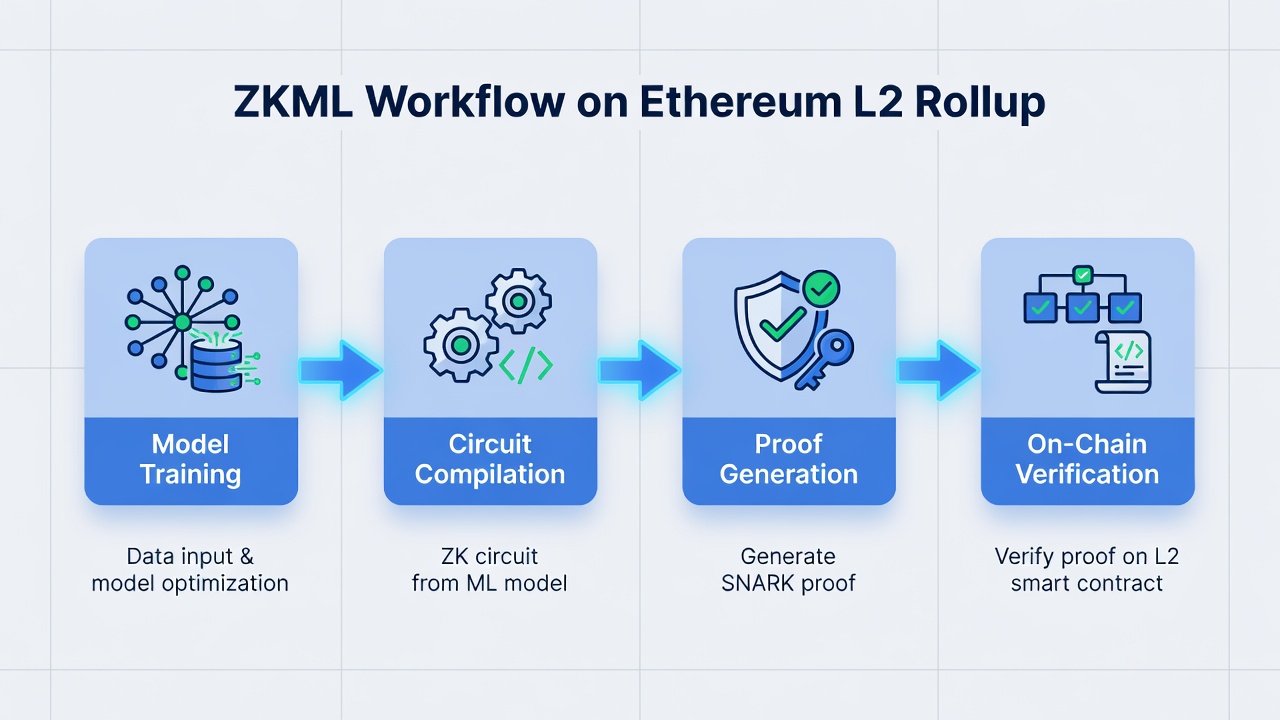
- Train the ML model off-chain using standard frameworks such as PyTorch or TensorFlow, ensuring the architecture remains compatible with circuit constraints.
- Compile the model into a zero-knowledge circuit using libraries that support arithmetic representations of activation functions and matrix multiplications.
- Generate proofs for inference results on L2 sequencers, leveraging parallelization where available to reduce latency.
- Submit verified outputs to the Ethereum mainnet via bridges, including any necessary state commitments for downstream smart contracts.
- Monitor and audit for ongoing optimization, incorporating feedback loops to refine circuit efficiency after initial mainnet deployment.
This workflow ensures seamless integration while minimizing on-chain resource use. Documentation from projects on major L2s often includes starter templates that accelerate the first three steps considerably.
Potential Use Cases in Decentralized Applications
ZKML powers privacy-focused DeFi risk models and confidential health data analysis in Web3. Autonomous agents can execute verifiable decisions without exposing strategies. NFT platforms benefit from AI-driven content moderation that remains private. Additional applications include supply-chain provenance tracking with predictive analytics and decentralized identity systems that verify attributes via machine learning without revealing raw user data.
Forward-looking trends point to tighter L2 integration, enabling more sophisticated on-chain AI agents by late 2026. Gaming ecosystems are also adopting these techniques for procedurally generated content that can be proven fair and unbiased.
FAQs on Adoption Barriers
What are the main technical barriers?
High circuit complexity and proof generation times top the list, though 2026 hardware accelerations are easing these issues. Developers also cite the steep learning curve associated with circuit design languages.
How does it impact gas fees?
ZKML typically reduces overall costs through batching, but initial setup requires careful optimization to avoid unexpected spikes during proof submission.
Is it compatible with all L2s?
Most major L2s support it via custom modules, with ongoing standardization efforts helping improve cross-chain portability.
What skills are needed for teams?
Proficiency in both cryptography and machine learning is essential, often requiring collaboration between specialized engineers.
Conclusion and Future Outlook
Ethereum L2 ZKML applications represent a pivotal advancement for 2026 and beyond. By combining privacy, verifiability, and scalability, they open doors to sophisticated decentralized AI. Staying updated with Ethereum.org resources and exploring Web3 Foundation initiatives will help developers navigate this evolving landscape effectively. Continued research into proof compression and hardware acceleration promises even broader adoption in the months ahead.

No comments yet. Be the first!