 CryptoChain Blog
Introduction to Advanced RBAC in Solidity
Role-Based Access Control (RBAC) remains a cornerstone of secure smart contract design, especially for enterprise applications on Ethereum and Layer 2 networks in 2026. As contracts grow more complex with increasing user bases and governance requirements, simple permission models fall short of delivering the granularity needed for large-scale operations. This comprehensive guide explores advanced RBAC hierarchies that support multi-level inheritance, efficient storage mechanisms, and robust revocation processes while addressing real-world demands such as DAO governance and multi-signature workflows. Developers building on Solidity 0.8.x can leverage custom roles to overcome basic limitations and create scalable access structures that minimize attack surfaces. We will examine practical implementations step by step, provide extensive Foundry test examples, and detail mitigation strategies for common vulnerabilities including role escalation and unauthorized access attempts. By the end of this tutorial, readers will possess the knowledge to implement production-ready RBAC systems that stand up to rigorous security audits and mainnet conditions.
Limitations of the Ownable Pattern
The Ownable contract from OpenZeppelin provides a straightforward single-owner model that works well for simple decentralized applications, but it creates significant bottlenecks in enterprise settings where multiple stakeholders require differentiated permissions. A single owner can become a single point of failure, exposing the entire contract to risks if the owner's private key is compromised or lost. Transferring ownership lacks granularity for team-based operations, forcing teams to either share a single key or implement cumbersome workarounds that increase operational overhead. In large organizations, different departments require distinct permissions without full ownership transfer, such as allowing a finance team to execute payments while restricting them from modifying core contract logic. Ownable also struggles with hierarchical needs, such as granting temporary elevated access during emergencies or revoking roles without redeploying the contract entirely. These constraints push teams toward more sophisticated RBAC implementations that support inheritance, delegation, and fine-grained control across multiple permission levels.
Designing Custom Role Hierarchies
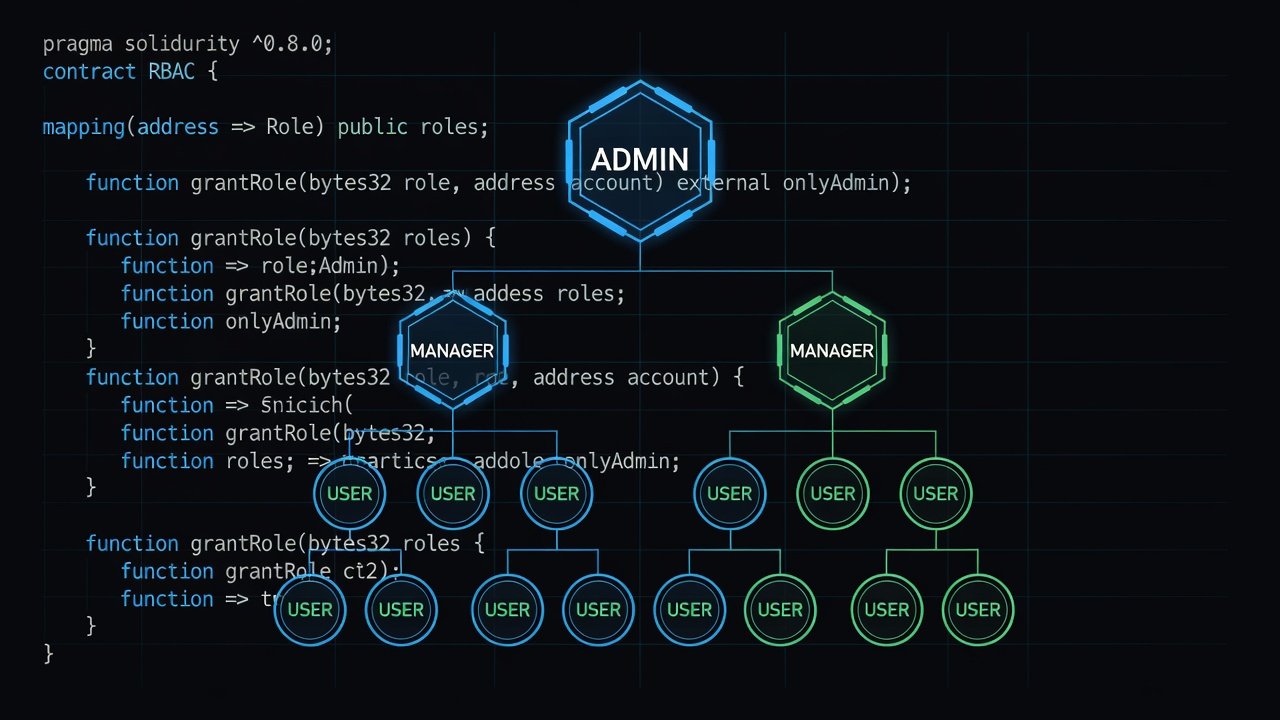
Custom RBAC starts with defining roles as bytes32 constants and mapping them to accounts using structures like role => account => bool. To enable hierarchies, introduce a parent-child relationship where higher roles inherit permissions from lower ones through a dedicated admin mapping. For example, an ADMIN role can automatically grant MANAGER and USER privileges through modifier checks that traverse the role tree. A typical structure uses a mapping of role to admin role, allowing dynamic hierarchy configuration at deployment or through privileged calls. Modifiers like onlyRoleWithHierarchy verify both direct assignment and inherited permissions by recursively checking parent roles until reaching the root or confirming access. This prevents unauthorized escalation while maintaining flexibility. Developers should also consider adding events for role grants, revocations, and hierarchy changes to enable off-chain monitoring tools. Implementing these patterns requires careful attention to storage layout to avoid unnecessary gas costs during frequent permission checks.
Gas-Efficient Storage Patterns
Storing roles in mappings can consume significant gas when checking hierarchies repeatedly across multiple function calls. Optimize by using bitmasks for flat roles or packed structs for small hierarchies where up to eight roles fit into a single storage slot. For deeper trees, employ a recursive check with caching in transient storage available in newer EVM versions to reduce repeated SLOAD operations that dominate gas consumption. Another powerful pattern involves role bitmaps where each bit represents a permission level, minimizing storage slots while supporting up to 256 distinct roles in a single uint256 variable. Comparisons between mapping-based and bitmap approaches show that bitmaps reduce gas by approximately 40 percent for complex checks in high-traffic contracts. Always benchmark implementations using Foundry's gas reporting features before finalizing the design.
Foundry Test Examples
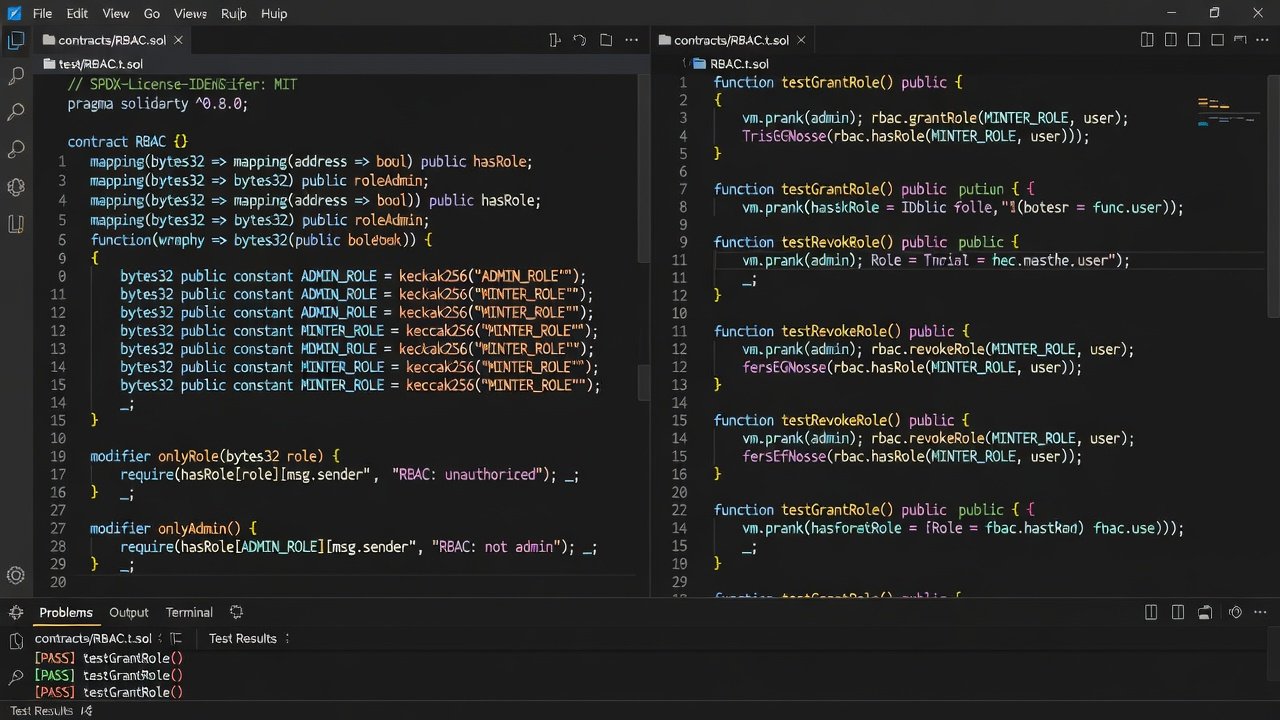
Testing RBAC hierarchies requires comprehensive coverage of inheritance paths, edge cases, and revocation scenarios. Below is a simplified yet expandable Foundry test setup that covers core functionality:
function testAdminInheritsManagerPermissions() public {
    vm.prank(admin);
    contract.grantRole(MANAGER_ROLE, user);
    assertTrue(contract.hasRole(MANAGER_ROLE, user));
    // Verify inherited access through modifier
    vm.prank(user);
    contract.executeManagerAction();
}
Include fuzz tests for role revocation flows and reentrancy attempts during permission changes. Additional tests should cover scenarios where a role is revoked mid-transaction and verify that lower roles cannot escalate without explicit grants from higher authorities. Running these tests across multiple fork environments ensures compatibility with 2026 mainnet conditions.
Real-World Scenario: DAO Governance Tiers
DAOs benefit tremendously from tiered RBAC where PROPOSAL_CREATOR, VOTER, and EXECUTOR roles form a clear hierarchy. A governance contract can enforce that only EXECUTORs finalize proposals after successful votes, while allowing VOTERs to delegate voting power upward through role-based delegation functions. Step-by-step implementation involves deploying the RBAC contract first, assigning initial roles via a multisig, and integrating the hierarchy checks into proposal and execution functions. Access revocation flows become critical during token holder disputes or when a participant acts maliciously. Implement time-locked revocations and multi-signature requirements for high-tier role changes to maintain decentralization and prevent single-point abuse. Real DAO examples demonstrate that properly structured hierarchies reduce governance attacks by limiting the blast radius of compromised accounts.
Common Pitfalls and Mitigation with Modifiers
Role escalation remains a frequent issue when modifiers fail to validate the full hierarchy chain during permission checks. Always implement a recursive or cached check that walks up the admin tree, returning early upon finding a valid parent role. Another pitfall involves front-running role grants on public mempools; mitigate this with commit-reveal schemes or access queues that require multiple confirmations. Overly complex hierarchies can also lead to gas griefing attacks where attackers force expensive recursive checks. Use the OpenZeppelin Contracts library as a secure foundation and extend it with custom hierarchy logic rather than writing from scratch. Thorough documentation of each role's scope and inheritance rules further reduces the chance of misconfiguration during team handoffs.
Security Checklist for 2026 Deployments
- Audit all modifiers for complete hierarchy traversal and include formal verification where possible
- Implement role revocation with configurable timelocks and multi-party approvals
- Use immutable role constants where possible to prevent runtime manipulation
- Test for gas griefing in permission checks under high load conditions
- Integrate with Foundry for invariant and fuzz testing across the entire role tree
- Verify compatibility with latest EVM features on mainnet before deployment
- Log all role changes via indexed events for real-time monitoring dashboards
Deployment Tips for 2026 Mainnet Environments
Before mainnet deployment, simulate hierarchies on testnets using realistic DAO participant counts exceeding 500 accounts to surface edge cases. Monitor storage costs with tools from Solidity documentation and optimize storage variables accordingly. Prefer proxy patterns for upgradable RBAC logic so hierarchies can evolve without full redeployment. Always include emergency pause roles at the top of the hierarchy and conduct multiple independent audits. Regularly review role assignments through on-chain events and maintain off-chain governance records for compliance and dispute resolution.
Conclusion
Advanced RBAC hierarchies elevate Solidity contracts from basic ownership models to enterprise-grade access management suitable for 2026 mainnet environments. By combining custom inheritance structures, gas optimizations such as bitmaps and transient caching, and rigorous testing with Foundry, developers can build secure, scalable systems ready for complex DAO governance and multi-tier enterprise workflows. Follow the security checklist, leverage established libraries like OpenZeppelin, and prioritize comprehensive test coverage to minimize risks while delivering powerful governance capabilities that withstand evolving threats.


No comments yet. Be the first!