 CryptoChain Blog

Introduction to AI-Powered Fuzzing in Solidity Development
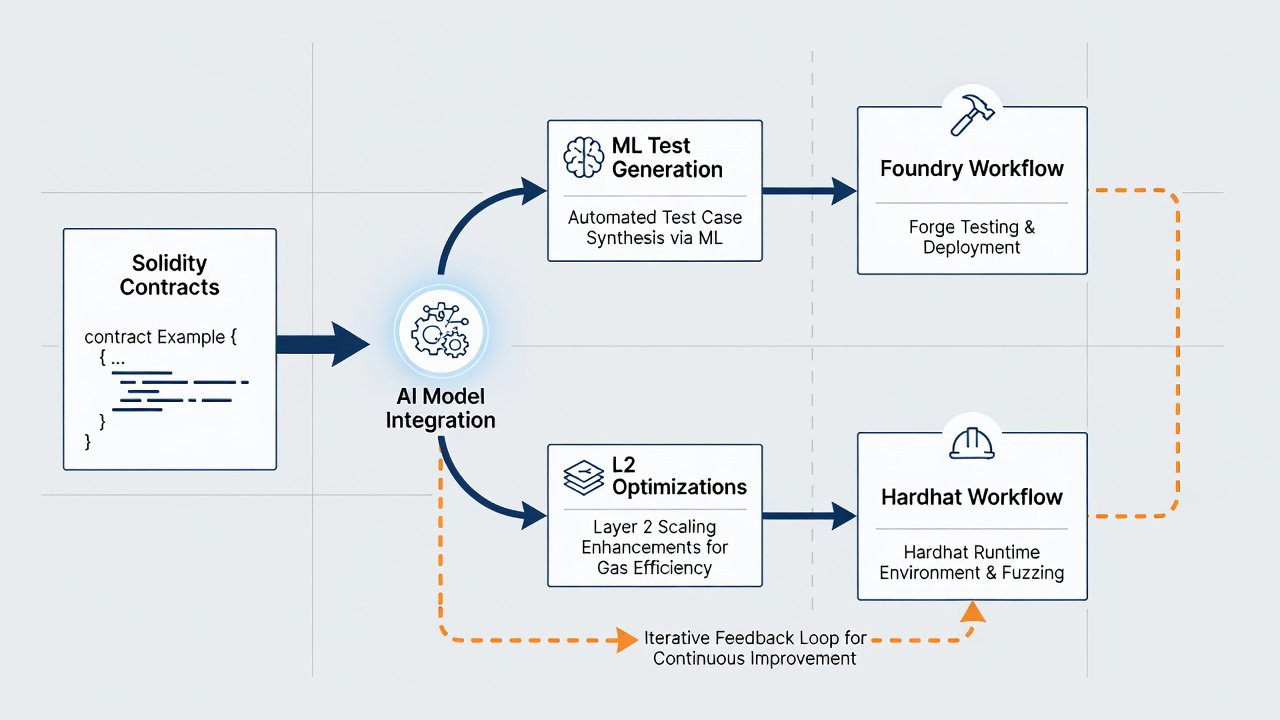
As blockchain ecosystems mature in 2026, securing smart contracts remains a top priority for DeFi protocols and enterprise applications. Traditional fuzzing methods often miss subtle edge cases in complex Solidity codebases. AI-powered fuzzing combines machine learning with established tools like Foundry and Hardhat to dramatically improve bug detection rates while preserving developer-friendly workflows. This approach leverages ML models to guide test generation toward high-risk areas, such as reentrancy patterns or integer overflows. Teams adopting these techniques report measurable gains in vulnerability discovery without inflating gas costs or slowing iteration cycles. In practice, AI guidance helps prioritize test inputs that traditional random fuzzers overlook, leading to higher coverage in fewer iterations.
The shift toward AI integration addresses the growing complexity of DeFi protocols, where contracts interact across multiple L2 networks and handle billions in value. Developers now face pressure to audit continuously rather than at discrete milestones. By embedding ML into fuzzing pipelines, teams can simulate realistic attack scenarios derived from historical on-chain data, making security testing more proactive and efficient.
Understanding Edge-Case Vulnerabilities in Modern Solidity Contracts
Edge-case vulnerabilities often arise from unexpected state combinations, unusual token interactions, or timing-dependent behaviors on L2 rollups. Common examples include flash-loan amplified price manipulations, improper handling of delegatecall in proxy patterns, and arithmetic edge cases under specific gas limits. AI models excel here by learning from large corpora of audited contracts to predict where such issues might hide. For instance, an ML classifier can flag functions with high cyclomatic complexity and low test coverage, directing fuzzers to focus there first.
Setting Up ML-Guided Test Generation with Foundry and Hardhat
Begin by installing Foundry alongside Hardhat plugins that support AI extensions. Configure your project with a Python-based ML layer using libraries like TensorFlow or PyTorch to analyze contract ASTs and predict vulnerable functions. Step-by-step configuration starts with cloning a starter repo and adding dependencies via npm and pip. Create a fuzzing harness that feeds AI-generated inputs into Foundry's invariant testing suite. For Hardhat, integrate the plugin ecosystem to run parallel fuzz campaigns. Ensure your environment includes recent versions of both frameworks for optimal compatibility with L2 chains like Arbitrum and Optimism. A practical example involves writing a Python script that parses Solidity source, extracts function signatures, and uses a trained model to generate seed inputs for fuzzing. This script then calls forge test with the --fuzz flag, feeding the AI-derived seeds directly into the campaign.
Next, set up continuous monitoring by exporting coverage reports after each run. These reports feed back into the ML model for retraining, creating a closed-loop system that improves over time. Teams typically allocate one dedicated server for these nightly jobs to avoid impacting local development machines.
Integrating AI Tools with Existing Security Plugins
Security plugins such as Slither and Mythril can be enhanced by piping their output into reinforcement learning agents. These agents prioritize test cases based on historical exploit data from public repositories. Integration involves writing custom scripts that map plugin alerts to AI model features. This hybrid setup allows continuous auditing pipelines to evolve beyond static analysis. For example, you can create a middleware layer that converts Slither's JSON output into feature vectors, then uses a reinforcement learning policy to select which invariants to test next in Foundry.
Gas-Efficient Patterns and L2-Specific Optimizations
AI fuzzers can be tuned to favor low-gas test scenarios, preventing unnecessary overhead on L2 networks. Focus on patterns that minimize storage writes during fuzz runs while still exploring deep state spaces. For L2 environments, optimize by simulating rollup-specific behaviors like batch submissions. This reduces false positives related to gas estimation differences between L1 and L2. Developers should also incorporate L2-specific oracles and sequencer assumptions into their test harnesses so that AI-generated tests reflect real production conditions on networks such as Base or zkSync.
Real 2026 Case Studies from DeFi Protocols
Leading DeFi projects have applied AI fuzzing to discover critical issues before mainnet deployment. One protocol identified a subtle flash-loan vulnerability through ML-guided invariant tests that traditional methods overlooked, allowing them to patch the issue in under two weeks. Another case involved scaling fuzzing across a large lending contract suite containing over 50 interconnected contracts. The AI system surfaced an edge case involving liquidation thresholds under extreme market volatility, resulting in faster iteration and fewer post-deployment patches. These examples demonstrate how measurable improvements in bug detection rates—often exceeding 40 percent compared to baseline fuzzing—translate directly into safer protocol launches.
Comparison of Open-Source AI Fuzzers
- Foundry with custom ML extensions: Strong for invariant testing and rapid iteration on complex state machines, with excellent L2 simulation support.
- Hardhat AI plugins: Excellent for JavaScript-based teams seeking seamless IDE integration and real-time feedback during development.
- Emerging tools like Echidna with neural guidance: Best for property-based exploration in complex DeFi logic, though they require more initial setup for ML components.
- Hybrid approaches combining multiple tools: Provide the broadest coverage when budgets allow parallel runs across different fuzzers.
Evaluate based on your team's language preferences and codebase size. Smaller teams often start with Foundry because of its speed, while larger organizations prefer Hardhat for its extensive plugin ecosystem.
Practical Checklist for Continuous Auditing Pipelines
- Establish baseline coverage metrics before introducing AI components, using tools like solidity-coverage to quantify starting points.
- Train models on internal exploit datasets updated monthly, incorporating new vulnerabilities discovered in the wild.
- Automate CI/CD triggers for nightly fuzz campaigns that run for at least four hours each.
- Review AI recommendations with human auditors weekly to filter false positives and refine model accuracy.
- Monitor L2 gas metrics to maintain efficiency and avoid tests that become prohibitively expensive on mainnet-equivalent environments.
- Document all discovered edge cases for future model improvement and team knowledge sharing.
- Integrate results into dashboards that track bug detection trends over multiple sprints.
Common Pitfalls When Scaling AI Fuzzing
Avoid over-reliance on synthetic data that fails to reflect real-world usage. Large codebases can overwhelm models if feature engineering is neglected, leading to diluted focus and wasted compute. Always validate AI suggestions against formal verification tools for critical functions. Another frequent issue is neglecting L2-specific state transitions, leading to incomplete coverage. Teams also sometimes forget to version-control their ML models alongside the Solidity code, making reproducibility difficult during audits.
Frequently Asked Questions
How long does it take to see results from AI fuzzing? Most teams observe initial improvements in coverage within the first two weeks of implementation, with more substantial bug discoveries appearing after model retraining cycles.
Does AI fuzzing replace manual audits? No, it augments them by surfacing candidates for deeper human review, allowing auditors to focus on high-value areas.
What hardware is recommended for running these pipelines? A machine with at least 32 GB RAM and a modern GPU accelerates ML inference, though CPU-only setups remain viable for smaller contracts.
Conclusion
AI-powered fuzzing represents a significant leap forward for Solidity security in 2026. By thoughtfully combining ML guidance with Foundry and Hardhat, teams achieve superior bug detection while keeping workflows efficient. Start small, iterate based on measurable results, and integrate into existing pipelines for lasting impact. For foundational resources, explore Foundry documentation, Hardhat guides, and Solidity language reference.

No comments yet. Be the first!