 CryptoChain Blog
Introduction to AI-Assisted Secure Solidity Development
In 2026, developers increasingly rely on AI to accelerate Solidity smart contract creation while prioritizing security and audit readiness. AI tools can produce functional code quickly, but they require careful prompt engineering and post-generation validation to mitigate risks like hallucinated vulnerabilities or inefficient gas usage. This comprehensive guide explores practical techniques for generating secure contracts, integrating with Foundry for immediate testing, comparing leading models, and establishing reliable workflows that keep contracts audit-ready before mainnet deployment. As blockchain adoption grows, combining AI generation with rigorous human oversight helps teams deliver robust decentralized applications faster without sacrificing the high standards demanded by security auditors and investors.
Prompt Engineering Techniques for Secure Outputs
Effective prompts guide AI models to incorporate security best practices from the start. Begin with context-rich instructions that specify Solidity version 0.8.28 or later, require OpenZeppelin imports for access control, and mandate reentrancy guards. For example, a strong prompt might read: "Generate a Solidity contract using pragma 0.8.28 that implements role-based access control with Ownable and includes events for all state changes." Always include explicit security constraints such as "prevent integer overflows using built-in checks" and "avoid using tx.origin for authentication." Iterative prompting refines outputs by feeding back compiler errors or audit feedback. Developers can also layer constraints like requiring NatSpec comments on every function and enforcing strict input validation on all public and external methods. This layered approach reduces the chance of incomplete logic and produces code that aligns closely with industry standards from the outset.
Integration with Foundry for Immediate Testing
Foundry provides a fast, local environment for compiling and testing AI-generated contracts. After generating code, developers can run forge build and forge test to catch issues instantly. Foundry Book offers comprehensive documentation on setting up fuzz testing and invariant checks that validate AI outputs against real-world scenarios. A typical workflow involves generating the contract, copying it into a Foundry project, writing unit tests for each function, and running gas reports to identify optimization opportunities. Teams often create reusable test templates that automatically check for common issues such as reentrancy, integer overflows, and unauthorized access attempts. This tight integration allows rapid iteration, turning raw AI output into verified, production-grade code within minutes rather than hours.
Common Pitfalls Including Hallucinated Vulnerabilities
AI models sometimes invent non-existent vulnerabilities or suggest outdated patterns like unchecked external calls. Another frequent issue is generating code that compiles but fails under edge-case conditions due to incomplete state management. Common pitfalls include the following:
- Always verify that the AI has not invented custom modifiers without proper implementation or missing visibility specifiers.
- Cross-check oracle integrations against official documentation to avoid price manipulation vectors and ensure fallback mechanisms are robust.
- Review for missing zero-address checks on critical parameters and insufficient event logging for off-chain monitoring.
- Watch for hallucinated security features that reference non-existent libraries or deprecated pragma versions.
Addressing these issues early prevents costly audit findings and deployment delays.
Step-by-Step Example: Generating Access Control Patterns
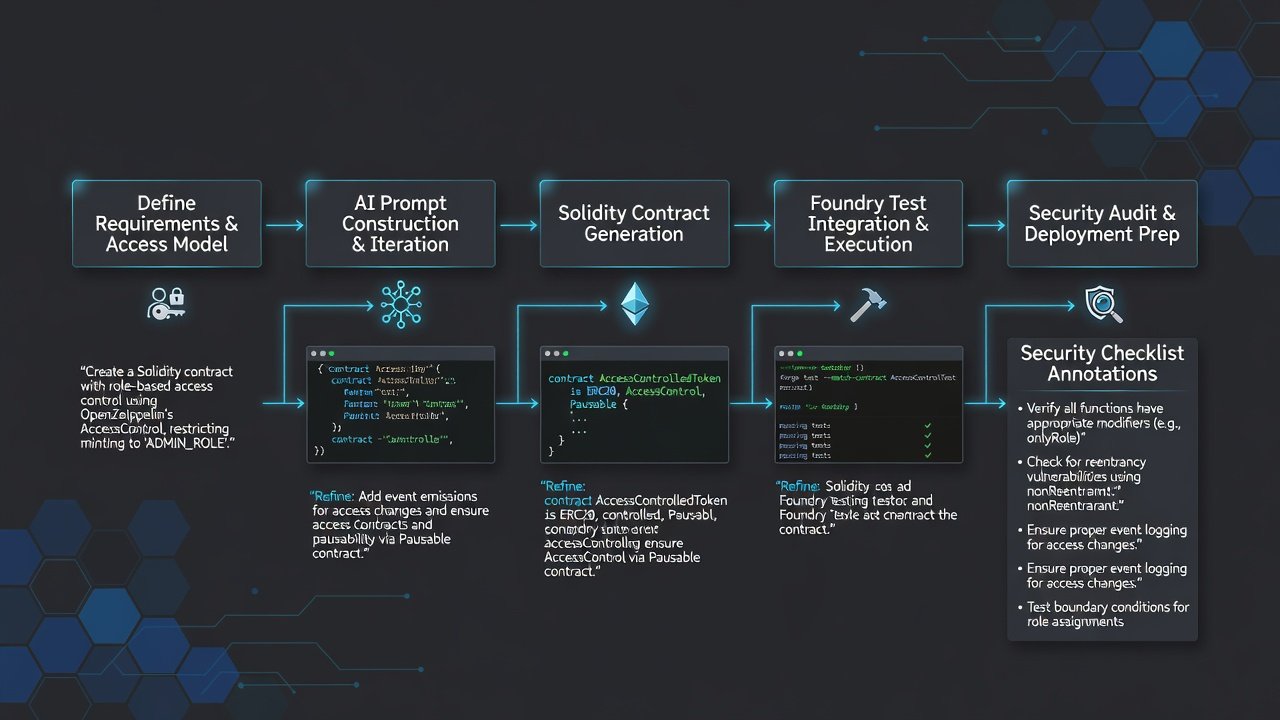
Consider generating a contract with role-based permissions. Start with a prompt specifying roles for admin, operator, and user. The AI typically outputs an Ownable2Step structure with additional custom roles. After generation, add modifiers and test each role transition using Foundry scripts. This ensures only authorized addresses can execute sensitive functions like pausing the contract or upgrading logic. Expand the example by requesting explicit revocation mechanisms and time-locked role changes to further harden the design. Developers should then simulate attacks in test environments, confirming that unauthorized callers receive proper reverts and that role hierarchies cannot be bypassed through inheritance flaws.
Step-by-Step Example: Oracle Integrations with Security Mitigations
For price feed integrations, prompt the AI to use Chainlink oracles with multiple fallback sources and circuit breakers. Include time-weighted average price logic and staleness checks. After generation, implement additional validation such as deviation thresholds before accepting oracle data. Chainlink documentation provides the authoritative reference for secure oracle patterns. Further mitigations involve wrapping oracle calls in try-catch blocks, maintaining a local price cache updated at regular intervals, and triggering emergency pauses when oracle responses fall outside expected ranges. These layers protect against flash loan attacks and temporary network disruptions that could otherwise lead to incorrect liquidations or pricing errors.
Comparing Leading AI Models for Contract Quality and Gas Efficiency
Models differ significantly in output quality. Advanced reasoning models produce more secure patterns and lower gas consumption compared to general-purpose ones. Developers should benchmark outputs by measuring deployment costs and execution gas across identical prompts. Consistent evaluation reveals which model best handles complex access control or oracle logic while maintaining readability for auditors. In practice, models with stronger chain-specific training tend to generate cleaner inheritance structures and more efficient storage layouts. Teams often maintain an internal leaderboard tracking metrics such as average gas per transaction and the number of manual fixes required after generation. This data-driven comparison helps select the optimal model for each contract type, whether it involves DeFi lending logic or NFT marketplace mechanics.
Practical Workflows for Reviewing and Hardening AI-Generated Code
1. Run static analysis with Slither and Mythril immediately after generation to surface potential vulnerabilities automatically.
2. Perform manual line-by-line review focusing on access control, external calls, and state transitions.
3. Write comprehensive Foundry tests covering happy paths, edge cases, and simulated attack scenarios including reentrancy and front-running.
4. Engage formal verification tools such as Certora or Scribble for critical invariants before moving to testnet.
5. Conduct a final gas optimization pass using Foundry reports and apply targeted improvements without altering security properties.
6. Document every change made to the AI-generated base and maintain a clear audit trail for compliance purposes.
7. Schedule a peer review or external audit for high-value contracts to catch subtle issues that automated tools might miss.
These steps transform raw AI output into production-ready, audit-ready contracts that meet the rigorous standards expected in 2026.
Additional Best Practices for Long-Term Maintainability
Beyond initial generation and testing, successful teams establish version control practices that treat AI-generated contracts as living codebases. They integrate continuous integration pipelines that automatically re-run tests whenever prompts or model versions change. Regular updates to OpenZeppelin libraries and compiler versions ensure contracts remain compatible with evolving Ethereum standards. OpenZeppelin documentation serves as an essential reference for keeping dependencies current and secure.
Conclusion
AI-powered code generation significantly speeds up Solidity development in 2026 when paired with rigorous testing and review processes. By mastering prompt engineering, leveraging Foundry, and applying structured hardening workflows, teams can produce secure contracts that withstand audits and real-world threats while remaining gas efficient and maintainable over time.
FAQs
Can AI replace human auditors for Solidity contracts?
No. AI accelerates initial drafting but cannot replace expert human review and formal verification processes required for high-stakes deployments.
Which AI model produces the most gas-efficient Solidity code?
Results vary by prompt complexity, but models with strong reasoning capabilities generally outperform others in gas benchmarks when properly guided.
How do I combine AI generation with formal verification?
Generate the contract, then feed the verified invariants into tools like Certora for mathematical proof of correctness on critical functions.
What are the biggest risks when using AI for smart contract code?
The primary risks include hallucinated vulnerabilities, incomplete access control logic, and outdated security patterns that require thorough manual validation.
Should every AI-generated contract undergo external auditing?
Yes, especially for contracts managing significant value. External audits provide an independent layer of assurance beyond internal testing and AI generation.


No comments yet. Be the first!