 CryptoChain Blog

Introduction to Invariant Testing in Solidity Security
Invariant testing has become a cornerstone of secure smart contract development in 2026. As Solidity projects grow in complexity with DeFi protocols, NFT marketplaces, and cross-chain applications, traditional unit tests often fall short in catching subtle state inconsistencies that lead to devastating exploits. Developers need methods that explore vast state spaces automatically. In 2026, Foundry remains the go-to framework for Ethereum developers seeking production-ready security practices. This comprehensive guide explores invariant testing in depth, covering setup with the latest features, writing robust invariants, hands-on exploit prevention examples, integration strategies, gas tips, L2 considerations, and audit workflows.
Invariant testing verifies that certain properties of your contract remain true across a wide range of inputs and states. Unlike unit tests that check specific scenarios, invariants provide broad coverage against issues such as unauthorized access or broken state transitions. By the end of this article, you will have actionable code samples and checklists ready for your next audit.
Project Setup with Latest Foundry Features
Begin by installing the most recent Foundry release. Run foundryup to update to the 2026-compatible version, which includes enhanced cheatcodes for invariant testing and improved fuzzing performance. Initialize a new project with forge init my-secure-project --template foundry-rs/foundry-template. This template includes pre-configured test directories and example contracts that speed up onboarding.
Update your foundry.toml file to enable advanced fuzzing and invariant modes. A recommended configuration looks like this: [invariant] runs = 1000 depth = 15 fail_on_revert = true. These settings ensure thorough exploration while stopping on reverts that indicate potential bugs. You can also enable shrink_run_limit for faster debugging of failing cases.
Installing Dependencies and Tooling
Install necessary dependencies like OpenZeppelin contracts via forge install OpenZeppelin/openzeppelin-contracts. This provides battle-tested access control and token implementations that pair well with invariants. For additional security tooling, add forge install crytic/slither to run static analysis before fuzzing campaigns. The latest Foundry also supports direct integration with forge coverage to measure how many invariants are actually exercised during runs.
After setup, verify your environment with forge test --list. This command shows available invariant tests and helps organize your test suite early.
Writing Effective Invariants for Access Control and State Consistency
Effective invariants target core security properties that must hold after any sequence of transactions. For access control, define an invariant that ensures only the owner can modify critical variables. Here is a practical example in a test contract:
contract MyInvariantTest is StdInvariant { address owner; function setUp() public { owner = msg.sender; targetContract(address(myContract)); } function invariant_onlyOwnerCanChangeAdmin() public view { assert(owner == address(this) || msg.sender == owner); } }For state consistency, check that token balances never exceed total supply or that mapping entries remain synchronized. Use Foundry's invariant keyword in test contracts inheriting from StdInvariant. Always make invariants view functions to avoid side effects during execution. A strong invariant for ERC20 contracts might assert totalSupply == sumOfAllBalances after arbitrary transfers and mints.
Developers should aim for invariants that capture business logic rather than implementation details. This makes them resilient to minor refactors while still catching logical errors.
Hands-on Examples: Defending Against Reentrancy and Overflow
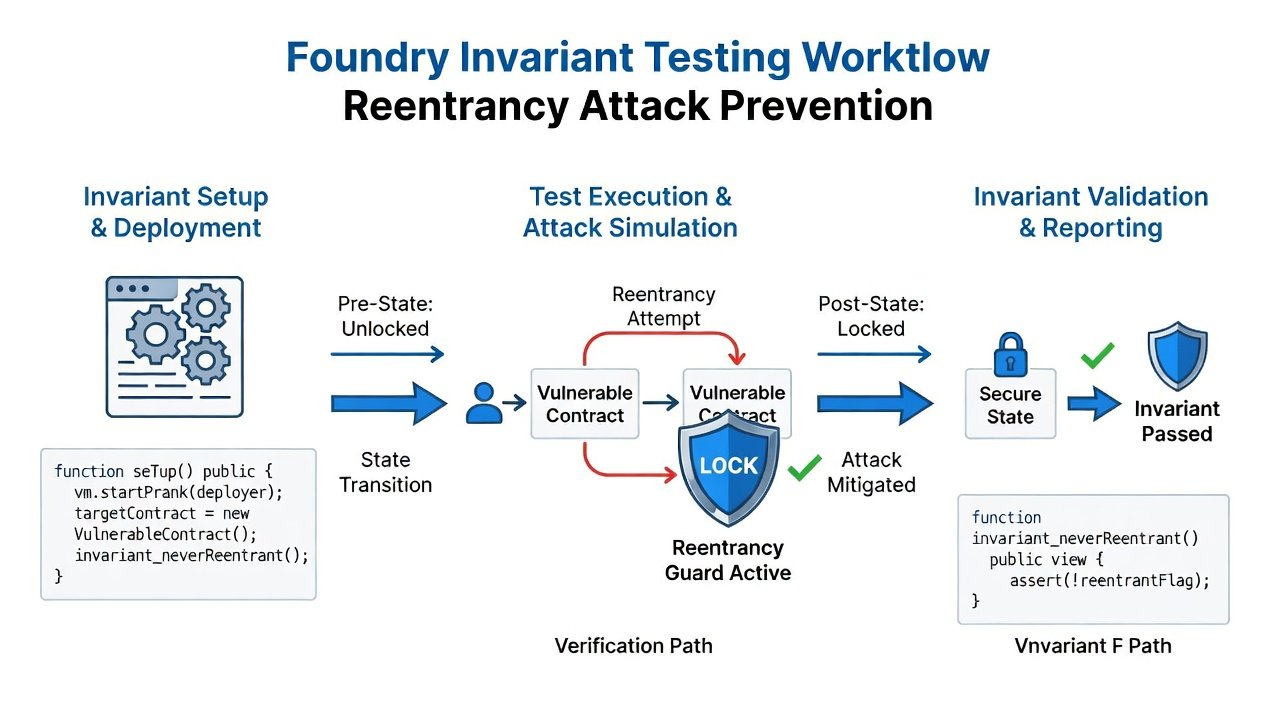
Consider a vulnerable reentrancy example in a simple vault contract. An invariant test might assert that the contract balance always matches recorded user deposits after any sequence of calls. Implement using vm.prank and targetContract to simulate attacker flows. A complete test could look like this:
function invariant_noReentrancyDrain() public { uint256 recorded = vault.totalDeposits(); uint256 actual = address(vault).balance; assert(recorded == actual); }Running this with high depth will attempt recursive calls and flag any imbalance. For overflow scenarios in older Solidity versions, test arithmetic invariants like balanceAfter = balanceBefore + amount under extreme values. Foundry's built-in overflow checks combined with invariants catch these reliably even when using unchecked blocks.
Another useful pattern is testing pause functionality: an invariant that confirms the contract remains paused after an emergency call regardless of subsequent user actions. These examples demonstrate how invariants expose issues that unit tests rarely reach.
Integration with Fuzzing and Static Analysis
Combine invariants with Foundry fuzzing by setting high run counts and using --fuzz-runs flags. This hybrid approach surfaces issues that pure fuzzing might miss. Integrate static tools like Slither via the installed package for pre-test analysis. Run slither . --filter-paths "test" before launching invariant campaigns to eliminate obvious low-hanging fruit.
Many teams now include invariant tests in their CI pipelines using GitHub Actions, automatically rejecting PRs that break core invariants. This practice catches regressions early and builds confidence before mainnet deployments.
Gas Optimization Tips During Invariant Testing
Monitor gas usage within invariants using vm.snapshotGasLeft and vm.gasLeft. Refactor functions that spike gas under invariant sequences. Target under 50,000 gas per critical path for L2 efficiency. Consider caching storage variables inside invariants when possible and avoid unnecessary external calls. Profiling with forge test --gas-report after each major change reveals optimization opportunities quickly.
L2 Deployment Considerations
When deploying to Optimism or Arbitrum, adjust invariant depths due to different block times and finality guarantees. Test with forge test --fork-url $L2_RPC to validate cross-layer consistency. Account for sequencer delays in state transition invariants. On L2s, also verify that gas refunds and L1 data posting do not break balance invariants. Many teams run separate invariant suites for each target chain to catch environment-specific issues.
Comparison: Invariant Testing vs Traditional Unit Tests
| Aspect | Invariant Testing | Traditional Unit Tests |
|---|---|---|
| Coverage | Broad state exploration across thousands of paths | Specific scenarios written by developer |
| Exploit Detection | Strong against unknown attack paths and edge cases | Limited to explicitly written cases |
| Setup Complexity | Medium – requires careful property definition | Low – straightforward assertions |
| Execution Time | Higher due to deep exploration | Lower, faster feedback loop |
| Maintenance | Low once invariants are stable | High as new features require new tests |
Common Pitfalls and How to Avoid Them
One frequent mistake is writing invariants that are too narrow, missing entire classes of bugs. Always think in terms of global properties. Another issue is failing to target the correct contracts with targetContract, which leaves important functions untested. Developers should also avoid invariants that depend on block timestamps without accounting for manipulation. Finally, running too few iterations leads to false confidence; always use at least 500 runs for serious audits.
Practical Checklist for Audit Workflows
- Define at least 5 core invariants per contract module covering access control, state consistency, and economic invariants.
- Run invariants with minimum 500 depth before any external audit engagement.
- Cross-verify findings with static analysis reports from Slither or similar tools.
- Document all failing invariant traces with reproduction steps for the security team.
- Re-test after any L2-specific optimizations or contract upgrades.
- Include invariant results in the final audit report appendix.
- Share failing cases with the broader community via Foundry Discord for peer review.
Frequently Asked Questions
How many invariants should a typical contract have?
Most production contracts benefit from 8–15 well-chosen invariants. Focus on properties that would break the system if violated rather than minor implementation details.
Can invariant testing replace all unit tests?
No. Unit tests remain essential for verifying specific business logic and function behavior. Invariants complement them by exploring unexpected interactions.
What is the recommended depth for mainnet preparation?
Teams targeting mainnet in 2026 typically run invariants at depth 20 or higher with at least 2000 total runs for high-value contracts.
Conclusion
Mastering invariant testing with Foundry equips developers to build resilient Solidity contracts that withstand real-world attacks. By following these practices, teams can significantly reduce exploit risks in 2026 deployments. Start small, iterate on your invariants, and integrate them into every stage of development. For further reading, consult the Foundry Book, Solidity Documentation, and OpenZeppelin Contracts Documentation.


No comments yet. Be the first!