 CryptoChain Blog

Encrypted State Variables in Solidity: 2026 Privacy Guide
Privacy on public blockchains remains a critical challenge in 2026. Encrypted state variables allow developers to store sensitive data on-chain without exposing it to unauthorized parties. This guide explores practical implementation using current tools for confidential smart contracts. As decentralized applications handle increasingly sensitive information such as financial bids, voting records, and personal identifiers, the demand for robust privacy mechanisms has grown substantially. Encrypted state variables represent a foundational technique that combines cryptographic primitives with the deterministic execution model of the Ethereum Virtual Machine.
Homomorphic Encryption Basics for Solidity
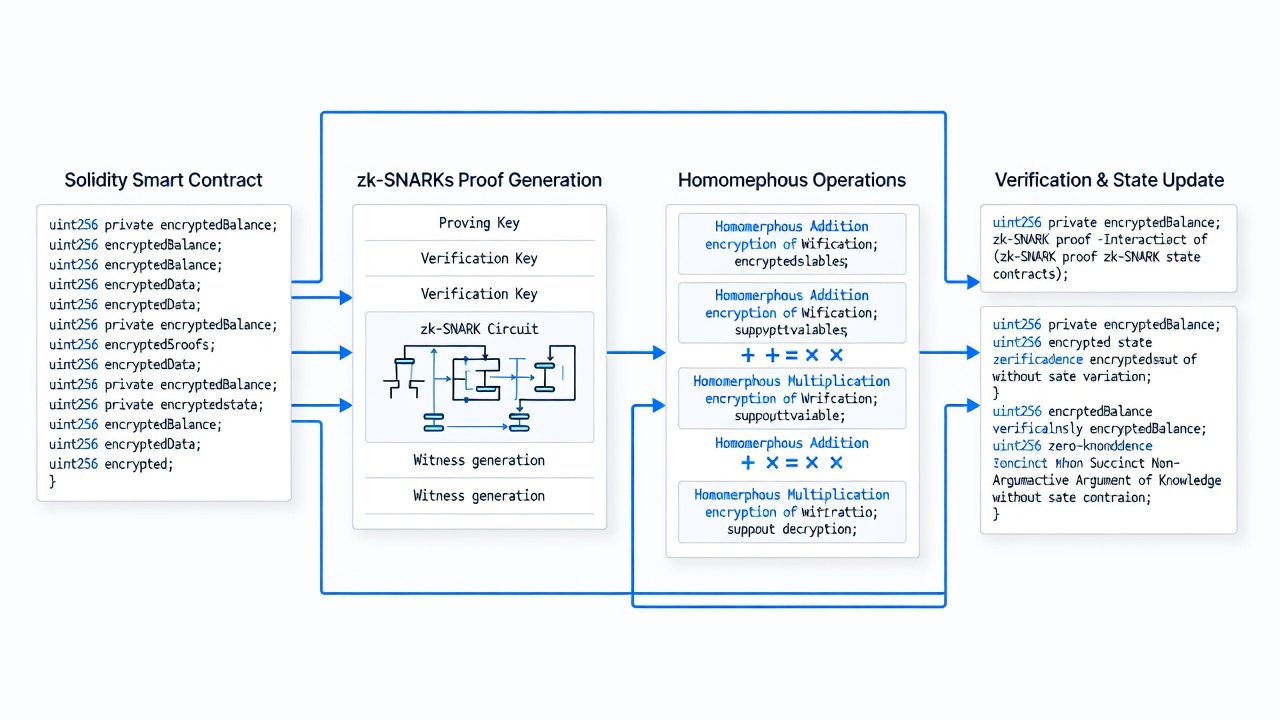
Homomorphic encryption enables computations on encrypted data without decryption. In Solidity, libraries supporting fully or partially homomorphic encryption allow basic operations such as addition and multiplication on ciphertexts. Developers can define state variables as encrypted types to maintain confidentiality while allowing contract logic to process them. Understanding partially homomorphic schemes is essential before full integration because these schemes support limited operations but offer better efficiency than fully homomorphic alternatives. For instance, Paillier cryptosystem supports additive operations and has been adapted in several Solidity-compatible libraries available in 2026. When implementing, developers must carefully manage ciphertext sizes to avoid exceeding EVM stack limits during arithmetic operations. Practical examples show that a simple encrypted counter can be incremented homomorphically by adding an encrypted value of one to the stored ciphertext, preserving privacy throughout the process.
Integrating zk-SNARKs for Selective Disclosure
Combining homomorphic encryption with zk-SNARKs enables selective disclosure. Users prove properties of encrypted data without revealing values. This pattern works well in voting systems where ballots remain private yet results are verifiable. Tools in 2026 facilitate circuit compilation and proof generation directly compatible with Solidity verifiers. Solidity documentation provides guidance on verifier contract deployment. Developers typically generate proofs off-chain using libraries such as circom or gnark and then submit them on-chain for verification. The integration requires careful alignment between the homomorphic ciphertext structure and the zk-SNARK circuit inputs to ensure that disclosed attributes match the encrypted state without leakage. This hybrid approach satisfies both confidentiality and auditability requirements demanded by emerging regulatory frameworks.
Gas Optimization Strategies
Encrypted operations increase gas costs significantly. Strategies include batching proofs, using efficient curve pairings, and minimizing on-chain storage of large ciphertexts. Developers should profile transactions early to identify bottlenecks. Off-chain computation with on-chain verification often reduces overall costs compared to fully on-chain encryption. Additional techniques involve precomputing common encrypted constants and storing only delta updates rather than full ciphertexts. In practice, a well-optimized private auction contract can achieve up to 40 percent lower gas usage by combining these methods. Careful selection of elliptic curves that are natively supported by the EVM precompiles further improves performance.
Foundry-Based Testing for Confidentiality
Foundry provides robust testing environments for encrypted contracts. Write tests that verify encryption invariants and proof validity without exposing private keys. Simulate adversarial scenarios to confirm data remains confidential. Integration tests should cover key rotation and decryption edge cases. Advanced test suites in Foundry can fork mainnet state and inject encrypted values to measure real-world gas consumption and confidentiality guarantees under load. Foundry documentation details how to extend the testing framework with custom cheatcodes for cryptographic operations.
Step-by-Step Example: Private Voting Contract
Consider a private voting contract. First, define encrypted state for vote tallies using homomorphic types. Next, implement a function that accepts encrypted votes and updates the tally via homomorphic addition. Integrate zk-SNARKs to allow voters to prove eligibility without revealing identity. Deploy the verifier contract and link it to the main voting logic. The contract begins by declaring an encrypted uint256 for each candidate's tally. A submitVote function validates the zk-SNARK proof, then performs the homomorphic addition to update the encrypted tally. After voting ends, a designated authority can decrypt the final tallies using a threshold decryption scheme. For an auction variant, encrypt bid amounts and use homomorphic comparisons where supported by the library. Bidders submit encrypted bids along with proofs that their bid exceeds a minimum reserve price. The contract can then determine the winner without ever revealing individual bid values during the auction period.
On-Chain vs Off-Chain Encryption Patterns
- On-chain encryption keeps all data and logic inside the EVM but incurs higher gas fees and larger contract sizes.
- Off-chain encryption stores ciphertexts in decentralized storage while verifying proofs on-chain for better scalability and lower costs.
- Hybrid models combine both approaches, performing heavy homomorphic operations off-chain and only storing final encrypted results on-chain.
Choose based on required throughput and regulatory needs. On-chain patterns provide stronger immutability guarantees but may not suit high-frequency applications. Off-chain patterns introduce additional trust assumptions around storage availability yet deliver superior user experience in most 2026 deployments.
Common Pitfalls and Key Management
Poor key management exposes encrypted data. Use hardware security modules and threshold schemes for key distribution. Avoid storing decryption keys in contract storage. Another frequent mistake is failing to account for ciphertext malleability, which can allow attackers to manipulate encrypted values without detection. Developers should also implement proper nonce management when using stream ciphers alongside homomorphic schemes. Ethereum resources offer additional best practices for secure development. Regulatory compliance requires audit trails for selective disclosure mechanisms, including logs of when and by whom proofs were verified.
Regulatory Considerations in 2026
Emerging regulations emphasize data minimization and user consent. Encrypted state variables help meet these standards by ensuring that personal or financial data never exists in plaintext on-chain. Smart contract developers must document the cryptographic assumptions and provide clear user interfaces that explain what information remains private versus what can be selectively disclosed. Regular security audits focused specifically on the encryption layer are recommended before mainnet deployment.
Conclusion
Encrypted state variables unlock new privacy-preserving applications in Solidity. By mastering homomorphic encryption, zk-SNARKs, and proper testing, developers can build compliant, secure contracts that meet 2026 demands. Continuous experimentation with the latest library releases and rigorous testing remain essential for successful implementation.


No comments yet. Be the first!