 CryptoChain Blog
Introduction to ERC-4626 Tokenized Vaults
ERC-4626 has become the standard for tokenized vaults on Ethereum, enabling seamless integration between yield-bearing assets and DeFi protocols. This tutorial provides a complete, security-focused guide to implementing an ERC-4626 vault in Solidity for 2026 environments. Developers will learn the standard's core mechanics, practical contract code, and critical protections against common vulnerabilities. The standard addresses fragmentation in vault implementations by providing a unified interface that protocols can rely on for deposits, withdrawals, and share calculations.
The ERC-4626 standard extends ERC-20 to represent shares in a vault that holds underlying assets. It standardizes deposit, mint, withdraw, and redeem functions, improving composability across protocols. For developers targeting 2026 Ethereum mainnet, considerations include post-Dencun optimizations and evolving gas dynamics. Real-world use cases range from yield aggregators to institutional tokenized funds, where accurate accounting and security are paramount. This guide goes beyond basics to cover production-ready patterns that reduce audit risks.
Core Concepts of the ERC-4626 Standard
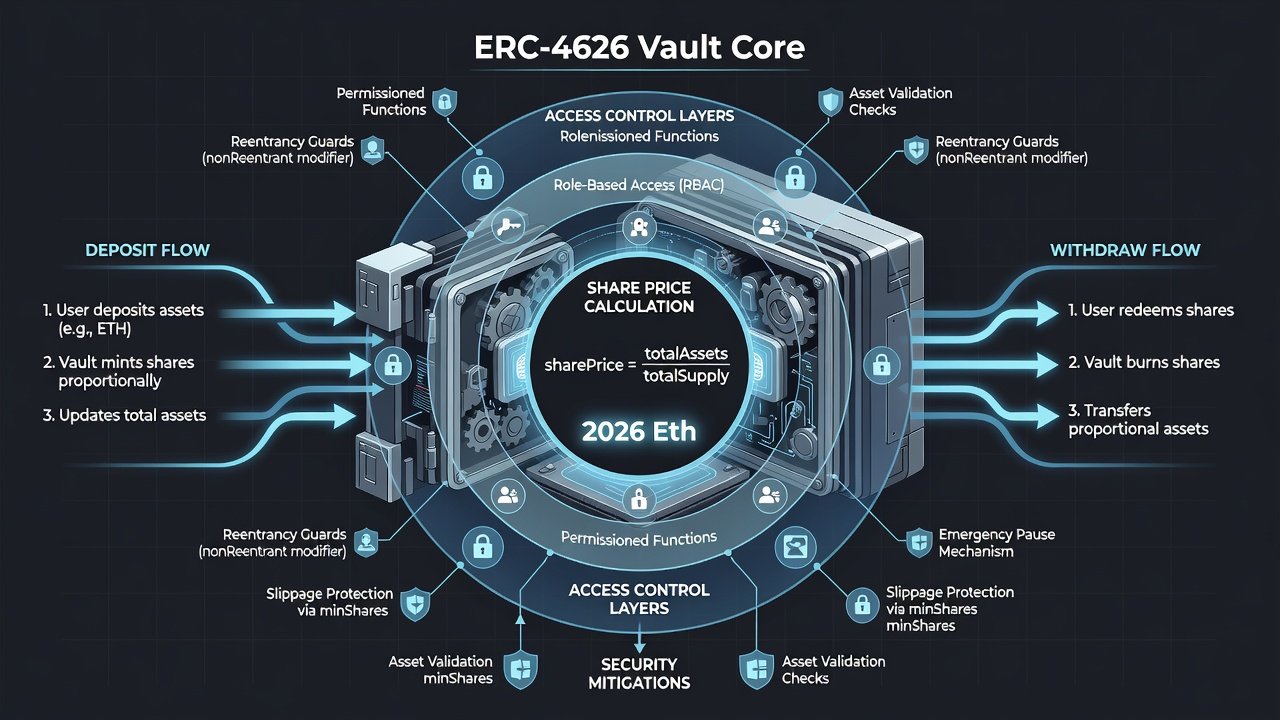
At its foundation, ERC-4626 defines how shares map to assets. The conversion rate depends on the vault's total assets and total shares. Key functions include asset(), totalAssets(), convertToShares(), and convertToAssets(). These ensure predictable behavior when integrating with lending protocols or aggregators. Understanding the difference between preview functions and actual execution is essential, as previews can be manipulated if not properly guarded.
Security begins with understanding share price manipulation risks. Attackers may inflate or deflate the price by manipulating totalAssets through flash loans or reentrancy. Proper implementation requires careful ordering of state updates and external calls. Additional concepts include the use of virtual shares to prevent rounding attacks and the importance of handling decimal mismatches between the asset and share tokens. Developers should also consider how the vault interacts with other standards like ERC-2612 for permit-based approvals to improve user experience.
Step-by-Step Contract Implementation
Start with the basic contract skeleton using OpenZeppelin libraries for ERC-20 and ERC-4626 inheritance. Import necessary contracts to handle shares and asset transfers securely. The constructor must correctly initialize the underlying asset and set up ownership or role-based permissions from the outset.
pragma solidity ^0.8.20;
import "@openzeppelin/contracts/token/ERC20/extensions/ERC4626.sol";
import "@openzeppelin/contracts/access/Ownable.sol";
import "@openzeppelin/contracts/security/ReentrancyGuard.sol";

contract SecureVault is ERC4626, Ownable, ReentrancyGuard {
    constructor(IERC20 asset_) ERC4626(asset_) Ownable(msg.sender) {}
}
Implementing Deposit and Withdraw Functions
The deposit function accepts assets and mints shares. Always update internal accounting before external transfers to prevent reentrancy. Include events for off-chain tracking and ensure that the receiver parameter supports third-party deposits common in DeFi strategies.
function deposit(uint256 assets, address receiver) public override nonReentrant returns (uint256 shares) {
    shares = previewDeposit(assets);
    _deposit(_msgSender(), receiver, assets, shares);
    emit Deposit(_msgSender(), receiver, assets, shares);
}
Withdraw mirrors this logic but burns shares first. Include slippage checks via preview functions for user protection. The redeem function should be implemented alongside withdraw to give users flexibility in specifying shares or assets.
function withdraw(uint256 assets, address receiver, address owner) public override nonReentrant returns (uint256 shares) {
    shares = previewWithdraw(assets);
    if (_msgSender() != owner) {
        _spendAllowance(owner, _msgSender(), shares);
    }
    _withdraw(_msgSender(), receiver, owner, assets, shares);
}
Addressing Key Security Risks
Share price manipulation remains a top concern. Mitigate by using virtual shares or enforcing minimum deposit amounts. Access control patterns prevent unauthorized upgrades or fee changes. Reentrancy attacks can drain funds if external calls occur before state updates. Another risk involves incorrect handling of fee-on-transfer tokens, which can break the asset-to-share ratio.
- Implement role-based access with OpenZeppelin AccessControl for vault management functions.
- Use reentrancy guards on all external call paths.
- Validate asset decimals and total supply consistency during initialization.
- Monitor for donation attacks that artificially increase totalAssets without minting shares.
Access Control Integration
Extend the contract with AccessControl to restrict sensitive operations like fee setting or emergency pauses. Define clear roles such as MANAGER_ROLE for operational tasks and PAUSER_ROLE for circuit breakers. Timelocks can be layered on top for governance-controlled changes.
bytes32 public constant MANAGER_ROLE = keccak256("MANAGER_ROLE");

function setFee(uint256 newFee) external onlyRole(MANAGER_ROLE) {
    require(newFee <= MAX_FEE, "Fee too high");
    // fee logic
}
Gas Optimization Tips for 2026
Optimize storage reads by caching totalAssets values. Prefer unchecked math blocks where safe. Batch operations and minimize external calls during preview functions to reduce gas costs on Ethereum. Use assembly for hot paths like share calculations when appropriate, but maintain readability. Consider immutable variables for constants set at deployment to avoid repeated storage loads. In 2026 environments, leverage EIP-4844 blobs where possible for off-chain data if the vault supports complex strategies.
Comparison: ERC-4626 vs Simpler ERC-20 Vaults
Traditional ERC-20 vaults require custom share tracking and lack standardized interfaces. ERC-4626 offers built-in preview functions and better composability with protocols like Aave or Compound. However, it demands stricter security audits due to its complexity. ERC-20 vaults may suffice for simple staking but fall short in DeFi integrations. ERC-4626 provides atomic preview and execution guarantees that reduce front-running risks, while custom ERC-20 implementations often suffer from inconsistent error handling. The standardized interface also simplifies integration testing and reduces the surface area for integration bugs across multiple protocols.
Real-World Deployment Considerations for 2026
Test thoroughly on Sepolia and Holesky testnets. Monitor for EIP-4844 blob fee impacts on calldata-heavy operations. Integrate with Chainlink price feeds for accurate asset valuation. Always conduct formal verification and third-party audits before mainnet launch. Reference Ethereum.org for latest protocol updates and OpenZeppelin documentation for secure library usage. Additional steps include setting up monitoring dashboards for vault TVL and share price, implementing emergency withdrawal mechanisms, and preparing upgrade paths via proxy patterns if future improvements are anticipated. Developers should also simulate high-load scenarios to verify gas limits under network congestion.
Frequently Asked Questions on Audit Findings
- How to prevent share inflation attacks? Use virtual offsets and enforce minimum share minting requirements. This ensures attackers cannot cheaply manipulate the exchange rate.
- What access controls are essential? Role-based permissions for admin functions and timelocks for critical changes reduce governance attack surfaces.
- Are there known gas pitfalls? Excessive storage writes during deposits can be optimized with assembly-level caching and immutable variables.
- How should rounding errors be handled? Always favor the vault in rounding disputes and document the approach clearly in the contract comments for auditors.
Conclusion
Building a secure ERC-4626 vault requires balancing standardization with robust defenses. Follow the patterns above for production-ready contracts that withstand 2026 Ethereum conditions. Continuous monitoring and updates remain vital post-deployment. By combining thorough testing, proper access controls, and gas-efficient code, developers can deliver vaults that earn trust in the competitive DeFi landscape.

No comments yet. Be the first!