 CryptoChain Blog

Introduction to Solidity for Beginners in 2026
Solidity remains the leading programming language for writing smart contracts on Ethereum and compatible blockchains. This beginner Solidity tutorial focuses on creating a secure contract from the start, emphasizing best practices like input validation and access controls to avoid common pitfalls. Whether you are a web developer transitioning to Web3 or completely new to blockchain, this guide provides concrete steps, code examples, and testing methods. In 2026 the Ethereum ecosystem continues to evolve with improved tooling and stronger emphasis on security education for newcomers. Understanding how to write secure code early prevents costly mistakes that have plagued the industry for years.
Security must be built in from the first line of code. Vulnerabilities such as integer overflow or unauthorized access have led to significant losses in the past. By following this tutorial, you will learn to mitigate these risks early while gaining hands-on experience with a practical example contract.
Why Prioritize Security Best Practices Immediately
Smart contracts are immutable once deployed, making early security essential. Common issues include reentrancy, overflow/underflow, and missing access restrictions. Historical incidents like the DAO hack demonstrated how small oversights can result in millions lost. Resources like the official Solidity documentation highlight safe coding patterns that every new developer should adopt. Starting with security in mind also builds good habits that scale as your contracts grow more complex. Beginners often rush to deploy without testing edge cases, but this tutorial shows how to integrate checks and controls from day one.
Setting Up Your Development Environment
Begin by installing the necessary tools. Use Node.js (version 20 or higher recommended) and npm. Then install Hardhat or Foundry for local development and testing. A reliable setup allows you to compile, test, and deploy without relying solely on public networks during learning.
- Install Node.js from the official site and verify with node --version.
- Run
npm install -g hardhatin your terminal to get the framework globally. - Create a new project folder and initialize with
npx hardhat init, choosing the TypeScript or JavaScript template. - Install OpenZeppelin contracts for secure building blocks:
npm install @openzeppelin/contracts. These libraries provide audited implementations of common patterns like ownership and safe math. - Optional: Add chai and ethers for testing by running the Hardhat recommended packages.
Remix IDE offers a browser-based alternative for quick experiments at remix.ethereum.org. It requires no local installation and supports direct deployment to testnets. For larger projects Hardhat provides better debugging and plugin support.
Solidity Syntax Basics
Solidity is statically typed and contract-oriented. A basic file starts with a pragma statement specifying the compiler version, followed by the contract declaration. Understanding core elements helps you read and write contracts confidently.
pragma solidity ^0.8.20;

contract SimpleStorage {
    uint256 private storedData;

    function set(uint256 x) public {
        storedData = x;
    }

    function get() public view returns (uint256) {
        return storedData;
    }
}
Key elements include state variables stored on-chain, functions with visibility modifiers (public, private, internal, external), and events for logging changes. Data types such as uint256, address, and mapping are fundamental. Control structures like require, if-else, and loops behave similarly to other languages but execute deterministically on the EVM. Always specify a recent compiler version to benefit from built-in overflow protection introduced in 0.8.x.
Building Your First Secure Contract
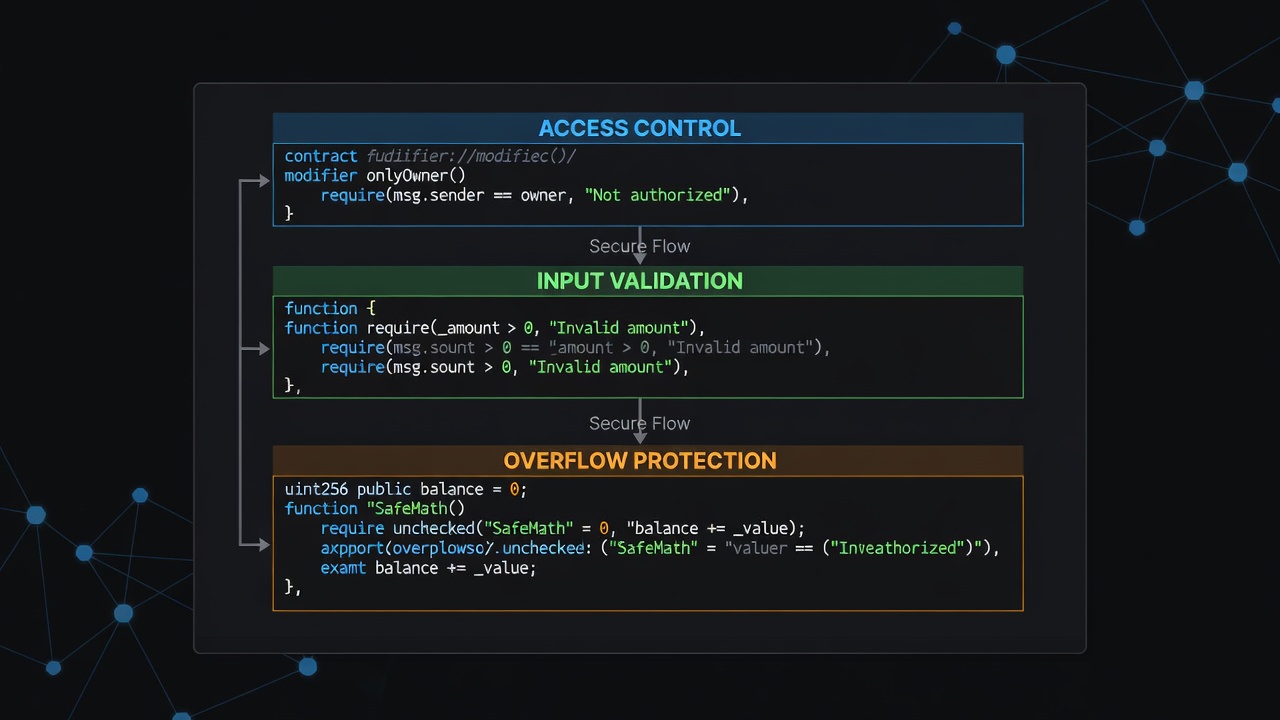
We will create a secure token vault contract that allows only the owner to withdraw funds and validates all inputs. The example demonstrates real-world patterns used in production contracts.
pragma solidity ^0.8.20;

import "@openzeppelin/contracts/access/Ownable.sol";
import "@openzeppelin/contracts/utils/math/SafeMath.sol";

contract SecureVault is Ownable {
    using SafeMath for uint256;

    mapping(address => uint256) private balances;

    event Deposit(address indexed user, uint256 amount);
    event Withdrawal(address indexed user, uint256 amount);

    function deposit() external payable {
        require(msg.value > 0, "Deposit must be greater than zero");
        balances[msg.sender] = balances[msg.sender].add(msg.value);
        emit Deposit(msg.sender, msg.value);
    }

    function withdraw(uint256 amount) external onlyOwner {
        require(amount > 0, "Amount must be greater than zero");
        require(balances[msg.sender] >= amount, "Insufficient balance");
        balances[msg.sender] = balances[msg.sender].sub(amount);
        payable(msg.sender).transfer(amount);
        emit Withdrawal(msg.sender, amount);
    }

    function getBalance() external view returns (uint256) {
        return balances[msg.sender];
    }
}
Implementing Access Controls and Input Validation
The contract uses Ownable from OpenZeppelin for owner-only functions. The require statements perform input validation to reject invalid transactions immediately. SafeMath (now built into Solidity 0.8+) prevents overflow automatically, though explicit use still improves readability. Events allow off-chain applications to track deposits and withdrawals efficiently. Consider adding a pause mechanism or role-based access for more advanced use cases later.
Testing for Common Issues Like Overflow
Write unit tests with Hardhat and Chai. Test edge cases such as zero deposits, unauthorized withdrawals, and maximum uint256 values. Comprehensive tests catch issues before deployment.
const { expect } = require("chai");

describe("SecureVault", function () {
    let vault, owner, addr1;
    beforeEach(async function () {
        const Vault = await ethers.getContractFactory("SecureVault");
        vault = await Vault.deploy();
        [owner, addr1] = await ethers.getSigners();
    });
    it("Should prevent unauthorized withdrawal", async function () {
        await expect(vault.connect(addr1).withdraw(100)).to.be.revertedWith("Ownable: caller is not the owner");
    });
    it("Should handle zero deposit correctly", async function () {
        await expect(vault.connect(addr1).deposit({value: 0})).to.be.revertedWith("Deposit must be greater than zero");
    });
});
Run tests with npx hardhat test. Check the Ethereum developer resources for additional testing patterns and gas optimization tips. Fuzz testing tools and static analyzers like Slither can further strengthen your workflow.
Deploying to a Testnet
Configure Hardhat with a Sepolia RPC URL and your private key in a .env file. Deploy using a script and verify the contract on Etherscan. Always test on testnets before mainnet deployment to confirm behavior under real network conditions. Monitor gas usage and transaction success rates during this phase.
Additional Best Practices and Common Mistakes to Avoid
- Never hardcode private keys or sensitive data in source code.
- Use the latest stable compiler and audited libraries only.
- Implement events for every state-changing function to aid debugging.
- Limit contract complexity; break large contracts into smaller, focused modules.
- Document assumptions and expected behaviors with NatSpec comments.
Avoid rushing to mainnet; spend extra time on local simulation and peer reviews.
FAQ: Common Beginner Pitfalls
- How do I handle compiler warnings? Treat them as errors and refactor code immediately to maintain high standards.
- What is the safest way to transfer Ether? Use
callwith checks instead oftransferin modern contracts to prevent reentrancy risks. - Should I use floating-point numbers? No, Solidity uses integers only; handle decimals manually with scaling factors.
- How often should I audit my code? Even simple contracts benefit from peer review before going live on any network.
- Can I upgrade a deployed contract? Use proxy patterns like those from OpenZeppelin if upgradeability is required from the start.
Conclusion
This beginner Solidity tutorial equips you with the foundation to write secure smart contracts in 2026. Start with the environment setup, practice the provided example, and always validate inputs while restricting access appropriately. Continue learning through official documentation and community resources to advance your skills safely. Consistent practice with security-first development will prepare you for more advanced topics in the future.

No comments yet. Be the first!