 CryptoChain Blog
Introduction
Generating secure randomness on-chain remains one of the most challenging problems in Solidity smart contract development. Predictable or manipulable random values can compromise lotteries, games, and fair selection systems. Commit-reveal schemes offer a robust solution that balances security and practicality while aligning with 2026 standards for decentralized applications. This approach separates the act of committing to a value from revealing it, creating a window where manipulation becomes computationally infeasible for attackers. By requiring participants to first lock in a hashed secret before disclosing the original value, the protocol ensures that no single party can predict or alter the final outcome after commitments are made.
This comprehensive guide provides developers with a complete walkthrough of commit-reveal implementations. It covers core mechanics, step-by-step code examples, edge-case handling, gas optimization strategies, and integration with modern access control patterns. Whether you are building a decentralized lottery, NFT minting raffle, or on-chain game, understanding these techniques is essential for maintaining trust and fairness in your protocol. The article also addresses real-world deployment considerations and provides actionable advice drawn from established security practices.
The Challenge of On-Chain Randomness
Blockchain environments lack true entropy sources because every transaction and state change must be deterministic and verifiable by all nodes. Common shortcuts such as using block hashes, timestamps, or miner-controlled values leave contracts vulnerable to manipulation. Attackers can influence outcomes through transaction ordering, by observing pending transactions in the mempool, or by controlling block production in certain consensus environments. These risks have been well documented in numerous smart contract audits and continue to affect projects that rely on weak randomness sources. In 2026, with increasing sophistication of MEV bots and validator centralization concerns, relying on block properties alone is no longer acceptable for high-value applications.
Commit-reveal addresses this fundamental limitation by separating the commitment to a random value from its revelation. Participants first submit cryptographic commitments, then later disclose the underlying secrets. The final random result is derived only after all reveals are complete, preventing prediction and ensuring fairness across all participants. This method has become a standard recommendation in secure smart contract design patterns.
Understanding Commit-Reveal Schemes
In a commit-reveal protocol, participants first submit a hash of their secret value combined with a unique salt during the commit phase. The contract stores these commitments along with participant addresses and strict deadlines. During the reveal phase, users submit the original secret and salt. The contract verifies that the hash matches the stored commitment before accepting the value. The final random seed is typically computed by combining or XORing all verified revealed values, or by feeding them into a deterministic function such as keccak256. This two-phase structure thwarts frontrunning because an attacker cannot know the secret values until the reveal window opens. By the time reveals occur, it is too late to influence the outcome without already having committed earlier. The scheme also provides transparency because every commitment and reveal is recorded on-chain and can be independently verified by anyone.
Implementing the Commit Phase
The commit phase requires careful design to prevent duplicate or invalid submissions. Users submit a keccak256 hash of their secret combined with a salt. Contracts should store commitments in a mapping, track timestamps, and enforce participation windows. Adding a small deposit can further discourage spam and non-revealing behavior. Consider implementing an array to track all participants so that the reveal phase can iterate efficiently when calculating the final result.
function commit(bytes32 _commitment) external payable {
    require(commitments[msg.sender] == bytes32(0), "Already committed");
    require(msg.value >= 0.01 ether, "Minimum deposit required");
    commitments[msg.sender] = _commitment;
    commitTimestamp[msg.sender] = block.timestamp;
    participants.push(msg.sender);
}
Developers should also implement a mechanism to return deposits only after successful reveals, creating economic incentives for honest participation. Additional checks can include verifying that the commit occurs within a defined time window to prevent late entries that could skew participation numbers.
Implementing the Reveal Phase
During the reveal phase, users submit their original secret and salt. The contract verifies the hash matches the stored commitment and records the revealed value. Time constraints must be enforced to prevent late reveals from skewing results. 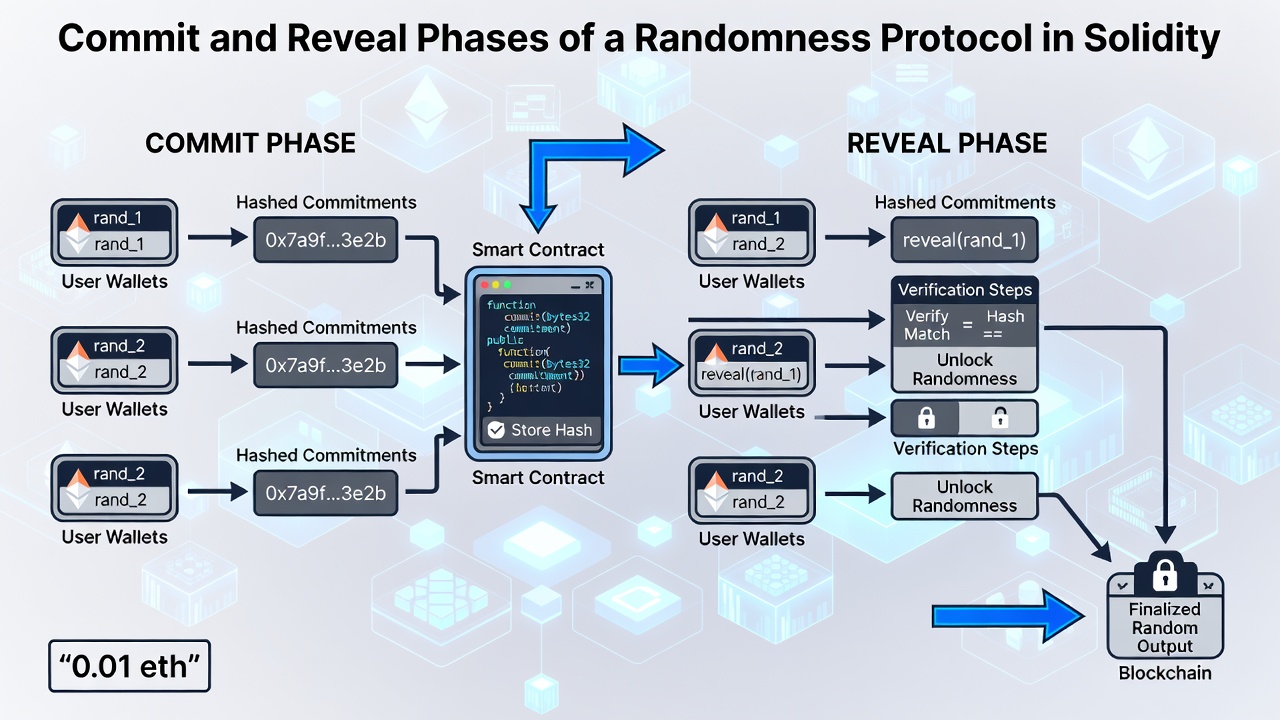
function reveal(uint256 _secret, bytes32 _salt) external {
    require(block.timestamp >= revealStart && block.timestamp <= revealEnd, "Reveal window closed");
    bytes32 commitment = keccak256(abi.encodePacked(_secret, _salt));
    require(commitments[msg.sender] == commitment, "Invalid reveal");
    revealedValues.push(_secret);
    delete commitments[msg.sender];
    payable(msg.sender).transfer(depositAmount);
}
After all reveals are collected, a separate function calculates the final random result using the aggregated values. It is critical to ensure that the reveal function cannot be called multiple times by the same address and that the contract handles cases where some participants never reveal their secrets.
Complete Working Example
A production-ready lottery contract combines both phases with reveal deadlines, winner selection logic based on XOR aggregation, and emergency pause capabilities. The contract should inherit from OpenZeppelin’s Pausable and AccessControl contracts to enable secure administrative functions. Developers are encouraged to add events for every state change so that off-chain indexers can track the process transparently. Additional features might include a mapping to store revealed secrets for post-mortem analysis and a mechanism to handle refunds if the protocol is paused.
Preventing Frontrunning and Edge Cases
Common attacks include observing reveals in the mempool and submitting last-minute commitments, or failing to reveal in order to manipulate the final seed. Effective mitigations include enforcing a minimum delay between commit and reveal deadlines, using commit-reveal windows that close before result calculation begins, implementing commit deposits that are slashed for participants who fail to reveal, adding role-based access control so only authorized addresses can trigger the final random generation, and allowing anyone to call the finalization function once the reveal window expires. Always test for reentrancy vulnerabilities and ensure revealed values cannot be influenced after the reveal window closes. Consider using a commit-reveal window of at least 24 hours to give participants sufficient time while limiting exposure to network congestion.
Gas Efficiency Considerations
Commit-reveal adds storage writes and hashing overhead compared with simpler but insecure methods. Developers can optimize by batching multiple reveals in a single transaction when possible, using efficient data structures such as dynamic arrays only when necessary, and minimizing state changes after the reveal phase. Qualitative comparisons show that pure on-chain randomness often fails security audits, while commit-reveal provides verifiable fairness at acceptable computational cost for most applications. Monitoring gas usage during test deployments helps identify bottlenecks before mainnet launch.
For authoritative guidance on Solidity patterns and security, refer to the official Solidity documentation and the OpenZeppelin Contracts library.
Integrating with Access Controls
Modern implementations should combine commit-reveal logic with role-based permissions. Using OpenZeppelin AccessControl, you can restrict functions such as finalizing the random result or withdrawing protocol fees to specific roles. This layered security model prevents unauthorized parties from interfering with the randomness generation process and allows for granular control over administrative actions.
Security Best Practices Aligned with 2026 Standards
Always conduct formal verification where feasible and follow audited templates from reputable libraries. Regularly update dependencies to address emerging vulnerabilities in the Ethereum ecosystem. Consider hybrid approaches that combine commit-reveal with external verifiable random functions when additional entropy is required. Document all assumptions about participant behavior and clearly define what happens when participants fail to reveal their secrets. Conducting multiple rounds of peer review and using tools like Slither for static analysis further strengthens the contract.
Testing and Auditing Recommendations
Thorough testing should cover happy paths, edge cases such as zero participants, and adversarial scenarios including frontrunning attempts. Use tools like Foundry or Hardhat to simulate multiple users committing and revealing under different timing conditions. Professional audits remain essential before mainnet deployment, especially for contracts managing significant value. Include fuzz testing to explore unexpected input combinations that could break the protocol logic.
Troubleshooting FAQ
Q: What happens if a participant fails to reveal? A: The contract can either exclude their value or apply a penalty mechanism defined at deployment time, such as forfeiting the deposit.
Q: How do I handle multiple participants efficiently? A: Store commitments in a mapping and aggregate reveals in an array before computing the final random seed using iterative XOR operations.
Q: Can this be used alongside VRF oracles? A: Yes, hybrid approaches combine commit-reveal with external oracles for additional entropy when needed, providing defense in depth.
Q: What is the recommended reveal window duration? A: Most production contracts use a 12- to 48-hour reveal window to balance user convenience with security against long-term attacks.
Q: How should deposits be managed? A: Deposits should be held in the contract until successful reveal or slashed according to predefined rules to maintain economic security.
Conclusion
Commit-reveal schemes remain a cornerstone technique for achieving secure randomness in Solidity contracts. By following the implementation steps outlined above, addressing frontrunning risks proactively, and applying modern security practices, developers can build trustworthy lotteries, games, and selection systems that users can rely on in 2026 and beyond.


No comments yet. Be the first!