 CryptoChain Blog
Introduction to Solidity and Vyper in 2026
As Ethereum and layer-2 ecosystems mature, developers face a critical choice between Solidity and Vyper when building secure smart contracts. Both languages compile to EVM bytecode yet offer distinct approaches to safety and developer experience. This 2026 comparison examines syntax safety, built-in protections, gas efficiency, and real-world usage to help teams select the right tool. Security remains the paramount concern because smart contract exploits continue to result in significant financial losses across decentralized finance and infrastructure protocols. Understanding the trade-offs between these two languages enables teams to design contracts that resist common attack vectors while maintaining acceptable performance and maintainability.
History and Current Adoption Trends
Solidity has dominated smart contract development since its introduction alongside Ethereum, powering the majority of decentralized applications and token standards. Vyper emerged later as a response to security incidents that highlighted the risks of overly permissive language features. By 2026, adoption data from major block explorers indicates Solidity still accounts for roughly 85 percent of deployed contracts, while Vyper has gained traction in high-security niches such as custodial bridges and institutional DeFi products. Both languages benefit from active community maintenance and regular compiler updates that address emerging threats on Ethereum mainnet and layer-2 rollups.
Syntax Safety and Readability Differences
Solidity uses a syntax reminiscent of JavaScript and C++, enabling rapid development but introducing risks from complex inheritance and implicit type conversions. Developers must manually enforce many safety checks, which increases the chance of oversight during audits. Vyper prioritizes Python-like simplicity with strict syntax rules that eliminate many common pitfalls such as reentrancy vectors through restricted state mutability and the deliberate removal of features like modifiers and inheritance. This design philosophy forces clearer code structure, making audits faster and reducing cognitive load for reviewers. In practice, teams report that Vyper contracts often require fewer lines of code to achieve equivalent functionality while exposing fewer edge cases that auditors must verify.
Built-in Protections Against Common Vulnerabilities
Vyper prevents several classic exploits by design: it forbids recursive calls by default and restricts external calls within payable functions. Solidity counters these risks through libraries such as OpenZeppelin Contracts, which provide battle-tested patterns for access control and pausability. Both languages now incorporate checked arithmetic to prevent integer overflows, yet Vyper enforces this protection without allowing developers to disable it. Additional protections in Vyper include the elimination of function overloading and the prohibition of inline assembly in most contexts, which removes entire classes of low-level vulnerabilities. Solidity developers mitigate similar risks by adopting strict coding standards and integrating automated tools during continuous integration pipelines. Real-world audits in 2026 frequently highlight that Vyper contracts surface fewer reentrancy and access-control issues compared with equivalent Solidity implementations.
- Integer overflows: Both languages now rely on built-in checked arithmetic, but Vyper enforces it at the compiler level without opt-out.
- Reentrancy: Vyper’s call restrictions make exploits harder; Solidity requires explicit checks-effects-interactions ordering.
- Delegatecall risks: Vyper limits low-level calls, reducing exposure compared with Solidity’s flexibility.
- Access control: Solidity offers flexible role-based systems; Vyper favors explicit, readable permission checks.
Gas Efficiency Benchmarks (2026)
Recent benchmarks on Ethereum mainnet as of June 2026 show Vyper contracts consuming 8-15 percent less gas for simple token transfers due to optimized bytecode generation. Complex DeFi logic, however, often favors Solidity when leveraging pre-audited libraries that reduce overall deployment costs. Rollup environments such as Arbitrum and Optimism exhibit similar patterns, although the absolute gas savings vary with calldata pricing. Developers should profile specific functions rather than relying on general benchmarks, because storage operations and external calls dominate gas consumption regardless of language choice.
Real-World Code Examples: Basic ERC-20 Token
Below is a minimal ERC-20 implementation in both languages, illustrating the readability contrast.
Solidity Version
pragma solidity ^0.8.26;
contract SimpleToken {
    mapping(address => uint256) public balanceOf;
    function transfer(address to, uint256 amount) external returns (bool) {
        require(balanceOf[msg.sender] >= amount);
        balanceOf[msg.sender] -= amount;
        balanceOf[to] += amount;
        return true;
    }
}
Vyper Version
# @version ^0.4.0
balanceOf: public(HashMap[address, uint256])
@external
def transfer(to: address, amount: uint256) -> bool:
    assert self.balanceOf[msg.sender] >= amount
    self.balanceOf[msg.sender] -= amount
    self.balanceOf[to] += amount
    return True
The Vyper version is noticeably shorter and removes any possibility of accidental state mutation outside the intended logic. 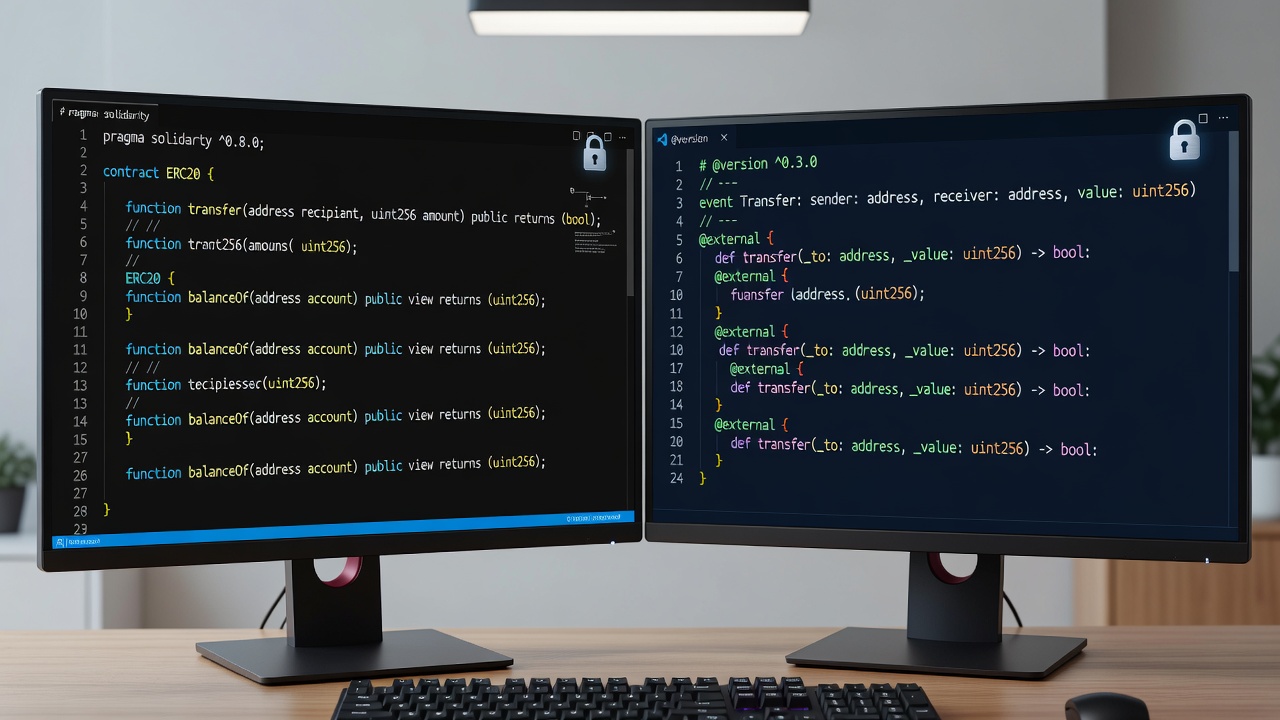
Step-by-Step Migration Considerations
- Audit existing Solidity contracts for Vyper-incompatible patterns such as complex inheritance and inline assembly.
- Rewrite storage layouts manually since Vyper uses different slot calculation rules that can break upgradeable proxies.
- Refactor events and error handling to match Vyper’s stricter syntax while preserving on-chain event signatures for indexers.
- Test gas costs on a local fork before mainnet deployment, paying special attention to storage refunds and calldata efficiency.
- Update frontend ABIs and event listeners to match new signatures and ensure off-chain monitoring tools remain compatible.
- Engage auditors familiar with both languages for final review, allowing extra time for cross-language verification of business logic.
Common Pitfalls and Mistakes to Avoid
Many teams underestimate the learning curve when switching languages mid-project. Attempting direct line-by-line translation without rethinking architecture often introduces new vulnerabilities. Another frequent error is neglecting to update deployment scripts and verification tools, resulting in contracts that cannot be verified on block explorers. Developers should also avoid mixing low-level assembly patterns from Solidity into Vyper codebases, as the languages enforce fundamentally different safety guarantees.
Integration with Modern Tools and Auditing Workflows
Both languages integrate seamlessly with Foundry, Hardhat, and ApeWorx frameworks. Vyper benefits from native support in Vyper documentation and Mythril static analysis. Solidity developers rely on Solidity official resources and Slither for automated vulnerability scanning. Ethereum’s smart contract documentation provides cross-language guidance on security patterns. Modern CI/CD pipelines now include language-specific linters and formal verification plugins that catch issues before they reach testnet.
Decision Framework
Choose Vyper when maximum auditability and minimal attack surface matter most, such as in high-value custody contracts or regulated financial products. Opt for Solidity when rapid iteration, rich library ecosystems, or complex protocol logic are required. Teams often prototype in Solidity then port critical modules to Vyper for final deployment. Hybrid approaches using proxy patterns allow organizations to combine the strengths of both languages within a single application.
Conclusion
The choice between Solidity and Vyper ultimately depends on project priorities, team expertise, and risk tolerance. Both languages continue to evolve with improved tooling and security features in 2026, making either a viable option when paired with rigorous auditing and testing practices.
FAQ
Is Vyper harder to learn than Solidity for beginners?
Vyper’s Python-like syntax lowers the initial barrier for many developers, though Solidity’s larger community offers more tutorials and tooling support. Most teams find they can become productive in either language within a few weeks when following structured learning paths.
Does the ecosystem fully support Vyper in 2026?
Yes. Major frameworks, block explorers, and auditors now provide first-class Vyper tooling alongside Solidity, including dedicated plugins for popular IDEs and automated verification services.
Can I use both languages in the same project?
Proxy patterns allow hybrid deployments where Solidity handles user interfaces and Vyper secures core logic, enabling teams to balance development speed with maximum security guarantees.
What resources exist for comparing gas costs across both languages?
Developers can use public benchmarking repositories and local fork testing with tools such as Foundry to generate accurate, project-specific gas reports before committing to a language choice.


No comments yet. Be the first!