 CryptoChain Blog

Introduction to Solidity Smart Contract Testing in 2026
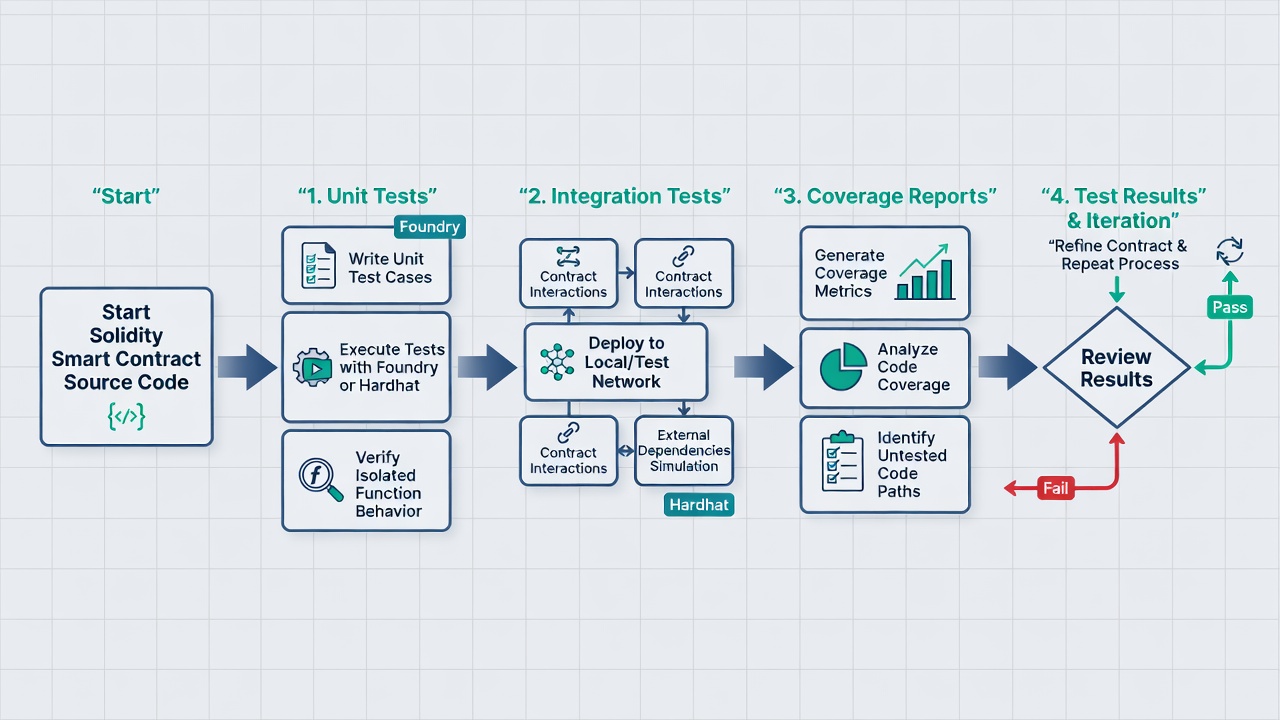
Building reliable Solidity smart contracts requires rigorous testing before mainnet deployment. In 2026, developers must adopt layered testing strategies that include unit tests, integration tests, and end-to-end simulations to catch vulnerabilities early. This guide provides actionable workflows using current frameworks to enhance contract security and robustness. With the growing complexity of decentralized applications, inadequate testing can lead to exploits costing millions in lost funds. Developers targeting search intent for practical tutorials will find step-by-step guidance here on setting up environments, writing tests, analyzing coverage, and avoiding common mistakes.
Setting Up Test Environments with Popular Frameworks
Choosing the right framework is foundational. Hardhat remains a top choice for its JavaScript/TypeScript integration and plugin ecosystem, allowing seamless debugging and deployment scripts. Foundry offers blazing-fast Rust-based testing ideal for complex interactions and property-based testing. Begin by installing Node.js and running npx hardhat or curl -L https://foundry.paradigm.xyz | bash followed by foundryup. Configure your project with hardhat.config.js to include networks like localhost and testnets such as Sepolia. For Foundry, use forge init to scaffold a project with built-in testing capabilities and gas reporting features. Always verify Solidity compiler versions match your contracts to avoid discrepancies during compilation. Advanced setups may incorporate plugins like hardhat-gas-reporter for monitoring transaction costs during tests. Compare the two: Hardhat excels in ecosystem flexibility while Foundry provides superior speed for large test suites. Refer to detailed setup guides for 2026 environments.
Hardhat documentation provides detailed setup guides for 2026 environments.
Writing Effective Unit Tests with Real Code Examples
Unit tests isolate individual functions and modifiers. Using Hardhat with Chai and Ethers.js, a sample test for a token transfer might look like this expanded example that checks multiple scenarios including approvals and events:
const { expect } = require("chai");
describe("Token", function () {
  let token, owner, addr1;
  beforeEach(async function () {
    const Token = await ethers.getContractFactory("Token");
    token = await Token.deploy();
    [owner, addr1] = await ethers.getSigners();
  });
  it("Should transfer tokens correctly", async function () {
    await token.transfer(addr1.address, 100);
    expect(await token.balanceOf(addr1.address)).to.equal(100);
    await expect(token.transfer(addr1.address, 0)).to.emit(token, "Transfer");
  });
  it("Should fail on insufficient balance", async function () {
    await expect(token.connect(addr1).transfer(owner.address, 1000)).to.be.reverted;
  });
});
Foundry uses Solidity test files for native speed. Write assertions directly in contracts inheriting from Test. Test edge cases such as zero-value transfers, unauthorized calls, and integer overflows to prevent reentrancy issues. Include fuzz testing with vm.assume to cover random inputs efficiently.
Integration and End-to-End Testing Workflows
Integration tests verify multiple contracts interact correctly, such as a token contract with a staking module. Deploy a suite of contracts and simulate scenarios like DEX swaps or lending protocols. Use Hardhat's mainnet forking for realistic state or Foundry's cheatcodes to manipulate block timestamps, balances, and prank callers. End-to-end testing involves full user flows on local networks or testnets. Tools like Tenderly or custom scripts automate these. Focus on complex interactions such as multi-signature approvals or oracle price feeds. A practical workflow includes forking Ethereum mainnet at a recent block, deploying upgraded proxies, and asserting state changes across contracts. This catches issues like storage layout mismatches that unit tests miss.
Comparing Tools for Coverage Analysis
Code coverage identifies untested paths. Hardhat with solidity-coverage plugin generates reports showing branch and statement coverage percentages. Foundry includes native forge coverage that outputs LCOV format for visualization in tools like Istanbul or VS Code extensions. Compare results across frameworks: Foundry often achieves higher coverage faster due to its execution model and lower overhead. Aim for at least 95% coverage on critical paths. Review uncovered lines and add targeted tests for modifiers, error conditions, and fallback functions. Integrate coverage into CI pipelines to enforce thresholds before merges.
Common Pitfalls to Avoid
- Skipping fuzz testing for input validation, which leaves contracts vulnerable to unexpected data.
- Ignoring gas optimization in test scenarios, leading to high deployment costs on mainnet.
- Failing to simulate upgradeable contract storage collisions during proxy upgrades.
- Over-relying on mock contracts without real-world state replication using forks.
- Neglecting event emission checks that auditors rely on for verification.
Always run tests in isolated environments and review recent security reports from Ethereum.org to stay updated on emerging threats.
Practical Step-by-Step Guide for Complex Contracts
- Write unit tests for every public and external function with positive and negative cases.
- Implement integration tests for contract dependencies and cross-contract calls.
- Run coverage analysis and address gaps with additional test cases.
- Perform property-based testing with Foundry's fuzzing capabilities.
- Simulate mainnet conditions using forks and time manipulation.
- Document all test cases for audit readiness and team collaboration.
- Incorporate continuous integration to run full suites on every pull request.
FAQ: Addressing Edge Cases in Contract Interactions
How do I test reentrancy in 2026 frameworks? Use Foundry's vm.expectRevert combined with external call simulations or Hardhat's impersonation features.
What coverage threshold is recommended? Target 90%+ on non-trivial logic while focusing on 100% for access control and critical financial functions.
Can tests run against live testnets efficiently? Yes, via Hardhat's network configuration with automated deployment scripts and gas estimation.
How to handle oracle dependencies? Mock oracles with Foundry cheatcodes for deterministic outcomes and test failure modes.
What about testing cross-chain interactions? Use layer-zero mocks or simulated bridges within your test environment.
Refer to Foundry Book and Solidity documentation for advanced techniques and best practices.
Conclusion
Adopting these best practices ensures your Solidity contracts are resilient against exploits in 2026. Layered testing with modern tools like Hardhat and Foundry, combined with thorough coverage analysis, prepares contracts for secure deployment. Start implementing these workflows today to build more trustworthy decentralized applications and reduce risks associated with mainnet launches.


No comments yet. Be the first!