 CryptoChain Blog

Introduction
Deploying Solidity smart contracts in 2026 demands a thorough understanding of security principles to safeguard against increasingly sophisticated threats in decentralized applications. Developers must prioritize contract security to prevent exploits that could drain funds or compromise entire protocols. This detailed pre-deployment checklist equips Solidity developers with step-by-step verification processes across access control, reentrancy prevention, input validation, and gas-efficient coding patterns. Integrating essential keywords such as smart contracts and contract security, the guide emphasizes turning smart contract tutorials into reliable production code that withstands real-world scrutiny.
The blockchain landscape continues to evolve rapidly, with new attack vectors emerging each year. Historical incidents have shown that even minor oversights in smart contract logic can lead to catastrophic losses. Therefore, a structured approach combining manual reviews, automated scans, and best practices is essential. This article delves into practical elements including code examples, tool recommendations, comparisons of review methods, common pitfalls, and a downloadable checklist template to support comprehensive preparation.
Access Control Best Practices
Access control forms the foundation of secure smart contracts by restricting who can execute privileged functions. In 2026, developers should leverage established libraries like OpenZeppelin's AccessControl to implement role-based permissions rather than relying on simple owner variables. This approach allows granular control over roles such as admin, minter, or pauser, reducing the risk of single-point failures.
Start by auditing all functions that modify state or transfer value. Ensure modifiers like onlyOwner or hasRole are applied consistently. A frequent pitfall involves failing to revoke roles after contract upgrades or leaving default admin privileges intact. To mitigate this, always initialize roles in the constructor and include functions for role revocation with proper event emissions for transparency.
Consider this example of a secure access-controlled mint function:
function mint(address to, uint256 amount) external onlyRole(MINTER_ROLE) {
  _mint(to, amount);
  emit Mint(to, amount);
}
Test these controls across multiple accounts and simulate role escalation attempts. Integrating multi-signature wallets for critical operations further strengthens security.
Reentrancy Prevention Techniques
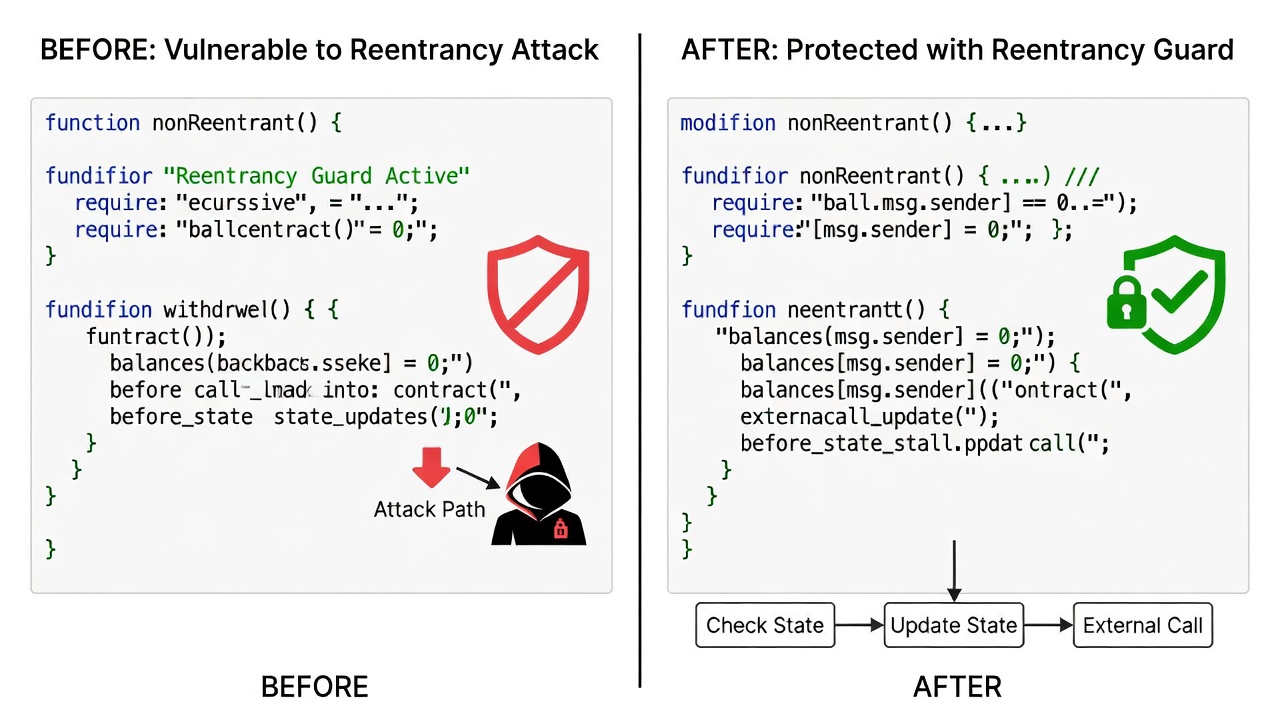
Reentrancy remains one of the most notorious vulnerabilities in Solidity development. Attackers exploit external calls to recursively invoke functions before state updates complete. Prevention starts with adopting the checks-effects-interactions pattern and incorporating reentrancy guards from trusted libraries.
Implement nonReentrant modifiers on all functions involving external calls. Additionally, limit the amount of Ether or tokens transferred in a single transaction to reduce attack surfaces. Developers should also consider using pull-over-push payment patterns where recipients initiate withdrawals.
Here is an expanded secure withdrawal implementation:
function withdraw(uint256 amount) external nonReentrant {
  require(balances[msg.sender] >= amount, "Insufficient balance");
  balances[msg.sender] -= amount;
  emit Withdrawal(msg.sender, amount);
  (bool success, ) = msg.sender.call{value: amount}("");
  require(success, "Transfer failed");
}
Always conduct targeted testing with malicious contract simulations to verify guards function correctly under recursive calls. Resources from Solidity documentation provide foundational patterns for these defenses.
Input Validation and Data Sanitization
Robust input validation prevents malformed data from causing unexpected behavior or state corruption. With Solidity 0.8 and later versions offering built-in overflow protection, developers must still explicitly check parameters for validity. Validate addresses against zero values, ensure numeric inputs fall within acceptable bounds, and sanitize arrays to avoid out-of-bounds access.
- Reject zero-address inputs for recipient fields
- Enforce minimum and maximum values on amounts and timestamps
- Verify array lengths before iteration to prevent gas exhaustion
- Use require statements with descriptive error messages
Incorporate custom error types introduced in recent Solidity versions for gas efficiency while maintaining clarity during debugging.
Gas-Efficient Security Patterns
Balancing security with gas optimization is crucial for user-friendly contracts. Excessive storage operations increase costs and potential attack windows. Prefer memory variables over storage where possible and emit events instead of storing historical data on-chain. Batch operations and use assembly sparingly for critical paths only after thorough auditing.
Automated Scanning Tools and Recommendations
Automated tools accelerate vulnerability detection. Slither excels at static analysis for common issues like uninitialized storage. Mythril performs symbolic execution to uncover complex logic flaws, while Echidna enables property-based fuzzing. Run these sequentially on compiled artifacts and integrate them into CI/CD pipelines for continuous checks. Combine results with manual interpretation for highest accuracy.
Manual vs Automated Review Comparison
Automated scans provide speed and repeatability, catching syntax-level and known pattern issues efficiently. However, they often overlook nuanced business logic errors or novel attack combinations. Manual reviews by seasoned auditors offer contextual depth and creative threat modeling. The optimal strategy involves automated tools first to filter obvious problems, followed by targeted manual audits. This hybrid method maximizes coverage while controlling review time.
Step-by-Step Verification Process
Follow this expanded checklist: 1. Map all external call sites. 2. Verify access modifiers on every state-changing function. 3. Run full test suites with 100% branch coverage. 4. Execute static and dynamic analysis tools. 5. Simulate edge cases including reentrancy and integer edge values. 6. Document findings and apply fixes iteratively. 7. Engage external auditors for final validation.
Common Pitfalls with Real Code Examples
Beyond reentrancy, watch for unhandled exceptions in low-level calls and timestamp dependencies vulnerable to miner manipulation. For instance, using block.timestamp for critical decisions without sufficient tolerance can enable front-running. Always prefer block numbers or oracles for time-sensitive logic when feasible.
Downloadable Checklist Template and FAQs
A practical template should include sections for each security domain with checkboxes and space for notes. FAQs address frequent oversights such as dependency updates, oracle reliability, and upgradeability risks. Regular library reviews from sources like OpenZeppelin help maintain currency against emerging threats.
Case Snippets Demonstrating Fixes
In one case, an unprotected fallback function allowed arbitrary calls; the fix added strict payable checks and logging. Another example involved missing input sanitization on array parameters, resolved by adding length validations and custom errors.
Conclusion
This Solidity smart contract security checklist provides developers with the depth needed for secure 2026 deployments. By integrating these practices with guidance from Ethereum security resources and Consensys best practices, teams can confidently launch resilient smart contracts that protect user assets and protocol integrity.


No comments yet. Be the first!