 CryptoChain Blog

Introduction to DoS Risks in Modern Solidity Development
Denial of Service (DoS) attacks remain a critical threat to Solidity smart contracts in 2026, especially as decentralized applications scale on Ethereum and layer-2 networks. Unlike traditional reentrancy exploits, DoS vulnerabilities often stem from gas griefing, unbounded operations, and external call failures that can freeze contract functionality indefinitely. Developers must move beyond basic patterns to implement robust defenses that maintain contract availability under adversarial conditions. In 2026, with increasing adoption of complex DeFi protocols and NFT marketplaces, attackers have refined techniques to exploit gas limits and array manipulations, leading to contracts that become unusable for legitimate users. This guide examines specific DoS vectors in depth, provides vulnerable versus secure code comparisons, and demonstrates integration with Foundry for automated testing. By the end, you will have actionable strategies tailored for 2026 deployments that go far beyond surface-level fixes.
Smart contract security has evolved significantly since the early days of Ethereum. While reentrancy and access control issues receive substantial attention, DoS through resource exhaustion continues to surface in audits. Understanding the underlying Ethereum Virtual Machine (EVM) constraints, such as block gas limits and transaction costs, is essential for writing resilient code. Contracts that process user-supplied data without safeguards can be rendered inoperable, resulting in locked funds or stalled business logic that affects thousands of users.
Understanding Gas Griefing and Unbounded Operations
Gas griefing occurs when an attacker forces a transaction to consume excessive gas, causing legitimate calls to fail. Unbounded loops or arrays exacerbate this by allowing input data to grow without limits. These issues frequently appear in reward distribution, batch processing, and access control mechanisms. Attackers may submit specially crafted transactions that force the contract to iterate over enormous datasets, pushing gas usage beyond what a standard block can accommodate.
Vulnerable Pattern: Unbounded Loop in Reward Distribution
function distributeRewards(address[] calldata users) external onlyOwner {
    for (uint i = 0; i < users.length; i++) {
        balances[users[i]] += rewards[users[i]];
    }
}
This implementation allows an attacker to pass an extremely long array, exhausting the block gas limit and rendering the function unusable. In practice, this pattern has appeared in staking contracts and airdrop mechanisms where batch operations were intended for efficiency but became a single point of failure.
Secure Implementation with Bounded Processing
function distributeRewards(address[] calldata users) external onlyOwner {
    uint256 length = users.length;
    require(length <= 100, "Batch size too large");
    for (uint i = 0; i < length; i++) {
        balances[users[i]] += rewards[users[i]];
    }
}
Adding an explicit cap prevents griefing while preserving functionality for normal use cases. Developers should also consider implementing pagination for very large distributions to handle thousands of recipients across multiple transactions.
Additional Vulnerable Pattern: External Call Griefing
Another common vector involves external calls that can be made to fail repeatedly. Consider a contract that iterates over a list of recipients and transfers tokens, without handling failures gracefully.
function batchTransfer(address[] calldata recipients) external {
    for (uint i = 0; i < recipients.length; i++) {
        token.transfer(recipients[i], amounts[i]);
    }
}
If one recipient contract reverts on transfer, the entire batch fails. Secure versions isolate failures using try-catch or separate pull mechanisms.
Step-by-Step Mitigation Techniques
Effective prevention requires a layered approach. Begin by auditing all external calls and loops for gas consumption. Next, implement pull-over-push patterns for fund transfers to avoid cascading failures. Finally, use circuit breakers that can pause critical functions without compromising user funds. Additional techniques include using storage variables sparingly during loops, pre-computing gas estimates, and designing modular contracts where risky functions are isolated.
- Identify high-gas operations during code review by profiling with tools like Foundry gas reports.
- Introduce maximum batch sizes and pagination for any user-supplied arrays.
- Replace synchronous external calls with asynchronous patterns or pull-based withdrawals.
- Implement require statements with clear error messages to fail fast on invalid inputs.
- Use low-level calls with explicit gas forwarding only when necessary and always wrap in try-catch blocks.
- Test edge cases with Foundry's fuzzing capabilities to simulate adversarial array sizes.
- Document all assumptions about maximum data sizes in NatSpec comments.
- Regularly re-audit after upgrades because new features can reintroduce unbounded operations.
Testing DoS Resilience with Foundry
Foundry provides powerful tools for simulating adversarial inputs. Developers can write fuzz tests that attempt to trigger gas griefing by supplying massive arrays or repeated failing calls. Integrating these tests into CI pipelines ensures that security regressions are caught early. Beyond basic fuzzing, developers should also run invariant tests that check contract state remains consistent even after many failed or expensive transactions.
function testFuzzDoSProtection(uint256 arraySize) public {
    vm.assume(arraySize > 100);
    address[] memory users = new address[](arraySize);
    vm.expectRevert("Batch size too large");
    contract.distributeRewards(users);
}
Running these tests regularly ensures mitigations remain effective after contract upgrades. Additional Foundry commands such as forge test --gas-report can highlight functions that consume disproportionate gas, guiding further optimization.
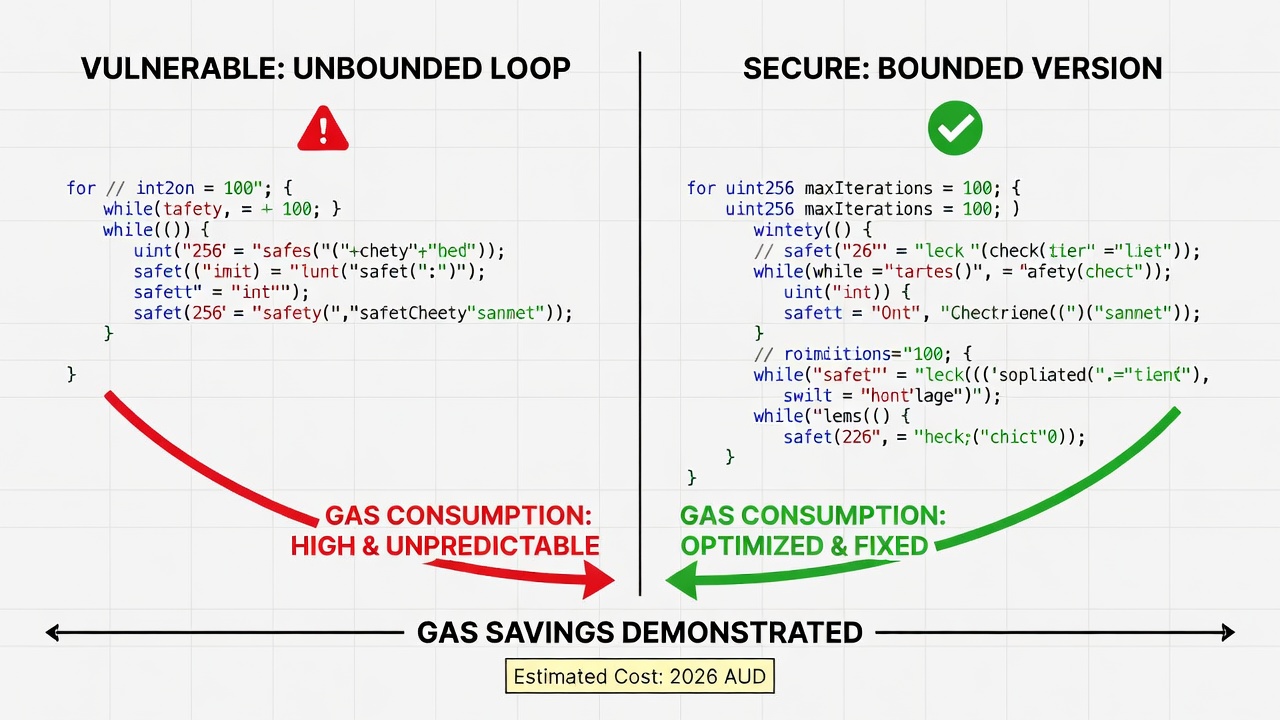
Secure vs Insecure Implementation Comparison
Side-by-side analysis reveals how small changes dramatically improve resilience. Insecure contracts often rely on unbounded data structures and synchronous external interactions. Secure versions incorporate explicit limits, pull-based withdrawals, and modular design that isolates risky operations. For example, an insecure reward distributor might iterate over an unlimited list and push tokens, while the secure counterpart caps the list and lets users claim individually. This shift reduces attack surface and improves user experience by avoiding mass transaction failures.
Audit Checklist for 2026 Deployments
- Verify all loops contain explicit iteration caps and document the rationale for each limit chosen.
- Ensure external calls use try-catch or low-level call handling with fallback logic.
- Confirm pull-over-push patterns for all token distributions to prevent griefing from failed transfers.
- Run Foundry invariant tests covering gas griefing scenarios across multiple block gas limits.
- Review access control to prevent attacker-controlled array lengths or recipient lists.
- Document circuit-breaker logic and emergency procedures with clear on-chain governance paths.
- Check for storage bloat risks in mappings that grow without bound over time.
- Validate that upgradeable proxy patterns do not introduce new unbounded operations in implementation contracts.
- Perform gas profiling on every public function using recent Ethereum mainnet conditions as of 2026-08-26.
- Include negative test cases that attempt to exceed batch limits and confirm proper reverts.
FAQs: Common Developer Pitfalls
How do I handle dynamic arrays safely?
Always enforce maximum lengths and consider splitting operations across multiple transactions when necessary. Avoid trusting user input for array sizes without validation.
Is Foundry sufficient for all DoS testing?
Foundry excels at unit and fuzz testing, but combine it with formal verification tools for high-value contracts. Supplement with manual audits for complex interactions.
What changed in 2026 regarding gas limits?
Ethereum mainnet gas limits have stabilized, yet layer-2 environments still impose stricter per-transaction constraints that require careful optimization and testing under realistic conditions.
Should I use mappings instead of arrays to avoid DoS?
Mappings can help but still require careful iteration patterns. Consider using linked lists or off-chain indexing when full enumeration is needed.
How often should I re-test after deployment?
Re-test after every upgrade or when new dependencies are added. Continuous monitoring with on-chain analytics tools is recommended for production contracts.
Conclusion
Preventing DoS attacks in Solidity demands proactive design choices rather than reactive patches. By applying bounded operations, rigorous testing with Foundry, and comprehensive audit checklists, developers can build contracts that remain available even under targeted attacks. Stay current with resources from Solidity documentation, Ethereum.org developer resources, and Foundry book to maintain security standards throughout 2026 and beyond. Implementing these practices early in the development lifecycle reduces the likelihood of costly incidents and builds user trust in decentralized applications.


No comments yet. Be the first!