 CryptoChain Blog
Introduction to Secure Lottery Smart Contracts
Creating a lottery smart contract in Solidity requires careful attention to security to prevent manipulation, ensure fairness, and protect user funds. In 2026, developers must address common vulnerabilities like reentrancy, weak randomness, and improper access controls. This tutorial provides step-by-step guidance for building a robust lottery contract using current best practices and tools available as of late 2026. The goal is a transparent system where participants can verify the process through emitted events, and winner selection relies on verifiable randomness rather than predictable on-chain logic. Lotteries on blockchain offer unique advantages such as censorship resistance and global participation, but they also introduce risks that centralized systems do not face. By following this tutorial, you will learn how to mitigate those risks while maintaining a functional and user-friendly experience.
Developers searching for smart contract tutorials often overlook the balance between functionality and robust protections. This guide emphasizes security-first design, drawing from real-world exploits seen in previous years. We will cover fund handling to avoid theft, winner selection to guarantee fairness, and transparency mechanisms that build trust. Throughout the article, practical code examples are provided, along with security checklists and testing strategies tailored to 2026 development environments.
Setting Up Your Development Environment
Begin with the latest tools available in 2026. Use Foundry for fast testing and Hardhat for flexible deployment workflows. Install Solidity 0.8.28 or newer to benefit from built-in overflow protection. Connect to testnets like Sepolia for realistic simulations before mainnet deployment. Ensure your local setup includes Node.js version 20 or higher, along with the latest versions of OpenZeppelin contracts for reusable secure components. Create a new project directory and initialize it with Foundry using the command forge init. This setup allows you to compile, test, and deploy efficiently while simulating mainnet conditions through forked networks.
Additional tools such as Slither for static analysis and Mythril for symbolic execution can help identify vulnerabilities early. Integrate these into your CI/CD pipeline to automate security checks on every code change. As of 2026, many teams also leverage Tenderly for real-time transaction simulation and debugging, which is especially useful when testing lottery prize distributions under high load.
Core Contract Structure
Start with a basic contract skeleton that manages entries, tracks participants, and handles prize pools. Emphasize separation of concerns by isolating payment logic from randomness generation. The contract should include state variables for owner address, ticket price, player list, and current round status. Use modifiers for access control and events to log critical actions. Here is an expanded example of the initial structure:
pragma solidity ^0.8.28;

import "@openzeppelin/contracts/access/Ownable.sol";
import "@openzeppelin/contracts/security/ReentrancyGuard.sol";

contract SecureLottery is Ownable, ReentrancyGuard {
    uint256 public ticketPrice = 0.01 ether;
    address[] public players;
    mapping(address => uint256) public entries;
    bool public lotteryOpen = true;

    event TicketPurchased(address indexed player, uint256 amount);
    event WinnerSelected(address indexed winner, uint256 prize);

    constructor() Ownable(msg.sender) {}
}
Secure Fund Handling
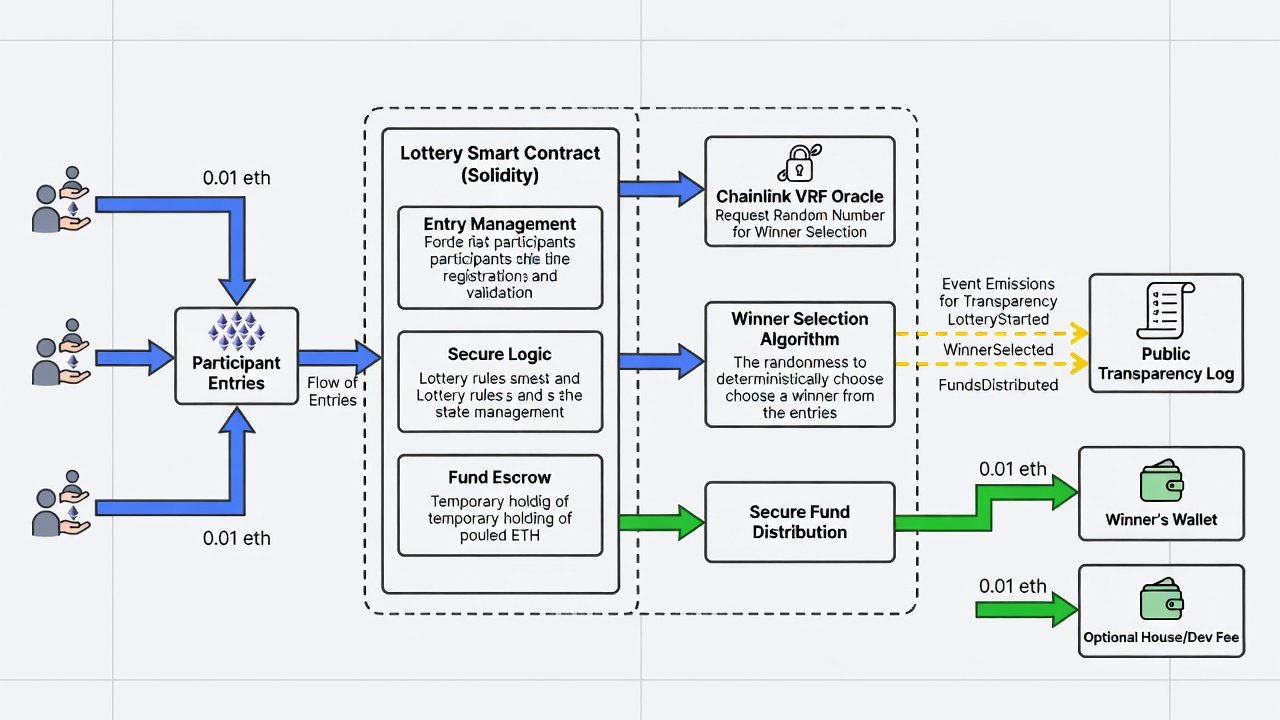
Never store large balances without strict withdrawal patterns. Use the checks-effects-interactions pattern and consider OpenZeppelin’s ReentrancyGuard. All incoming Ether should be validated, and prize distribution must occur only after winner verification. Implement a pull-over-push payment model so winners claim their prizes themselves, reducing the attack surface. For example, add a claimPrize function that checks the caller is the winner before transferring funds. This approach prevents reentrancy because the state is updated before any external call. Always emit events after state changes to maintain an immutable audit trail on the blockchain.
Winner Selection Logic
Avoid using block variables for randomness. Instead, integrate a trusted oracle such as Chainlink VRF for provably fair selection. This prevents miners or validators from influencing outcomes. Request randomness via the VRF coordinator, then fulfill the request in a callback function that selects the winner using modular arithmetic on the returned random value. Store the request ID to match requests with responses and handle edge cases such as failed oracle calls by allowing the owner to retry after a timeout period.
Transparency Through Events
Emit detailed events for every critical action: ticket purchases, winner announcements, and fund transfers. This allows external observers to audit the contract’s behavior on-chain. Events should include indexed parameters for efficient filtering in tools like Etherscan or The Graph. In addition, consider emitting the final random seed used for selection so that anyone can independently verify the winner was chosen fairly.
Security Checklist
- Use latest Solidity compiler with overflow checks
- Implement access control via Ownable or role-based permissions
- Avoid low-level calls without safeguards
- Conduct fuzz testing and formal verification where possible
- Limit external contract interactions
- Implement time locks for sensitive functions
- Use established libraries like OpenZeppelin instead of custom implementations
- Monitor gas usage to prevent denial-of-service through expensive operations
Practical Testing Strategies
Write comprehensive test suites covering edge cases such as multiple entries, failed VRF calls, and reentrancy attempts. Use Foundry’s fuzzing capabilities and simulate mainnet conditions with forked networks. Create unit tests for each function, integration tests for the full lottery flow, and invariant tests that ensure the prize pool always matches total ticket sales minus fees. Run coverage reports to identify untested branches and aim for at least 95 percent coverage. Test on testnets with real user simulations using multiple wallets to mimic concurrent ticket purchases.
Comparison of Implementation Approaches
Simple on-chain randomness is fast but insecure. Oracle-based solutions like Chainlink VRF add cost but deliver verifiable fairness. Commit-reveal schemes offer another middle ground but require more complex user interaction. When comparing costs, oracle calls typically incur a small premium paid in LINK tokens, while commit-reveal adds user friction. For high-stakes lotteries, oracle integration is strongly recommended despite the extra step. Each approach has trade-offs in security, usability, and gas efficiency that should be evaluated based on the specific use case and expected participant volume.
Deployment Risks and Audit Recommendations
Always have contracts audited by reputable firms before mainnet launch. Start with small test deployments and gradually increase stakes. Monitor for unusual activity post-deployment using on-chain analytics tools. Common deployment risks include incorrect oracle configuration, insufficient access controls, and overlooked edge cases in prize calculation. Schedule audits early in the development cycle and incorporate auditor feedback before final deployment. After launch, maintain an emergency pause function controlled by a multi-signature wallet.
FAQ
What are the main risks when deploying a lottery contract?
Primary risks include predictable randomness, reentrancy attacks, and centralized control. Mitigate these with oracles, guards, and multi-signature ownership.
Should I use Chainlink VRF in 2026?
Yes, Chainlink VRF remains the industry standard for verifiable randomness and integrates seamlessly with Solidity contracts.
How often should contracts be audited?
Audit before every major upgrade and after significant changes. Regular security reviews help maintain trust as the ecosystem evolves.
What testing frameworks are recommended for 2026?
Foundry and Hardhat continue to be the most popular choices, with Foundry excelling in speed and fuzzing while Hardhat offers excellent plugin ecosystem support.
Conclusion
Building a secure lottery contract demands rigorous attention to detail at every stage. By following the patterns outlined above and leveraging 2026 tooling, developers can create fair, transparent, and manipulation-resistant systems. For further reference, consult Solidity documentation, Ethereum security guides, and Chainlink developer resources.
No comments yet. Be the first!