 CryptoChain Blog
Introduction to Secure Voting Smart Contracts
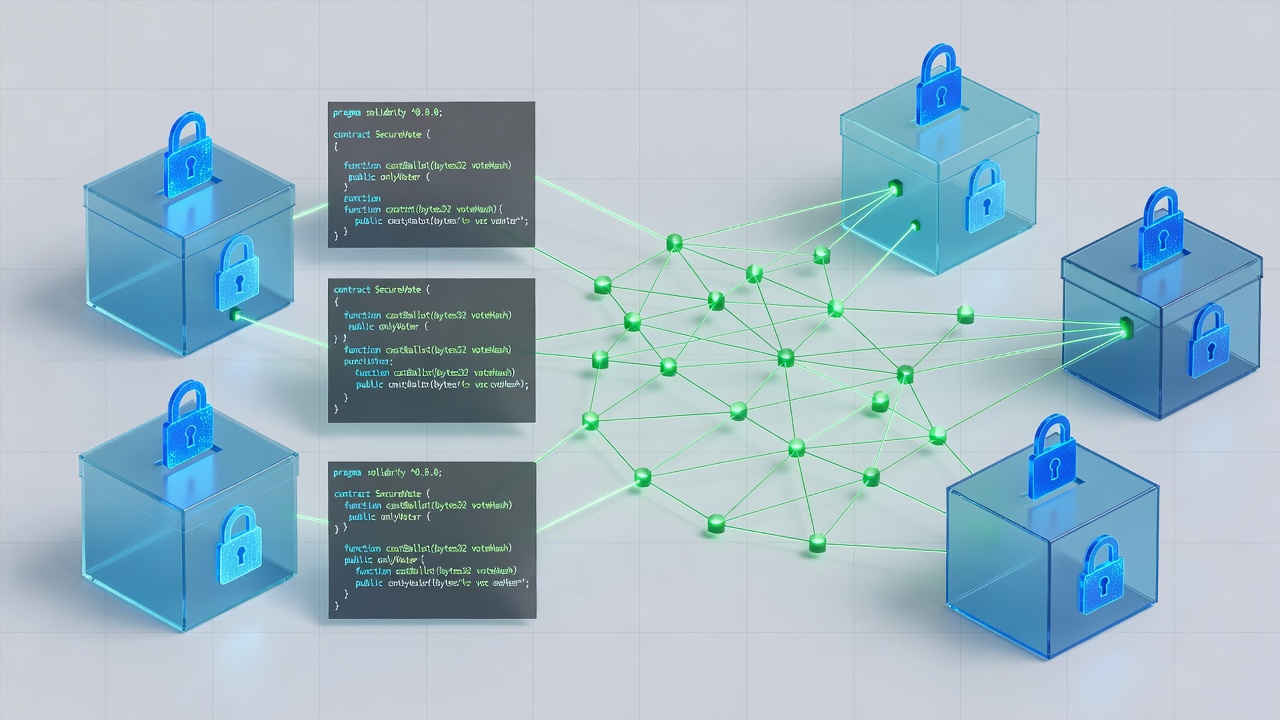
Building tamper-proof voting systems on Ethereum requires careful attention to security, transparency, and efficiency. In this 2026 tutorial, developers will learn how to create a production-ready voting contract in Solidity that prevents double-voting, enforces time-bound periods, and uses gas-efficient patterns. Whether you are exploring governance use cases or election-style applications, this guide provides step-by-step code examples and practical testing strategies. The demand for decentralized voting has grown with DAOs and on-chain governance, making robust smart contract design essential to maintain trust in digital elections. As more organizations move decision-making on-chain, the need for contracts that resist manipulation while remaining user-friendly becomes paramount.
The core goal is auditability and resistance to manipulation. We will examine modifiers, events, and storage optimizations while comparing fully on-chain solutions with hybrid approaches that leverage off-chain computation. By the end of this tutorial you will have a complete, deployable example that follows current best practices for security in Solidity 0.8.x. This includes detailed explanations of why certain patterns are chosen and how they protect against real-world threats observed in past DAO votes and governance proposals.
Key Security Principles for Voting Contracts
Secure voting contracts must address several attack vectors. Double-voting occurs when a single address submits multiple ballots. Manipulation risks arise from unauthorized access or flawed tallying logic. To mitigate these, implement strict access controls and immutable vote records. Another critical principle is ensuring that the voting period cannot be altered after deployment unless explicitly designed with upgrade mechanisms. This prevents malicious actors from extending or shortening windows to favor certain outcomes. Developers must also guard against sybil attacks by combining on-chain identity checks or requiring token holdings for eligibility.
Start by defining clear roles: an admin who sets the voting window and eligible voters who cast ballots once. Events log every action for on-chain verification, enabling third-party audits without revealing sensitive details prematurely. Developers should also consider front-running attacks where transactions are observed in the mempool and copied. Using commit-reveal patterns can help protect proposal or vote secrecy until the reveal phase. In addition, all functions that change state should be protected by require statements that revert with clear error messages to aid debugging during audits.
Environment Setup and Tooling
Developers should use Foundry for its speed and built-in fuzzing capabilities. Install Foundry via the official instructions at Foundry Book. Create a new project with forge init voting-contract and add OpenZeppelin contracts for battle-tested access control utilities from OpenZeppelin. These libraries reduce the risk of introducing custom vulnerabilities in access control logic. You can install the OpenZeppelin package with forge install OpenZeppelin/openzeppelin-contracts and import Ownable or AccessControl as needed.
Additionally, integrate Slither or Mythril for static analysis before deployment. Set up a local Anvil instance for rapid iteration and connect to testnets such as Sepolia for realistic gas and timing simulations. This setup allows you to test time-dependent functions accurately without waiting for real block production. Consider adding a .env file for private keys during testing and use Foundry's cast tool to interact with deployed contracts directly from the command line.
Contract Structure and State Variables
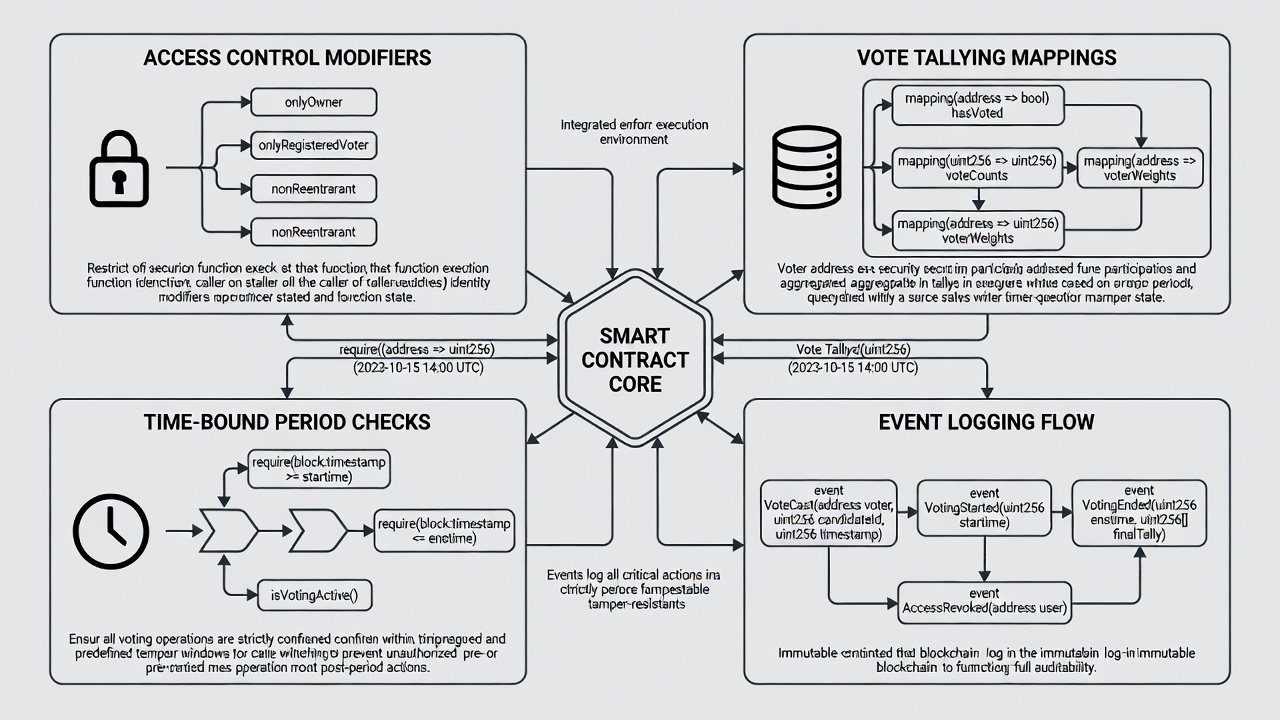
The contract begins with pragma solidity ^0.8.20. Use mappings for voter status and a struct for proposals. Store votes in a bytes32 array for gas efficiency rather than dynamic arrays that bloat storage costs. Include an array of proposal descriptions and a mapping from proposal ID to vote count. Add a separate mapping to track whether an address has already voted, which is the foundation for preventing double-voting. You may also want to store the total number of votes cast to enable quick quorum checks without iterating through all proposals.
contract SecureVoting {
    address public admin;
    uint256 public startTime;
    uint256 public endTime;
    mapping(address => bool) public hasVoted;
    mapping(uint256 => uint256) public voteCount;
    string[] public proposals;
    event VoteCast(address indexed voter, uint256 proposalId);
    event VotingPeriodSet(uint256 start, uint256 end);
}
Implementing Time-Bound Voting and Modifiers
Modifiers enforce the voting window and one-vote-per-address rule. The onlyDuringVoting modifier checks block.timestamp against start and end times set during deployment. This ensures votes can only be cast within the intended period. Combine these with an onlyAdmin modifier using OpenZeppelin’s Ownable for clean role separation. Always initialize the voting window in the constructor or through a dedicated setup function that can only be called once. This prevents accidental or malicious changes after the contract is live.
modifier onlyDuringVoting() {
    require(block.timestamp >= startTime && block.timestamp <= endTime, "Voting closed");
    _;
}
modifier hasNotVoted() {
    require(!hasVoted[msg.sender], "Already voted");
    _;
}
Using block.timestamp is acceptable for most governance scenarios but developers should be aware of minor miner manipulation risks on short timeframes. For high-stakes elections, consider using block numbers instead. You can also add a modifier that checks the caller is in a whitelist of eligible voters if your use case requires it.
Vote Casting and Tallying Logic
The castVote function updates storage atomically and emits an event. Tallying occurs via a view function that iterates proposals without state changes, keeping gas low for readers. A complete implementation would also include a function to add proposals before the voting period begins, restricted to the admin role. This separation of setup and voting phases improves security by locking the proposal list once voting starts. In the castVote function, always verify the proposal ID is valid before incrementing the count to avoid out-of-bounds errors.
For larger elections, consider a hybrid model where votes are committed off-chain and only roots are stored on-chain, reducing costs while maintaining verifiability. The tally function can then verify Merkle proofs submitted by voters or oracles. This approach balances transparency with scalability for thousands of participants.
Preventing Common Attacks
- Double-voting: Enforced by the hasVoted mapping and hasNotVoted modifier.
- Front-running: Use commit-reveal schemes for proposal selection.
- Reentrancy: Avoid external calls during tally updates.
- Timestamp manipulation: Rely on block numbers for critical deadlines when possible.
- Unauthorized proposal changes: Lock proposal list after startTime is set.
- Denial of service through gas griefing: Use fixed-size arrays and avoid unbounded loops in critical paths.
Each of these mitigations should be accompanied by unit tests that attempt to trigger the attack and confirm the contract reverts as expected.
On-Chain vs Hybrid Voting Approaches
Fully on-chain voting maximizes transparency but incurs higher gas fees. Hybrid systems batch votes off-chain and post Merkle roots, offering scalability. Choose based on voter volume and required audit depth. The Ethereum community resources at ethereum.org provide further context on scaling governance. On-chain approaches suit small to medium DAOs where every vote must be immediately visible, while hybrid models are better for large-scale elections requiring privacy and cost efficiency. When deciding, factor in the expected number of voters and whether real-time results are necessary.
Testing Strategies with Foundry
Write unit tests that fuzz voting windows and attempt double-votes. Use vm.warp to simulate time progression. Run invariant tests to confirm vote counts never exceed eligible voters. Create test cases for edge scenarios such as voting exactly at the start and end timestamps, attempting to vote after the period closes, and verifying that the admin cannot change proposals mid-voting. Foundry’s fuzzing capabilities allow you to run thousands of random scenarios quickly, catching subtle bugs that manual testing might miss. You can execute tests with forge test --fuzz-runs 10000 to increase coverage.
Deploy to a local Anvil node first, then verify on testnets before mainnet. Comprehensive test coverage catches edge cases like zero-vote proposals or late submissions. Always measure gas usage during tests to ensure the contract remains economical for voters. Consider writing a dedicated test suite for the tally function to confirm it returns accurate results under various vote distributions.
Deployment and Upgradeability Considerations
Deploy via a proxy pattern if future fixes are anticipated, but note that upgradeability can introduce governance risks. Document all parameters at deployment for full audit trails. When using upgradeable contracts, consider adding a timelock so that any proposed changes must wait a minimum period, giving the community time to react. This is especially important in voting systems where trust in immutability is a core feature. Use tools like Hardhat or Foundry’s deployment scripts to automate the process and verify the contract on Etherscan for transparency.
Common Mistakes to Avoid
One frequent error is failing to initialize the voting period correctly, leaving the contract in an unusable state. Another is allowing the admin to modify proposals after voting begins, which undermines fairness. Developers sometimes overlook gas costs in tally functions, leading to expensive reads for users. Always test with realistic voter numbers and review the contract with multiple auditors before mainnet launch.
Conclusion
This tutorial equips developers with the tools to build secure, auditable voting contracts in Solidity. By combining modifiers, events, and efficient storage, your contracts resist manipulation while remaining practical for real-world governance. Continue experimenting with the provided patterns and always audit before mainnet deployment.
FAQ
How do you handle voter privacy? Use zero-knowledge proofs or commit-reveal to hide individual choices while proving validity.
Can the contract be upgraded after deployment? Yes, via proxy patterns, but this requires careful governance to prevent malicious changes.
What happens if the admin key is lost? Implement a multi-sig or timelock for admin functions to reduce single points of failure.
How should proposals be added securely? Restrict proposal addition to the admin role and lock the list once the voting period begins.
What gas optimizations are most effective? Prefer mappings over arrays for lookups, emit events instead of storing logs on-chain, and use view functions for tallying.

No comments yet. Be the first!