 CryptoChain Blog
Understanding Delegatecall in Solidity Smart Contracts
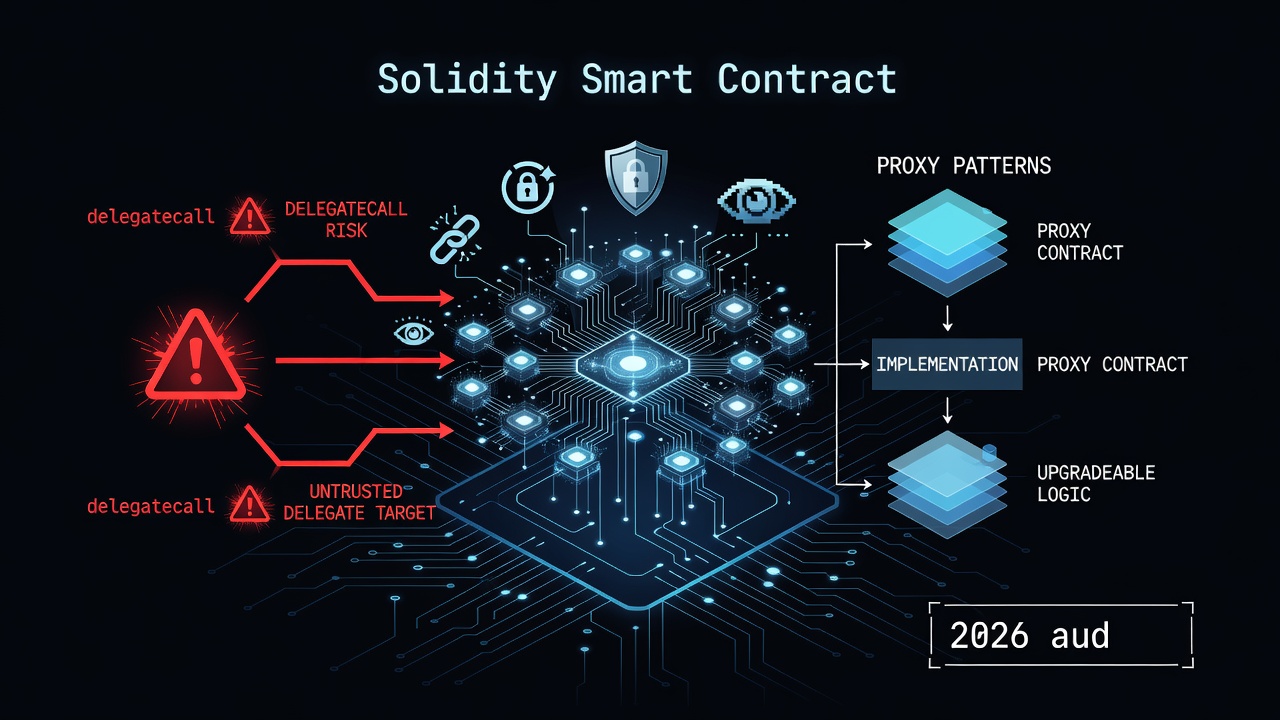
Delegatecall remains one of the most powerful yet hazardous opcodes available in Solidity. It enables a contract to execute code from another contract while maintaining the caller's own storage, balance, and context. This mechanism underpins upgradeable proxy architectures widely adopted in DeFi and Web3 applications. However, improper use frequently results in severe vulnerabilities such as storage collisions, unauthorized code execution, and complete contract takeovers. This comprehensive guide examines these risks in detail, analyzes recent attack vectors, and delivers practical, step-by-step safe implementation patterns tailored for developers in 2026.
How Delegatecall Works at the EVM Level
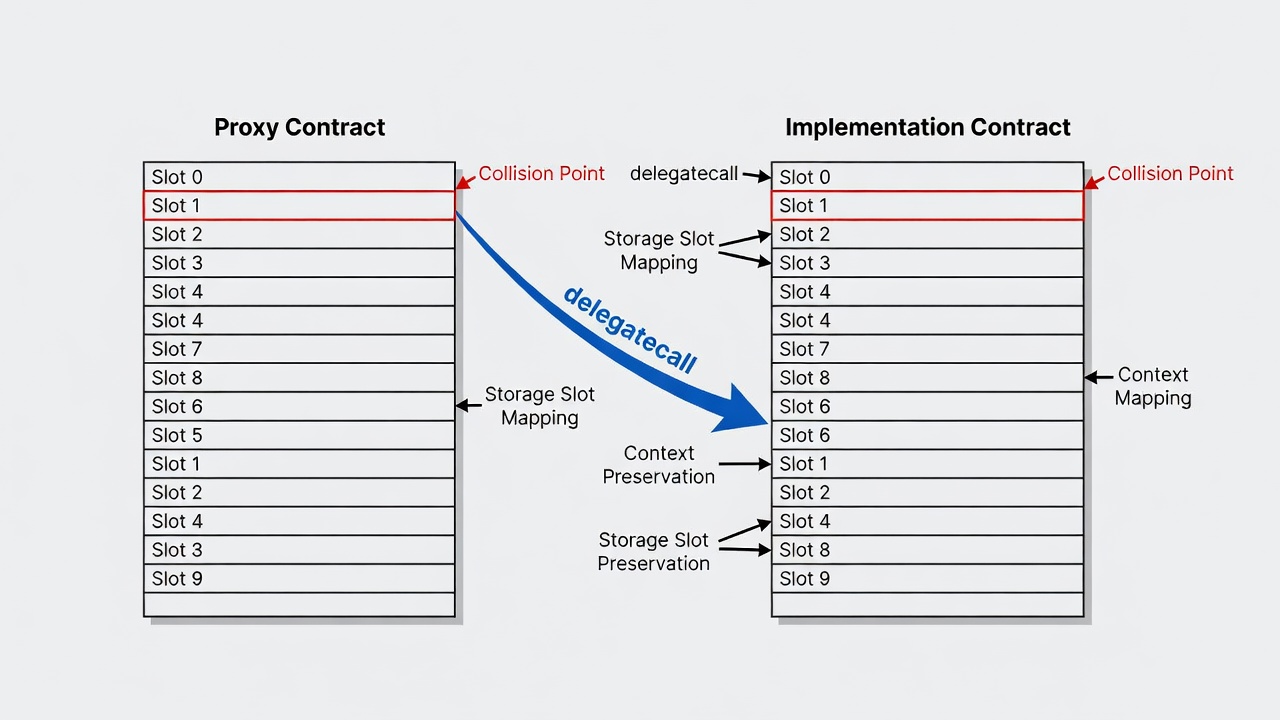
At its core, delegatecall copies the bytecode of the target contract and runs it within the caller's storage environment. Unlike a standard call, which isolates storage, delegatecall preserves variables at identical storage slots. This behavior allows shared state across proxy and implementation contracts but demands perfect alignment of storage layouts. Any mismatch can overwrite critical variables such as owner addresses or balances, leading to unintended behavior or fund losses.
Developers must understand the difference between delegatecall, call, and staticcall. While call changes the execution context, delegatecall does not. This distinction is essential when designing upgradeable systems where the proxy must appear as the primary contract to external users and other protocols.
Core Risks: Storage Collisions and Unauthorized Executions
Storage collisions happen when the implementation contract declares variables in slots already used by the proxy for different purposes. For example, a proxy storing an implementation address at slot zero will conflict with an implementation that places its first state variable at the same slot. Unauthorized executions occur when a proxy forwards arbitrary calls without restrictions, allowing attackers to invoke privileged functions or self-destruct the contract.
A vulnerable forward function might look like this:
function forward(address target, bytes calldata data) external {
    (bool success, ) = target.delegatecall(data);
    require(success, "Delegatecall failed");
}
Such code permits any external caller to execute malicious operations in the proxy's context, bypassing intended access controls.
Real Attack Vectors from Recent Incidents
Historical cases such as the Parity multisig wallet incident demonstrated how delegatecall misuse can freeze funds permanently. More recent 2025 and early 2026 audits continue to surface similar issues in upgradeable contracts where uninitialized proxies or poorly managed storage slots allowed attackers to claim ownership. Attack vectors often involve front-running initialization or exploiting fallback functions that blindly delegate to attacker-controlled addresses.
Step-by-Step Safe Implementation Patterns
Secure delegatecall usage begins with audited libraries. Follow these steps for robust implementation:
- Adopt established proxy contracts from OpenZeppelin rather than writing custom delegatecall logic.
- Define storage slots explicitly using assembly to avoid collisions.
- Restrict delegate targets through whitelists and role-based access control.
- Implement proper initialization functions instead of relying on constructors.
- Test extensively with tools that simulate storage layouts before mainnet deployment.
A secure delegate function using structured assembly appears below:
bytes32 private constant IMPLEMENTATION_SLOT = 0x360894a13ba1a3210667c828492db98dca3e2076cc3735a920a3ca505d382bbc;

function _delegate(address implementation) internal {
    assembly {
        calldatacopy(0, 0, calldatasize())
        let result := delegatecall(gas(), implementation, 0, calldatasize(), 0, 0)
        returndatacopy(0, 0, returndatasize())
        switch result
        case 0 { revert(0, returndatasize()) }
        default { return(0, returndatasize()) }
    }
}
Code Examples: Vulnerable vs Secure Delegatecall Usage
The vulnerable pattern above exposes the contract to arbitrary execution. In contrast, a secure version validates the caller, checks the target against an approved list, and uses immutable storage slots. Developers should also separate logic contracts from storage contracts to minimize collision risks. Comparing both side-by-side reveals how small changes in access control and slot management dramatically improve security.
Comparing Proxy Designs and Gas Considerations
Transparent proxy patterns provide clear separation between admin and user functions but incur additional gas overhead from conditional checks in every call. UUPS proxies move upgrade logic into the implementation itself, reducing gas consumption for regular operations. Beacon proxies allow multiple instances to share a single implementation address, beneficial for token factories or large-scale deployments. Each design trades off complexity against operational costs, and teams should benchmark gas usage during development using current EVM conditions.
Practical Auditing Checklist
- Confirm identical storage layouts between proxy and implementation using automated tools such as Hardhat upgrades or Foundry storage inspection.
- Verify that no delegatecall targets untrusted or user-supplied addresses.
- Ensure initialization functions are protected and cannot be called after deployment.
- Test upgrade paths with simulated malicious implementations.
- Check for reentrancy vectors that could arise when delegatecall executes external code.
- Review all fallback and receive functions for unintended delegation.
- Validate that admin roles follow least-privilege principles.
- Run static analysis tools and obtain independent audits before mainnet launch.
Common Pitfalls to Avoid
Many developers overlook the need to lock implementation contracts after deployment, leaving them open to direct calls that alter shared state. Another frequent mistake involves confusing constructor execution with initializer functions in upgradeable contracts. Relying on Solidity's default storage packing without explicit slot control often triggers collisions. Always consult the latest Solidity documentation for syntax changes and review Ethereum Foundation resources on proxy security patterns. Never assume delegatecall behaves identically to regular calls regarding msg.sender or storage persistence.
Integrating with Security Tools and 2026 Compliance Standards
Modern workflows combine static analyzers like Slither and Mythril with dynamic testing frameworks. Formal verification adds another layer for critical contracts. In 2026, compliance increasingly references updated EIP standards for upgradeable contracts and requires documented audit trails. Integrating these tools early in the development cycle reduces remediation costs and improves overall contract resilience.
Conclusion
Delegatecall enables powerful upgradeability but demands rigorous attention to storage layout, access control, and testing. By adopting audited patterns, following structured checklists, and avoiding common pitfalls, developers can build secure contracts that withstand both known and emerging threats in the evolving blockchain landscape.
FAQ
How does delegatecall differ from a regular call?
Delegatecall executes the target bytecode inside the caller's storage and context, whereas a regular call isolates the execution environment completely.
Is delegatecall safe for production projects in 2026?
When implemented using audited libraries such as OpenZeppelin UUPS proxies and verified storage layouts, delegatecall is considered safe according to OpenZeppelin documentation.
What tools best detect storage collisions?
Foundry's built-in storage inspection and Hardhat's upgrade plugins provide reliable detection for current development environments.
Should teams prefer UUPS or transparent proxies?
UUPS generally offers better gas efficiency for high-frequency contracts, while transparent proxies simplify admin separation for complex governance scenarios.


No comments yet. Be the first!