 CryptoChain Blog

Introduction to Front-Running in DeFi
Front-running attacks exploit transaction ordering on blockchains like Ethereum. In 2026, MEV remains a critical threat to decentralized applications. Developers building on Solidity must understand these risks to protect users and maintain protocol integrity. This comprehensive guide explains the mechanics of transaction ordering attacks with real-world DeFi examples and provides detailed mitigation patterns such as batch auctions, time-weighted average pricing, and private transaction relays. You will find step-by-step code implementations in Solidity 0.8.26, qualitative gas cost comparisons, and integration strategies for common DEX architectures. The article also covers testing strategies using Foundry for attack simulation along with an expanded FAQ addressing common implementation pitfalls. Front-running prevention serves as an essential layer of contract security alongside existing audit practices.
Understanding the Mechanics of Transaction Ordering Attacks
Miners and validators control the order in which transactions are included in blocks. Attackers monitor the public mempool and insert their own transactions ahead of or behind victim trades to profit from price movements. This creates sandwich attacks where an attacker buys tokens just before a large purchase and sells immediately after, capturing the slippage. In decentralized exchanges, even small delays in transaction inclusion can lead to significant value extraction. Understanding these dynamics requires familiarity with how Ethereum's transaction pool works and the incentives for block producers.
Real-World DeFi Examples of Front-Running
Consider a large swap on a major automated market maker. An attacker observes the pending transaction and front-runs it by purchasing the same asset at a lower price, then sells at the inflated price after the victim's trade executes. Historical incidents on protocols like Uniswap and SushiSwap have demonstrated losses in the millions of dollars before widespread adoption of protective measures. These examples illustrate why developers must embed defenses directly into smart contract logic rather than relying solely on off-chain solutions.
Core Mitigation Patterns for Front-Running Prevention
Implementing Batch Auctions
Batch auctions collect multiple orders over a period and execute them simultaneously at a single clearing price. This eliminates the advantage of transaction ordering. A practical implementation involves a commit-reveal scheme where users first submit hashed orders and later reveal details. The contract then calculates the uniform price and settles all trades atomically. This approach requires careful handling of commitment periods and reveal deadlines to prevent griefing attacks.
Time-Weighted Average Pricing (TWAP) Implementation
TWAP oracles provide price data averaged over time intervals, making it difficult for attackers to manipulate prices with single transactions. Integrate oracles from established providers to fetch these averages before executing trades. In Solidity, store cumulative price sums and divide by elapsed time to compute the average. This method is particularly effective in lending protocols and derivatives platforms where accurate pricing is critical.
Using Private Transaction Relays
Private relays allow transactions to bypass the public mempool entirely. Services like Flashbots enable developers to send bundles directly to validators. Integrate these by constructing signed bundles that include your contract calls and submitting them through dedicated APIs. This significantly reduces exposure to front-running. Learn more at Flashbots. Additional resources are available on Ethereum.org and the official Solidity documentation.
Detailed Solidity 0.8.26 Code Implementations
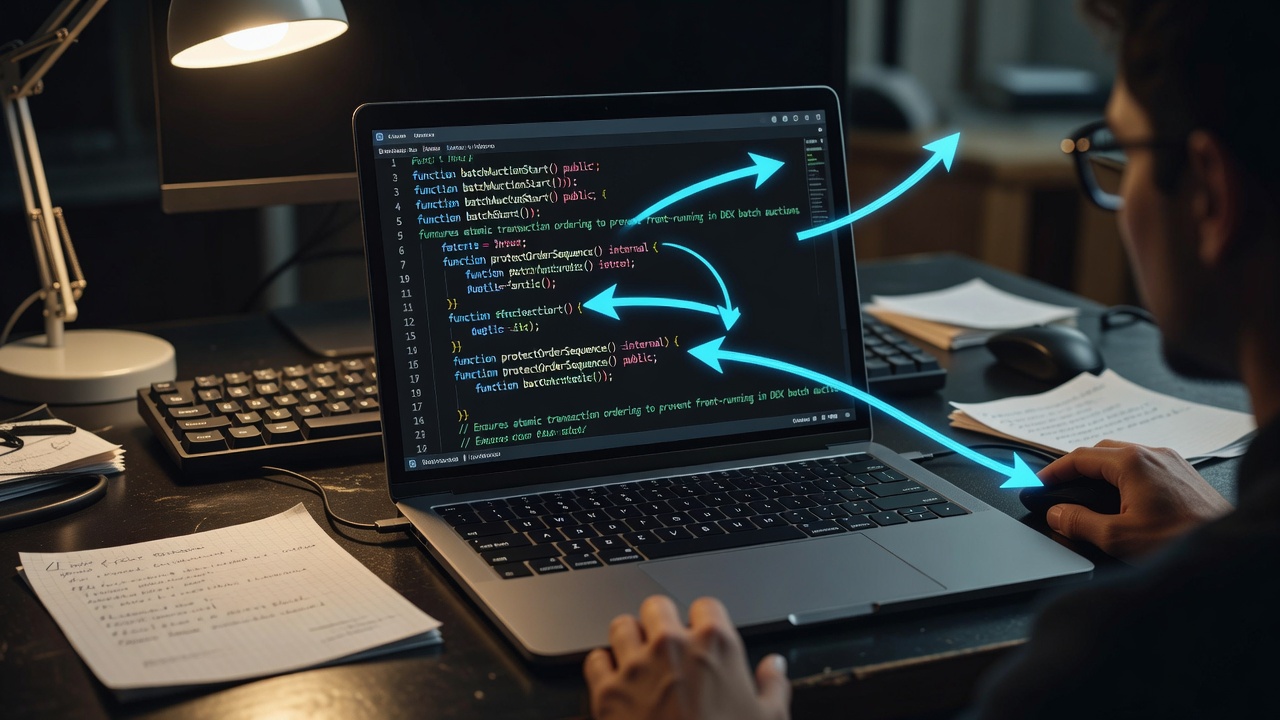
Below is an expanded commit-reveal batch auction contract demonstrating core logic for order collection and settlement.
pragma solidity ^0.8.26;

contract BatchAuction {
    struct Order {
        address trader;
        uint256 amountIn;
        uint256 amountOutMin;
    }
    mapping(bytes32 => Order) public orders;
    bytes32[] public orderHashes;
    uint256 public commitDeadline;

    function commit(bytes32 hash) external {
        require(block.timestamp < commitDeadline, "Commit phase ended");
        orderHashes.push(hash);
    }

    function reveal(uint256 amountIn, uint256 amountOutMin, bytes32 salt) external {
        bytes32 hash = keccak256(abi.encode(msg.sender, amountIn, amountOutMin, salt));
        // Settlement logic here
    }
}
Gas costs for batch auction operations typically run higher than simple swaps due to additional storage and computation steps. Developers should benchmark these differences during testing to optimize for production use.
Integrating Protections into Common DEX Architectures
When modifying AMM contracts, add checks for TWAP validity before any swap execution. Update liquidity pool logic to support private bundle submissions. Test these changes thoroughly against simulated attack scenarios to ensure slippage protection remains effective. Many leading DEXes now combine multiple mitigations for layered security.
Comprehensive Testing Strategies Using Foundry
Foundry provides powerful cheatcodes for simulating block timestamps, transaction ordering, and mempool conditions. Begin by writing unit tests that deploy your contract and attempt sandwich attacks. Use fuzz testing to explore edge cases with varying order sizes and timing parameters. The official Foundry book offers detailed guidance at book.getfoundry.sh. Include assertions that verify no value is extracted by attackers in your test scenarios.
Common Pitfalls and How to Avoid Them
- Over-reliance on block timestamps without fallback oracles can lead to manipulation.
- Failing to handle gas griefing during commit phases wastes user funds.
- Inadequate reveal windows allow attackers to front-run the reveal itself.
- Ignoring integration with existing DEX routers creates compatibility issues.
Frequently Asked Questions
How does batch auction affect user experience?
Users experience slight delays due to batch periods but gain protection against slippage exploitation. Most protocols set batch intervals between 30 seconds and several minutes.
Is TWAP sufficient as a standalone defense?
TWAP works well for pricing but should be combined with private relays or batching for complete coverage in high-value trades.
What Foundry features help most with front-running tests?
Cheatcodes such as vm.warp, vm.roll, and transaction simulation tools allow precise control over ordering and timing.
Conclusion
Implementing front-running prevention strengthens smart contract security and builds user trust. By combining batch auctions, TWAP oracles, and private relays with rigorous Foundry testing, developers can create resilient DeFi protocols ready for 2026 and beyond. Always audit changes and monitor on-chain activity after deployment.

No comments yet. Be the first!