 CryptoChain Blog
Introduction to Privacy in Solidity Smart Contracts
Smart contracts deployed on Ethereum and other EVM-compatible blockchains execute in a fully transparent environment where every transaction, state change, and function call is visible to anyone with access to the blockchain explorer. This inherent transparency creates significant challenges for applications that must handle sensitive data such as voting records, financial positions, or personal identifiers. By 2026, regulatory pressures and user expectations have pushed developers toward advanced privacy-preserving techniques that maintain the benefits of decentralization while protecting confidentiality. This comprehensive guide explores methods that extend far beyond simple require statements or modifier-based access controls, focusing on zero-knowledge proofs, encrypted state variables, and hybrid off-chain computation patterns with on-chain verification. Readers will find detailed code examples written for Solidity 0.8.25 and later, step-by-step integration instructions, realistic gas cost comparisons, and strategies tailored to use cases including private voting systems and confidential decentralized finance transactions.
Zero-Knowledge Proofs for Private Logic
Zero-knowledge proofs enable one party to prove the correctness of a statement without revealing any underlying information. In the context of Solidity, zk-SNARKs and zk-STARKs have become practical tools for hiding inputs while still allowing the contract to enforce rules. A typical implementation workflow begins with circuit design using frameworks such as Circom or Halo2, followed by proof generation in an off-chain environment and final verification inside the smart contract. The verifier contract itself is usually generated automatically from the circuit and deployed once, after which multiple proofs can be validated efficiently.
Consider a private voting scenario where participants must prove eligibility and uniqueness without disclosing their identity or vote choice. The contract stores only a Merkle root representing the set of eligible voters and a mapping of used nullifiers. When a user casts a vote, they submit a zk proof demonstrating membership in the set and that the nullifier has not been used before.
pragma solidity ^0.8.25;

interface IVerifier {
    function verifyProof(bytes calldata proof) external view returns (bool);
}

contract PrivateVote {
    mapping(bytes32 => bool) public nullifiers;
    bytes32 public merkleRoot;
    address public verifier;
    event VoteCast(bytes32 indexed nullifier);

    constructor(address _verifier, bytes32 _merkleRoot) {
        verifier = _verifier;
        merkleRoot = _merkleRoot;
    }

    function castVote(bytes calldata proof, bytes32 nullifier) external {
        require(!nullifiers[nullifier], "Nullifier already used");
        require(IVerifier(verifier).verifyProof(proof), "Invalid proof");
        nullifiers[nullifier] = true;
        emit VoteCast(nullifier);
    }
}
Developers must also handle the off-chain side carefully. Proof generation typically occurs in a Node.js or Rust environment using libraries that compile the circuit into WebAssembly or native binaries. Testing should include both positive and negative cases to ensure the verifier rejects malformed proofs. Gas consumption for a single verification call usually falls between 250000 and 450000 units depending on the curve and proof size, making layer-2 deployments attractive for high-volume applications.
Encrypted State Variables
When data must remain hidden yet still support conditional updates, developers turn to cryptographic commitments or homomorphic schemes. A commit-reveal pattern using keccak256 hashes allows users to lock in values without exposing them until a later reveal phase. More advanced approaches leverage libraries implementing elliptic curve commitments or threshold encryption so that state transitions can occur without full decryption on-chain.
Here is an expanded example demonstrating confidential balance tracking suitable for shielded DeFi positions:
pragma solidity ^0.8.25;

contract ConfidentialBalance {
    mapping(address => bytes32) private commitments;
    mapping(address => uint256) private lastUpdateBlock;

    event CommitmentUpdated(address indexed user, bytes32 commitment);

    function updateCommitment(bytes32 newCommitment) external {
        commitments[msg.sender] = newCommitment;
        lastUpdateBlock[msg.sender] = block.number;
        emit CommitmentUpdated(msg.sender, newCommitment);
    }

    function revealAndProcess(uint256 balance, bytes32 salt, address recipient) external {
        bytes32 expected = keccak256(abi.encodePacked(balance, salt, msg.sender));
        require(expected == commitments[msg.sender], "Commitment mismatch");
        require(balance > 0, "Invalid balance");
        // Perform private transfer logic here
        delete commitments[msg.sender];
    }
}
These patterns integrate well with access control lists or role-based permissions when multiple parties need selective visibility into the data.
Off-Chain Computation with On-Chain Verification
Many privacy operations are computationally intensive and therefore expensive when executed entirely on-chain. The recommended architecture moves heavy lifting to off-chain environments such as trusted execution environments, multi-party computation networks, or dedicated zk provers, while the smart contract only verifies succinct attestations or proofs.
Implementation follows these concrete steps:
- Define the computation logic and required inputs in a high-level language.
- Execute the computation off-chain and generate either a zk proof or a signed attestation from a trusted oracle.
- Submit the result together with the proof to a Solidity verifier contract.
- The contract validates the proof and updates state only if verification succeeds.
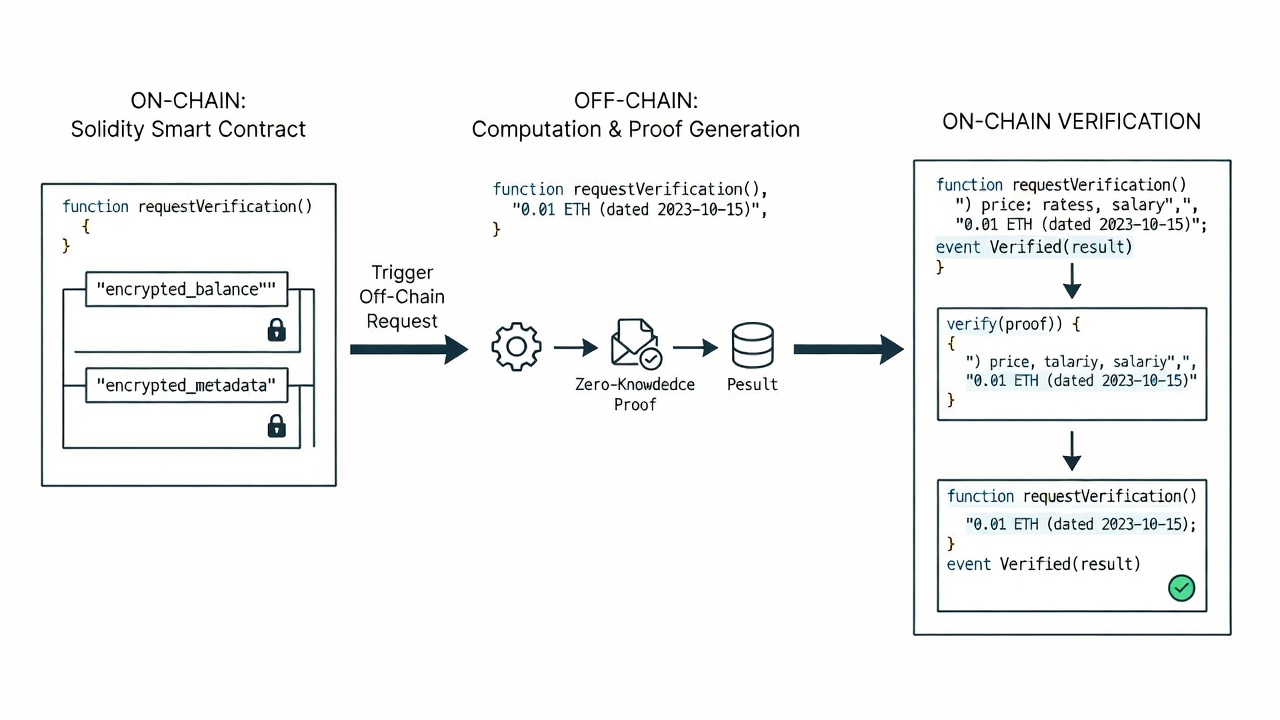
This hybrid model can reduce on-chain gas usage by more than 80 percent compared with fully on-chain equivalents while preserving public auditability of the verification step. Developers should evaluate frameworks that support both proof generation and Solidity verifier templates to minimize integration friction.
Gas Cost versus Security Trade-offs
Every privacy feature adds overhead. A basic access-controlled function consumes roughly 21000 gas, whereas a zk verification call can exceed 300000 gas. Encrypted state operations add storage and hashing costs that accumulate over multiple transactions. Teams should benchmark implementations using tools such as Hardhat Gas Reporter or Foundry’s gas snapshots during development. Security audits become even more critical because vulnerabilities in circuits or commitment schemes can expose entire datasets. Common mitigation strategies include formal verification of circuits and bug-bounty programs focused on the cryptographic components.
Practical Use Cases in 2026
Private voting platforms rely on the combination of Merkle trees, nullifiers, and zk proofs to deliver anonymous yet verifiable elections. Confidential DeFi protocols use encrypted balances and verified off-chain matching engines to enable hidden order books and shielded lending positions. Both categories benefit from careful key management practices and user-friendly wallet integrations that abstract away the complexity of proof generation.
Common Pitfalls to Avoid
Developers frequently encounter the same issues when implementing privacy features. First, avoid emitting raw private data inside events or transaction logs because these remain permanently visible. Second, never reuse nullifiers across different sessions or contracts. Third, account for front-running risks during commit phases by incorporating time delays or commit-reveal windows. Fourth, rely exclusively on audited and actively maintained cryptographic libraries rather than custom implementations. Finally, test thoroughly on testnets that mirror mainnet gas limits and block times.
FAQs and 2026 Tooling Recommendations
Q: Which regulatory frameworks should teams consider? Projects handling personal or financial data must evaluate GDPR, emerging digital asset regulations, and jurisdiction-specific privacy statutes. Early consultation with legal specialists is strongly advised.
Q: What development tooling is recommended? Current best practices center on Solidity 0.8.25 or newer, the official Solidity documentation, and resources available at ethereum.org. Additional guidance can be found through OpenZeppelin documentation for secure contract patterns and audited libraries.
Q: How should teams approach circuit audits? Engage specialized auditors experienced with zk circuits and schedule multiple rounds of review before mainnet deployment.
Conclusion
Privacy-preserving techniques for Solidity smart contracts have reached a level of maturity that allows production deployment in 2026. By thoughtfully combining zero-knowledge proofs, encrypted state variables, and verified off-chain computation, development teams can deliver applications that satisfy both user privacy expectations and regulatory requirements while preserving the core advantages of public blockchains. Careful attention to gas optimization, security auditing, and tooling selection will determine long-term success.
No comments yet. Be the first!