 CryptoChain Blog

Introduction to 2026 Solidity Security Landscape
The blockchain ecosystem continues to evolve rapidly, and Solidity developers face increasingly sophisticated threats in 2026. Advanced Layer 2 solutions, intricate cross-contract calls, and frequent compiler updates introduce new attack surfaces that require proactive attention. This article examines these challenges in depth, drawing on recent exploit trends and offering actionable guidance for building resilient contracts. As decentralized applications grow more complex, understanding these emerging risks becomes essential for anyone deploying on Ethereum or compatible chains. Developers who ignore these trends risk significant financial losses and loss of user trust. We will explore practical code examples, compare mitigation strategies, and outline implementation steps that teams can adopt immediately.
Threats from Advanced L2 Ecosystems
Layer 2 scaling solutions like optimistic and zk-rollups have matured significantly by 2026, yet they bring unique risks such as sequencer centralization and fraud-proof manipulation. Developers must account for delayed finality and bridge vulnerabilities when deploying contracts on L2 networks. These environments often operate with different assumptions than L1, leading to subtle bugs that surface only under specific conditions. For instance, optimistic rollups rely on challenge periods that can be exploited if economic incentives are misaligned. Zk-rollups introduce proof verification complexities that demand careful integration with existing Solidity logic.
Key L2-Specific Risks
- Sequencer downtime leading to transaction censorship and front-running opportunities
- Bridge exploits allowing unauthorized fund withdrawals across layers
- State synchronization delays between L1 and L2 creating race conditions
- Compressed transaction data exposing new calldata manipulation vectors
Practical mitigation involves using audited bridge contracts and implementing circuit breakers in your code. Consider adding pause functions triggered by oracle-detected anomalies. Teams should also monitor L2-specific events using specialized dashboards to detect unusual withdrawal patterns early.
Evolving Cross-Contract Interactions
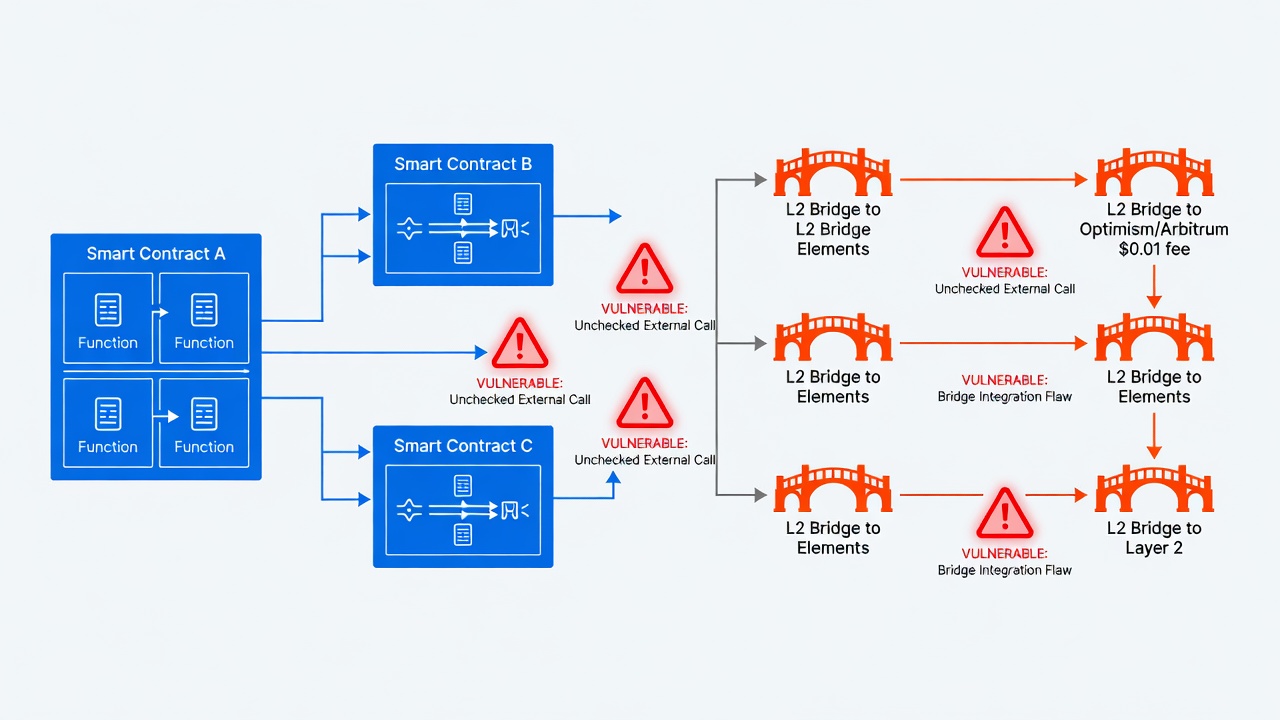
Modern DeFi protocols rely heavily on composability, increasing the attack surface through reentrancy and delegatecall vulnerabilities. In 2026, attackers exploit complex call chains across multiple contracts, often chaining several external calls to bypass traditional checks. This evolution stems from the rise of modular protocols where logic is split across many small contracts for upgradability and gas efficiency.
Consider this example of a vulnerable pattern that remains common despite years of awareness:
function withdraw(uint amount) external {
    require(balances[msg.sender] >= amount);
    (bool success, ) = msg.sender.call{value: amount}("");
    require(success);
    balances[msg.sender] -= amount;
}
Updated patterns use checks-effects-interactions and reentrancy guards from established libraries. A safer implementation looks like this:
function withdraw(uint amount) external nonReentrant {
    require(balances[msg.sender] >= amount, "Insufficient balance");
    balances[msg.sender] -= amount;
    (bool success, ) = msg.sender.call{value: amount}("");
    require(success, "Transfer failed");
}
Developers should also audit all delegatecall usages and prefer interfaces over low-level calls when possible. Side-by-side testing of these patterns in local environments helps surface edge cases before mainnet deployment.
Compiler Changes Impacting Security
Solidity 0.8.x and later versions introduced breaking changes around overflow checks and ABI encoding. Staying current with Solidity documentation helps avoid deprecated features that weaken security. Recent compiler releases have improved optimizer settings but also changed how storage layouts are handled in certain inheritance scenarios. Developers upgrading from older versions must recompile and retest all contracts to catch new warnings that were previously silent. Ignoring these changes can lead to unexpected behavior in production, especially when interacting with libraries compiled under different versions.
Dissecting Recent Exploit Patterns
Analysis of 2025-2026 incidents reveals patterns like flash-loan enabled oracle manipulation and proxy upgrade attacks. Storage collision vulnerabilities remain prevalent in upgradeable contracts, often because teams reuse the same storage slots without proper namespacing. Another growing pattern involves cross-layer message passing exploits where L2 contracts assume L1 state without sufficient verification. Side-by-side comparisons show that immutable contracts avoid many upgrade risks but sacrifice flexibility, while proxy-based designs require rigorous storage management.
Mitigation Comparison Table
| Approach | Pros | Cons |
|---|---|---|
| Immutable Contracts | No upgrade risks, simpler auditing | Limited flexibility for fixes |
| Proxy Upgrades | Post-deployment fixes possible | Storage collision potential, higher complexity |
| Diamond Pattern | Modular function replacement | More complex implementation and testing |
Adopting Proactive Defense Frameworks
Implement formal verification tools and continuous auditing. Follow these steps: 1) Use Slither for static analysis on every commit, 2) Integrate fuzzing with Foundry to simulate adversarial inputs, 3) Schedule regular third-party reviews before major upgrades, 4) Maintain an internal threat model document updated quarterly. These practices reduce the likelihood of missing subtle bugs that automated tools overlook. Combining multiple layers of defense creates resilience against both known and zero-day threats.
Evaluating Tools for Ongoing Monitoring
Tools such as Tenderly and Forta provide real-time alerts on suspicious contract behavior. Compare them against Ethereum security resources for best results. Additional options include integrating on-chain monitoring via custom event listeners and off-chain services that track gas usage anomalies. Choose tools that support your specific L2 environment and offer customizable alert thresholds. Regular evaluation ensures the monitoring stack remains effective as new attack techniques emerge.
Implementation Steps for Updated Patterns
- Audit all external calls and replace low-level calls with safe wrappers where possible
- Adopt ERC-7201 for storage namespacing in upgradeable contracts
- Enable compiler warnings as errors in your build pipeline
- Write comprehensive tests covering reentrancy, delegatecall, and L2-specific timing scenarios
- Document upgrade procedures and maintain a rollback plan
Conclusion
Staying ahead of 2026 threats demands continuous learning and robust tooling. Developers who integrate these practices will build more resilient smart contracts capable of withstanding evolving attack vectors.
FAQ
How often should contracts be upgraded? Evaluate based on new compiler releases and emerging threats, typically every 6-12 months, while always performing thorough testing and audits beforehand.
What is the best long-term maintenance strategy? Combine immutable core logic with upgradeable periphery modules, and maintain clear documentation for future teams inheriting the codebase.

No comments yet. Be the first!