 CryptoChain Blog

Introduction to Merkle Trees in Modern Solidity Development
Merkle trees remain a cornerstone for scalable data verification in Ethereum smart contracts. In 2026, developers continue to rely on them to handle large datasets without storing everything on-chain, reducing gas costs while maintaining security. This tutorial covers secure patterns for Solidity 0.8.x that go beyond basic access controls, focusing on efficient proof generation, integration strategies, and mitigation of common attack vectors. By leveraging Merkle proofs, contracts can verify membership or data integrity using only a root hash. This approach is essential for applications like token airdrops, whitelists, and layer-2 scaling solutions. We will explore practical implementations, compare gas usage, and demonstrate testing with Foundry. The goal is to provide developers with production-ready patterns that align with evolving security standards, ensuring contracts remain efficient even as datasets grow to tens of thousands of entries.
Understanding Merkle Tree Fundamentals for Smart Contracts
A Merkle tree is a binary tree where leaf nodes contain data hashes and internal nodes are hashes of their children. The root hash serves as a compact commitment to the entire dataset. In Solidity, this enables verification without exposing the full dataset, which is critical for scalability. Key benefits include reduced storage requirements and lower transaction costs compared to storing arrays of addresses or data. For instance, verifying a single leaf against the root requires only log(n) hashes, making it ideal for contracts handling thousands of entries. Developers should understand that each leaf is typically double-hashed to prevent length-extension vulnerabilities. The tree construction process begins off-chain using libraries like merkletreejs, where leaves are sorted and paired iteratively until a single root remains. This structure allows efficient incremental updates when only a subset of data changes, a feature particularly useful in dynamic whitelists or vesting schedules.
Building Merkle Proofs in Solidity 0.8.x
Start by implementing a basic Merkle proof verifier. Use OpenZeppelin's MerkleProof library as a foundation, but extend it for custom security needs in 2026. Consider the following expanded contract that incorporates domain separation and supports multiple verification modes:
pragma solidity ^0.8.20;
import "@openzeppelin/contracts/utils/cryptography/MerkleProof.sol";

contract SecureMerkleVerifier {
    bytes32 public merkleRoot;
    mapping(bytes32 => bool) public usedProofs;

    constructor(bytes32 _merkleRoot) {
        merkleRoot = _merkleRoot;
    }

    function verify(bytes32[] calldata proof, bytes32 leaf) public view returns (bool) {
        bytes32 leafHash = keccak256(abi.encodePacked("DOMAIN", leaf));
        return MerkleProof.verify(proof, merkleRoot, leafHash);
    }

    function verifyAndMark(bytes32[] calldata proof, bytes32 leaf) public returns (bool) {
        require(verify(proof, leaf), "Invalid proof");
        bytes32 proofHash = keccak256(abi.encodePacked(proof));
        require(!usedProofs[proofHash], "Proof already used");
        usedProofs[proofHash] = true;
        return true;
    }
}
This pattern ensures the proof is validated against the stored root while adding replay protection. Always hash leaf data with a prefix to prevent second-preimage attacks. For larger trees, precompute sibling paths off-chain and pass them as calldata to minimize gas. Advanced variations include multi-proof verification for batch operations, which can further optimize scenarios involving simultaneous claims by multiple users.
Integrating Merkle Trees with Existing Contract Structures
Integrate the verifier into larger contracts such as NFT minting or access-controlled functions. Update the root dynamically only through privileged functions secured by multisig or governance. For dynamic updates, implement a mechanism to rotate roots while preserving pending proofs. Use a timestamp-based delay to allow users to complete actions before changes take effect. A practical example involves combining the verifier with an ERC-721 mint function where the leaf encodes the recipient address and token ID. This ensures only whitelisted addresses can mint specific tokens without exposing the full list on-chain.
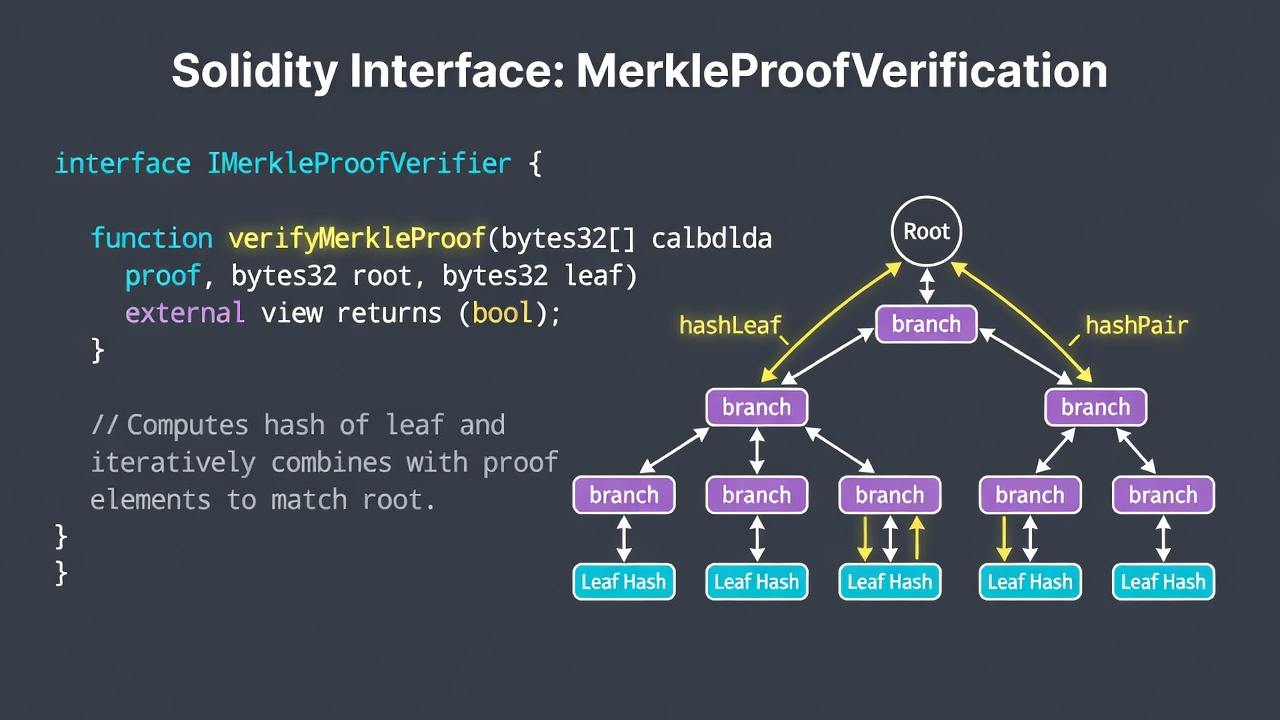
Additional integration considerations include event emission for off-chain indexers to track root changes and support for delegated verification through meta-transactions.
Gas Cost Comparisons and Optimization Techniques
Merkle verification typically costs 20-40k gas per proof in optimized 0.8.x contracts, versus hundreds of thousands for on-chain storage checks. Benchmarks from recent deployments show that batch verification can reduce per-user costs by up to 60% when proofs share common nodes. Optimize by sorting leaves during tree construction and using assembly for hash operations where appropriate. Avoid unnecessary storage reads during verification. Compare this approach to alternatives like ECDSA signatures, which may cost more per verification but offer different flexibility for revocation. In practice, Merkle trees excel when the dataset is static or changes infrequently, while hybrid models combining trees with signatures provide the best of both worlds for highly dynamic scenarios.
Common Attack Vectors and Mitigation Steps
Attack vectors include proof forgery through hash collisions, front-running root updates, and replay attacks with old proofs. Mitigate these by using keccak256 with domain separation, implementing nonce or timestamp checks in leaves, requiring signatures alongside proofs for high-value operations, and following Solidity security guidelines. Additional vectors involve malicious leaf construction that exploits unsorted trees or duplicate entries. To counter this, enforce unique leaf generation by including user addresses and nonces during tree building. Front-running can be addressed with commit-reveal schemes or by requiring the proof submission within a narrow time window after root publication. Regular audits aligned with 2026 standards from firms like OpenZeppelin are recommended. Reference further reading at ethereum.org for broader smart contract security patterns.
Testing Scenarios with Foundry
Use Foundry for comprehensive testing. Write fuzz tests that generate random proofs and verify edge cases such as invalid siblings or empty trees. Include tests for gas usage and failure modes. Reference the Foundry documentation for advanced cheatcodes. A robust test suite should cover valid proofs, tampered proofs, duplicate leaf handling, and root update flows. For example, simulate a full airdrop claim sequence across multiple blocks while asserting correct state transitions and gas bounds. Integration tests with mainnet fork data help validate real-world performance before deployment.
Common Mistakes to Avoid
Developers often overlook leaf uniqueness, leading to potential collisions. Another frequent error is failing to update proofs after root rotation, leaving users unable to claim. Always implement off-chain proof regeneration services and communicate changes via indexed events. Avoid storing proofs on-chain as this defeats the scalability purpose. Finally, never expose the full Merkle tree in the contract ABI, as this could leak sensitive membership data.
FAQ: Edge Cases Like Proof Updates
How do I handle proof updates after root changes? Issue new proofs off-chain and notify users via events. Store a grace period in the contract to accommodate transition windows.
What if a leaf needs revocation? Remove it from the new tree and update the root; old proofs will fail verification automatically.
Are there risks with duplicate leaves? Yes, always ensure unique leaves by salting with addresses or indices. See best practices at ethereum.org.
How should proofs be generated for very large datasets? Use incremental tree libraries and shard the dataset into multiple roots when exceeding practical memory limits during construction.
Can Merkle trees be combined with other access control methods? Absolutely, pairing them with role-based access or time-locks adds defense-in-depth for critical operations.
Conclusion
Secure Merkle tree patterns empower developers to build scalable Solidity contracts without compromising security. By following the implementations and mitigations outlined, your contracts will meet 2026 standards for efficiency and robustness. Start experimenting with the provided code examples and expand based on your specific use case, always prioritizing thorough testing and audits.


No comments yet. Be the first!