 CryptoChain Blog

Introduction to Enterprise Solidity Security in 2026
Enterprise adoption of Solidity smart contracts has accelerated dramatically as organizations across finance, supply chain, and other regulated industries seek blockchain solutions capable of handling complex business logic. In 2026, the emphasis has moved well beyond basic functionality toward robust, enterprise-grade security architectures that satisfy stringent regulatory demands, ensure scalability under high transaction volumes, and integrate seamlessly with existing legacy systems. This comprehensive guide examines proven patterns and workflows for building secure contracts that can withstand rigorous audits and operational pressures typical of large organizations.
Business environments require far more than standard open-source templates. They demand sophisticated permissioned access controls, comprehensive audit workflows, and risk-mitigation strategies tailored to high-stakes deployments. Throughout this article, we provide in-depth analysis, multiple practical code examples, step-by-step implementation guidance, and direct comparisons between approaches to help enterprise teams make informed decisions.
Regulatory Considerations for Enterprise Smart Contracts
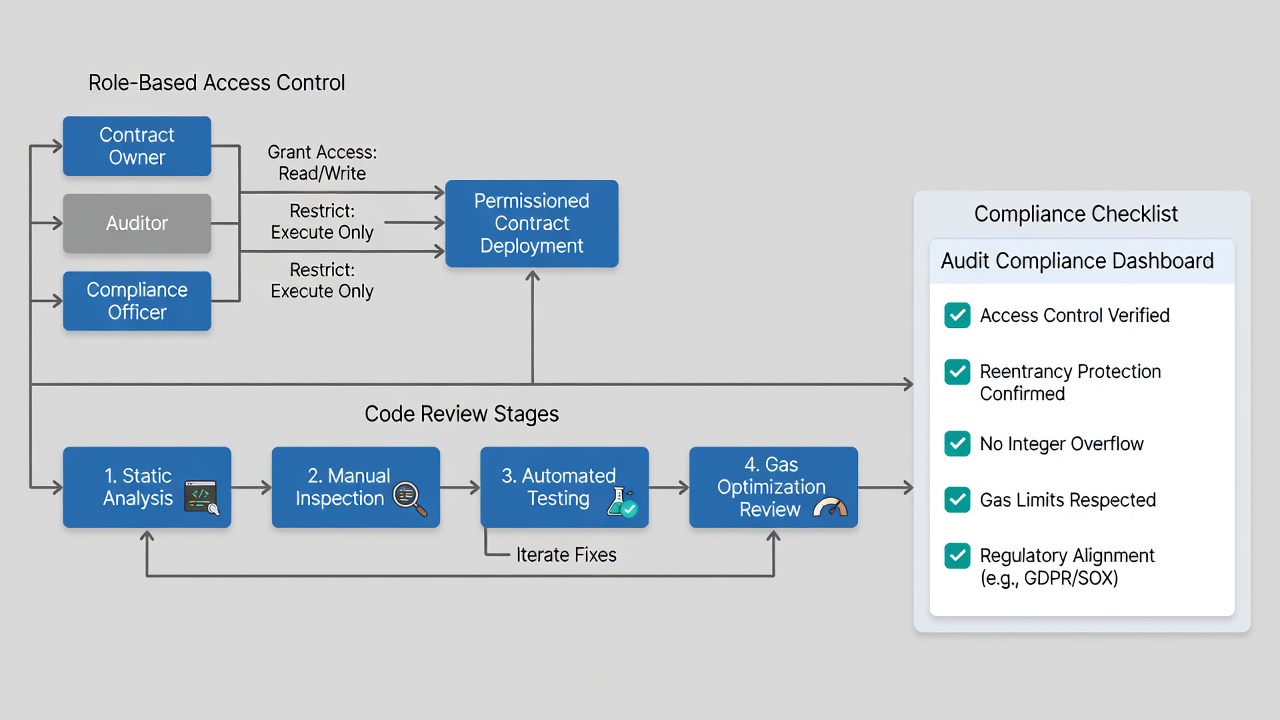
Regulatory frameworks in 2026 place heavy emphasis on data privacy, anti-money laundering compliance, and cross-border transaction transparency. Enterprises must embed these requirements directly into contract logic rather than treating them as afterthoughts. Role-based permissions, for example, ensure that only pre-approved entities can invoke sensitive functions such as asset transfers or data modifications. Developers should also incorporate immutable audit trails that support real-time reporting to oversight bodies.
Key regulatory influences include evolving European Union directives and U.S. financial oversight guidelines. Teams frequently reference authoritative resources such as Ethereum Foundation resources when designing compliant decentralized applications that meet these standards.
Permissioned Access Models
Enterprise deployments typically operate on permissioned or hybrid networks rather than fully public blockchains. These models restrict contract interactions to verified participants through multi-signature wallets, on-chain identity verification, and role hierarchies. Implementing such models reduces attack surfaces while satisfying internal governance policies.
Implementation Steps
- Define granular roles using Solidity modifiers for owner, auditor, operator, and compliance officer levels.
- Integrate with enterprise identity providers through secure oracle feeds that validate off-chain credentials.
- Implement time-locked execution for high-impact operations to allow review windows.
- Add emergency pause mechanisms that can be triggered only by designated roles.
Below is an expanded code example demonstrating a robust role-based access control pattern suitable for enterprise use:
pragma solidity ^0.8.20;

import "@openzeppelin/contracts/access/AccessControl.sol";
contract EnterpriseAccess is AccessControl {
    bytes32 public constant AUDITOR_ROLE = keccak256("AUDITOR_ROLE");
    bytes32 public constant OPERATOR_ROLE = keccak256("OPERATOR_ROLE");
    constructor() {
        _grantRole(DEFAULT_ADMIN_ROLE, msg.sender);
    }
    function addAuditor(address account) external onlyRole(DEFAULT_ADMIN_ROLE) {
        grantRole(AUDITOR_ROLE, account);
    }
    modifier onlyAuditor() {
        require(hasRole(AUDITOR_ROLE, msg.sender), "Not auditor");
        _;
    }
}
This pattern leverages established libraries and can be extended with additional modifiers for time locks and multi-signature requirements.
Audit Workflows Tailored for Large Organizations
Enterprise audit workflows combine automated static analysis, formal verification, dynamic testing, and manual expert review. A typical phased process begins with automated scanning for common vulnerabilities, proceeds to mathematical proofs of correctness for critical functions, and concludes with simulated attack scenarios. This layered approach dramatically reduces the likelihood of post-deployment exploits.
Standard open-source contracts frequently lack enterprise-specific safeguards such as controlled upgradeability, gas optimization for high-volume environments, and built-in compliance hooks. Customized security layers add circuit breakers, role-based emergency stops, and detailed event logging that supports regulatory inquiries.
Developers should consult Official Solidity documentation and extend these patterns with organization-specific controls.
Scalability and Performance Considerations
Enterprise contracts must handle thousands of transactions per minute without excessive gas costs or network congestion. Techniques include batch processing of operations, optimized data structures that minimize storage writes, and layer-2 scaling solutions that maintain security guarantees. Teams should benchmark contract performance under peak loads during the testing phase to identify bottlenecks early.
Integration Challenges with Enterprise Systems
Connecting Solidity contracts to existing ERP, CRM, and database infrastructures introduces unique challenges around data consistency, latency, and security. Secure oracles and API gateways serve as bridges while preserving permissioned access. Organizations often deploy middleware layers that translate between on-chain events and off-chain workflows, ensuring that every state change is logged and auditable.
Step-by-Step Implementation Guide
Follow this structured process when deploying enterprise contracts: first, map all business requirements and regulatory obligations; second, design role hierarchies and access matrices; third, write and unit-test core logic; fourth, conduct internal reviews; fifth, engage external auditors; and finally, deploy with monitoring and incident response plans in place. Each phase should include documentation that can be presented to regulators or internal compliance teams.
Real-World Case Studies
Finance Sector
A leading global bank deployed a permissioned Solidity contract suite for tokenized bond settlement. The implementation featured multi-party computation for transaction privacy and produced immutable compliance logs that satisfied 2026 regulatory examinations. Settlement cycles shortened from multiple days to under ten minutes while maintaining full auditability.
Supply Chain Sector
A multinational logistics provider built customized contracts to track high-value shipments across dozens of partners. Permissioned access prevented data leakage, and integrated oracles delivered real-time provenance verification. The project avoided reentrancy and access-control vulnerabilities that had plagued earlier public-network attempts.
Common Pitfalls to Avoid
- Neglecting upgradeability controls, which can result in permanently frozen assets during necessary updates.
- Insufficient load testing of permissioned roles, leading to unexpected failures during peak business hours.
- Ignoring cumulative gas costs in high-frequency transaction environments, eroding operational efficiency.
- Failing to maintain detailed, regulator-ready audit trails that document every state change.
- Over-reliance on unmodified community libraries without adding enterprise-specific safeguards.
Comparison of Standard vs. Customized Security Approaches
Standard approaches leverage community libraries for rapid prototyping but typically require extensive modifications to meet enterprise governance and compliance needs. Customized security implementations incorporate proprietary controls and extended testing cycles, increasing upfront development effort yet delivering measurably lower long-term risk exposure. Decision-makers should evaluate total cost of ownership, including potential regulatory penalties, when choosing between the two paths.
Conclusion
Building enterprise-grade secure Solidity contracts in 2026 requires deliberate attention to regulatory alignment, permissioned access design, rigorous auditing, and scalable integration. The patterns, code examples, and workflows presented here equip teams to deliver solutions that perform reliably across finance and supply chain applications while satisfying stakeholder and regulatory expectations.
FAQ
How do enterprises handle contract upgrades securely?
Proxy patterns combined with timelocks and multi-signature approvals allow controlled, reviewable upgrades without disrupting ongoing operations.
What tools are recommended for automated audits?
Teams typically combine static analyzers, formal verification platforms, and fuzzing tools specifically tuned for Solidity codebases.
Can these contracts integrate with existing ERP systems?
Yes, through secure oracle networks and API gateways that enforce the same permissioned access rules used on-chain.
How long does a typical enterprise audit workflow take?
Depending on contract complexity, the full process from initial scan to final report usually spans four to eight weeks for large organizations.
What emerging trends will shape Solidity security in late 2026?
Zero-knowledge proof integration for privacy-preserving compliance checks and AI-assisted vulnerability detection are gaining rapid adoption.


No comments yet. Be the first!