 CryptoChain Blog

Introduction to ERC-1155 and Its Security Needs
ERC-1155 has become the standard for multi-token contracts on Ethereum, allowing both fungible and non-fungible tokens in a single contract. Developers in 2026 need robust security patterns to handle batch operations safely while avoiding common vulnerabilities. This tutorial provides a complete guide to building production-ready ERC-1155 contracts using modern Solidity practices, with emphasis on gas efficiency, access control, and protection against reentrancy and overflow issues.
Compared to ERC-20 for fungible tokens and ERC-721 for NFTs, ERC-1155 offers superior efficiency for projects managing multiple asset types. It reduces deployment costs and enables atomic batch transfers that ERC-20 and ERC-721 cannot match natively. Understanding these differences is critical for developers transitioning from single-token standards to multi-token environments.
ERC-1155 vs ERC-20 and ERC-721: Key Differences
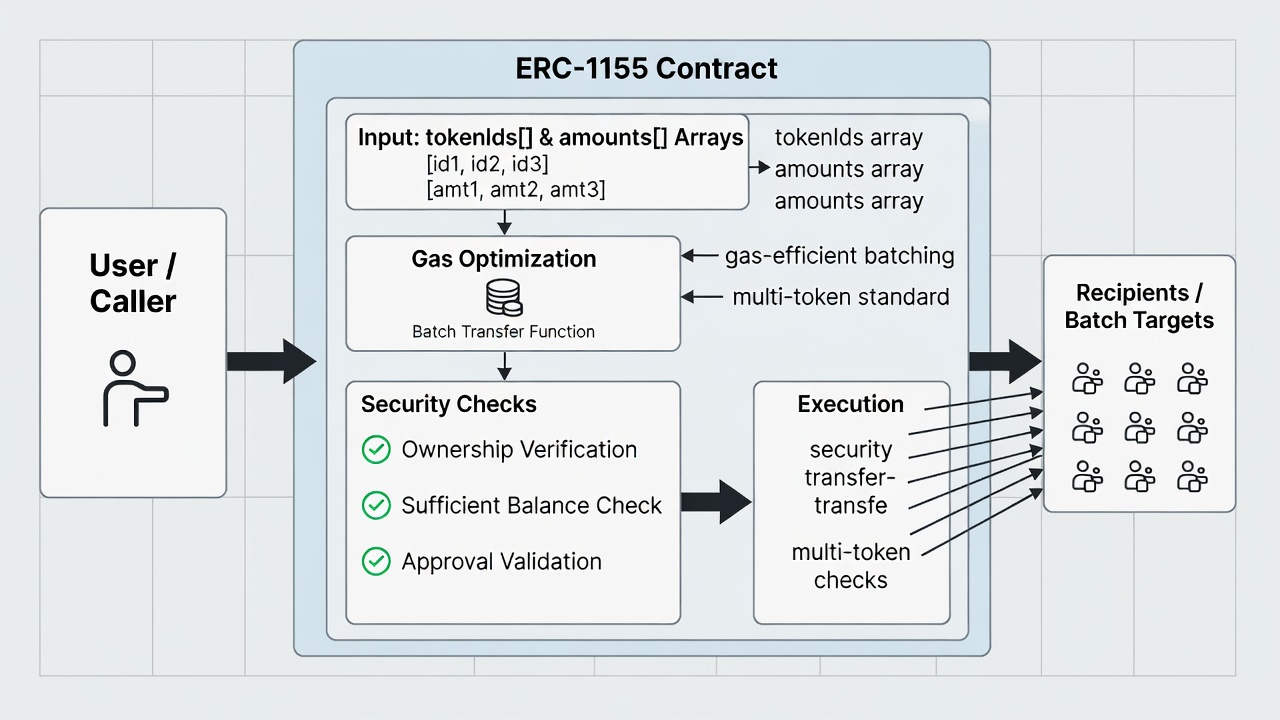
ERC-20 focuses solely on fungible tokens with simple transfer functions, requiring separate approvals and transfers for each token type. ERC-721 handles unique NFTs but requires separate contracts for different collections and lacks native batch support. ERC-1155 unifies both paradigms, supporting id-based token types and batch methods like safeBatchTransferFrom, which can move multiple token ids and amounts in one transaction.
Security implications include the need for stronger input validation on batch arrays and protection against reentrancy during multiple token movements. Gas savings from batching must be balanced against potential denial-of-service vectors if arrays grow too large. For example, an ERC-1155 contract can represent both in-game currencies (fungible) and rare items (non-fungible) without deploying multiple contracts, lowering attack surface while increasing complexity in access control.
Setting Up the Development Environment
Begin by installing Foundry, the preferred framework in 2026 for Solidity development due to its speed and integrated testing. Run foundryup to get the latest version, then initialize a new project with forge init. Add OpenZeppelin contracts via forge install OpenZeppelin/openzeppelin-contracts for battle-tested base implementations. This setup allows rapid iteration on secure patterns without reinventing core token logic.
Secure Contract Implementation
We start with OpenZeppelin’s ERC1155 base and add custom security layers. The contract below demonstrates access control via Ownable and reentrancy guards. Each function includes explicit checks to prevent unauthorized minting or unsafe transfers.
pragma solidity ^0.8.20;
import "@openzeppelin/contracts/token/ERC1155/ERC1155.sol";
import "@openzeppelin/contracts/access/Ownable.sol";
import "@openzeppelin/contracts/utils/ReentrancyGuard.sol";

contract SecureMultiToken is ERC1155, Ownable, ReentrancyGuard {
    constructor(string memory uri) ERC1155(uri) Ownable(msg.sender) {}

    function mint(address to, uint256 id, uint256 amount, bytes memory data)
        public onlyOwner
    {
        _mint(to, id, amount, data);
    }

    function safeBatchTransferFrom(
        address from,
        address to,
        uint256[] memory ids,
        uint256[] memory amounts,
        bytes memory data
    ) public override nonReentrant {
        require(ids.length == amounts.length, "Array length mismatch");
        require(ids.length <= 50, "Batch too large");
        super.safeBatchTransferFrom(from, to, ids, amounts, data);
    }
}
Gas-Efficient Batch Transfers
Batch transfers reduce gas per token compared to individual calls. Always validate array lengths match and use unchecked blocks only after bounds checking to prevent integer overflows, a risk mitigated in Solidity 0.8+ but still relevant for custom math. In practice, limit batch sizes to 50 items to avoid out-of-gas errors on mainnet, and emit events for off-chain indexing of large operations.
Metadata Handling and URI Management
Store metadata URIs per token id using a mapping. Override uri() to support dynamic metadata. Consider IPFS or Arweave for immutable storage and include a fallback mechanism for upgrades. Proper metadata handling prevents front-running attacks where malicious actors could replace token descriptions during minting.
Access Control and Reentrancy Protection
Beyond Ownable, consider role-based access with AccessControl for granular permissions. Always wrap external calls in nonReentrant modifiers. Test scenarios where a malicious contract attempts reentrancy during batch transfers to ensure state updates occur before external interactions.
Upgrade Safety Patterns
Use the UUPS proxy pattern from OpenZeppelin for upgradeability. Ensure initializer functions are protected and storage slots remain consistent across versions. Test upgrade scenarios thoroughly with Foundry by simulating proxy deployments and verifying that existing token balances persist after upgrades.
Common Pitfalls and How to Avoid Them
- Integer overflows: Rely on Solidity 0.8 checked arithmetic and add explicit require statements for custom calculations.
- Reentrancy: Always apply nonReentrant modifiers on state-changing external calls and follow the checks-effects-interactions pattern.
- Batch size limits: Enforce reasonable array length caps to avoid out-of-gas failures during high-load periods.
- Approval abuse: Use safeTransferFrom patterns and revoke approvals promptly after use.
- Metadata injection: Sanitize URI inputs to prevent malicious redirects.
Writing Comprehensive Foundry Test Cases
Write tests covering happy paths, edge cases, and attack vectors. Include fuzz testing for batch arrays and invariant checks for token balances.
function testBatchTransfer() public {
    uint256[] memory ids = new uint256[](2);
    uint256[] memory amounts = new uint256[](2);
    ids[0] = 1; amounts[0] = 100;
    ids[1] = 2; amounts[1] = 50;
    vm.prank(owner);
    token.mint(user1, 1, 100, "");
    vm.prank(user1);
    token.safeBatchTransferFrom(user1, user2, ids, amounts, "");
    assertEq(token.balanceOf(user2, 1), 100);
}
Security Checklist for 2026 Deployment
- Run static analysis with Slither and Mythril on every commit.
- Conduct formal verification where possible using tools like Certora.
- Perform multiple external audits from reputable firms.
- Test on testnets with realistic load and monitor gas usage.
- Monitor on-chain activity post-deployment using tools from ethereum.org.
- Implement circuit breakers for emergency pauses.
- Document all roles and permissions clearly.
Deployment Best Practices and Auditing FAQs
Deploy first to a testnet like Sepolia, verify source code on Etherscan, and gradually migrate liquidity or users. Always schedule audits at least four weeks before mainnet launch.
Q: When should I audit an ERC-1155 contract? A: Before mainnet deployment and after any significant upgrade to catch new attack surfaces.
Q: What tools are recommended in 2026? A: Foundry for testing, OpenZeppelin documentation for patterns, and Foundry book for advanced workflows. Additional guidance is available at Solidity documentation.
Following these practices ensures your multi-token contracts remain secure and efficient throughout 2026 and beyond. Regular updates to dependencies and continuous monitoring are essential for long-term safety.

No comments yet. Be the first!