 CryptoChain Blog
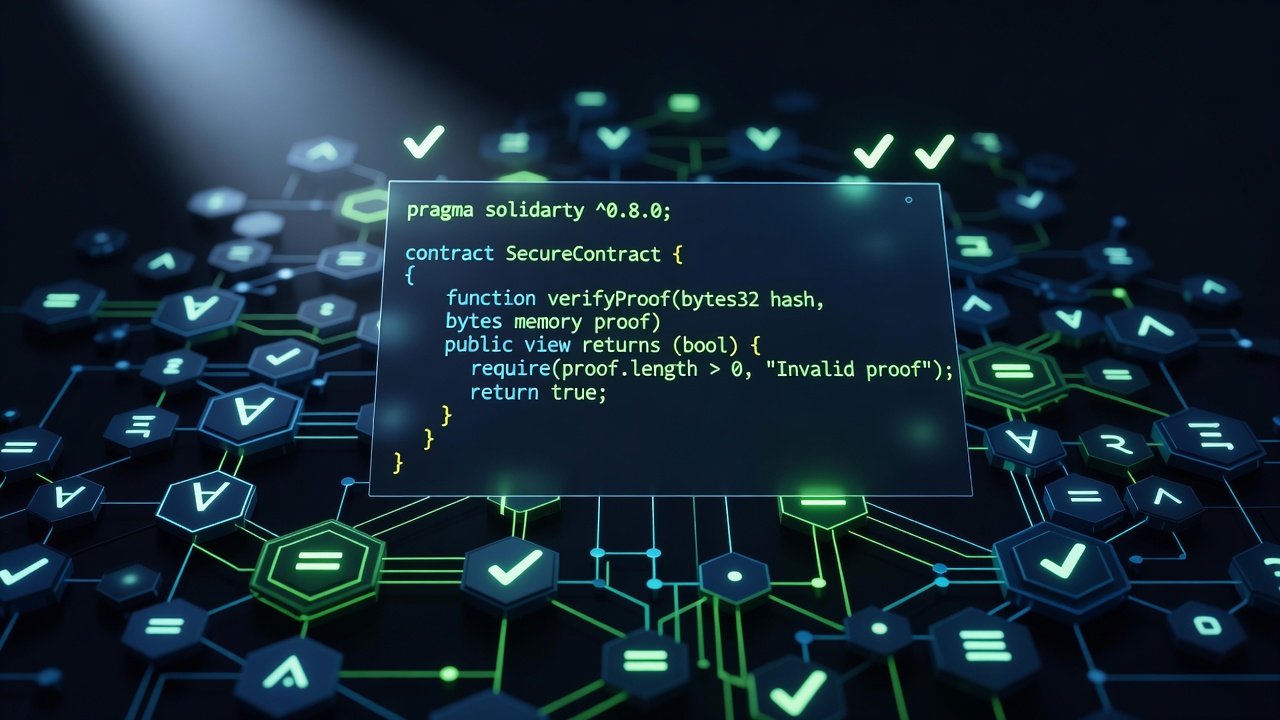
Introduction to Formal Verification in Solidity
Formal verification provides mathematical guarantees that smart contracts behave as intended, going far beyond traditional audits. In 2026, as DeFi protocols manage billions in value, developers increasingly turn to these methods to prevent exploits that have historically cost the ecosystem hundreds of millions. This guide explores advanced concepts, practical implementation, and integration strategies tailored for Solidity developers seeking robust security. Formal verification translates contract logic into mathematical models that can be exhaustively checked by specialized solvers, ensuring properties hold for every possible execution path rather than relying on sampled test cases.
Understanding Formal Verification Concepts
Formal verification uses mathematical proofs to confirm that a contract satisfies specified properties under all possible inputs. Unlike testing which samples scenarios, it exhaustively checks the state space. Key elements include invariants, pre- and post-conditions, and temporal logic. For Solidity, this means encoding rules like "the total supply never decreases unexpectedly" directly into verification tools. Developers define these properties in a specification language, after which an automated prover attempts to demonstrate that no counterexample exists. If a counterexample is found, it points to a specific input sequence that violates the property, allowing precise debugging.
Why Formal Verification Matters for 2026 Projects
With rising complexity in lending protocols, cross-chain bridges, and tokenized assets, exploits often stem from subtle logical flaws missed by fuzzing or manual reviews. Formal methods catch these early. They complement audits by providing machine-checked assurances, reducing post-deployment risks significantly. In an era where regulatory scrutiny on decentralized finance is increasing, projects that can demonstrate formally verified components gain a competitive edge in user trust and institutional adoption.
Theoretical Foundations of Formal Methods
At its core, formal verification draws from model checking and theorem proving. Model checking explores all reachable states of a finite-state system, while theorem proving uses deductive reasoning to establish properties from axioms. In the context of Solidity, tools abstract the EVM bytecode into logical formulas that capture storage, memory, and call semantics. This abstraction enables reasoning about reentrancy, overflow conditions, and access control without executing the contract on a live network.
Comparing Certora and Scribble Tools
Certora offers a powerful prover for Solidity that translates contracts into a formal language for automated theorem proving. It excels at complex invariants in production code. Scribble, on the other hand, provides an annotation-based approach that compiles to standard Solidity for easier adoption in testing pipelines. Certora suits teams needing deep guarantees, while Scribble integrates faster into CI/CD workflows. Both support Ethereum's latest EVM features as of 2026. Certora's strength lies in its ability to handle large codebases with minimal annotation overhead, whereas Scribble emphasizes readability and gradual adoption by allowing developers to embed specifications directly in comments.
Visit Certora's official site for documentation and examples.
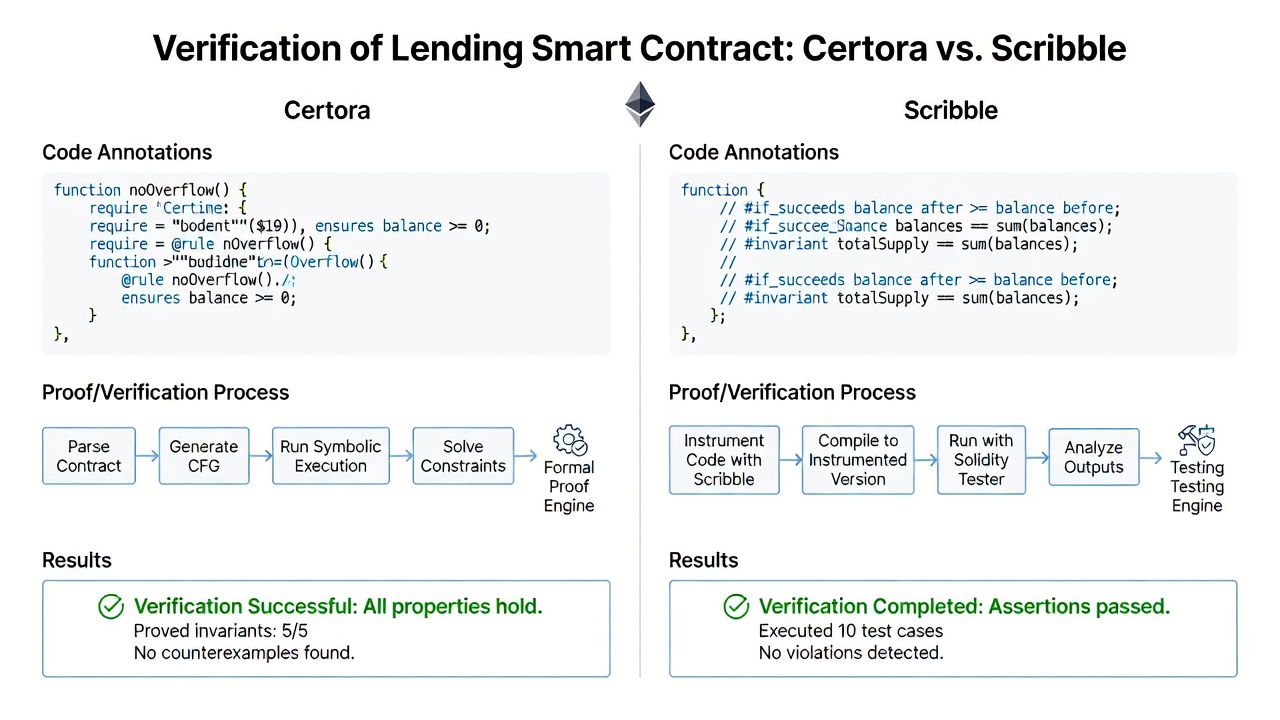
Step-by-Step Walkthrough: Verifying a Lending Contract
Consider a simplified lending contract with deposit and borrow functions. First, define the specification using tool-specific syntax. For Certora, write a spec file asserting that collateralization ratios remain above thresholds. Run the prover to check for violations. If a counterexample appears, refine the contract logic or spec. Include code snippets like:
function deposit(uint amount) external { balances[msg.sender] += amount; totalSupply += amount; }Verify the invariant that totalSupply equals the sum of all balances. Next, add a borrow function and specify that borrowed amounts cannot exceed collateral value multiplied by a liquidation threshold. The verification process involves compiling the contract alongside the specification, invoking the prover, and interpreting results. In practice, teams iterate multiple times, adding helper lemmas to guide the prover when initial attempts time out. This walkthrough demonstrates how to encode business logic such as interest accrual rules into verifiable assertions.
Integration with Existing Solidity Workflows
Incorporate formal verification into Foundry or Hardhat pipelines by running verifiers as additional test stages. Start with annotations during development, then escalate to full proofs before mainnet deployment. This hybrid approach minimizes overhead while maximizing coverage. For example, a typical workflow might involve writing Scribble annotations during feature development, running automated checks on every pull request, and reserving Certora for final verification of core modules. Integration also extends to continuous integration systems where verification reports are generated as artifacts for audit teams.
Explore Solidity documentation for compatible language features.
Limitations Compared to Fuzz Testing
Formal verification demands precise specifications and can face scalability issues with very large contracts. Fuzz testing like Echidna provides rapid feedback on random inputs but may miss edge cases. The optimal strategy combines both: use fuzzing for exploration and formal methods for critical invariants. Limitations include the need for domain expertise in writing specifications and potential computational costs for contracts with extensive state variables. Developers must also account for the fact that verification applies only to the modeled properties, not necessarily to every external dependency or oracle interaction.
Advanced Techniques and Best Practices
Beyond basic invariants, advanced users leverage modular verification by breaking contracts into smaller verifiable units. Techniques such as loop invariants and ghost variables help manage complexity in iterative operations like reward distributions. Best practices include starting with the most critical functions, maintaining a living specification document, and regularly updating proofs after contract upgrades. Teams often maintain a verification dashboard that tracks which properties remain proven after each change.
Practical Checklist for Adoption
- Identify high-value invariants in your contract.
- Choose a tool matching your team's expertise.
- Write modular specifications that can be reused across versions.
- Iterate on counterexamples promptly and document each resolution.
- Document verified properties for auditors and stakeholders.
- Schedule regular re-verification after upgrades or dependency changes.
- Combine with static analysis and fuzz testing for layered defense.
- Train the team on specification writing through internal workshops.
Frequently Asked Questions
What skills are needed to start with formal verification?
Basic knowledge of Solidity and logical reasoning suffice initially; tools abstract much of the underlying math. Over time, familiarity with first-order logic improves efficiency in writing specifications.
How long does verification take for a typical contract?
Simple contracts verify in minutes, while complex ones may require hours of compute time depending on the prover and the number of properties checked.
Is formal verification replacing audits in 2026?
No, it augments them by providing complementary guarantees that auditors can reference when assessing overall security posture.
What are common mistakes when adopting these tools?
Over-specifying trivial properties or neglecting to verify upgrade mechanisms are frequent pitfalls that reduce the value of the effort.
Conclusion
Formal verification elevates Solidity security to a new level, essential for 2026's sophisticated decentralized applications. By mastering tools like Certora and Scribble and following structured processes, developers can build contracts that withstand rigorous scrutiny. Begin integrating these practices today to future-proof your projects against emerging threats and regulatory expectations.


No comments yet. Be the first!