 CryptoChain Blog

Cross-chain interoperability has become essential for decentralized applications in 2026. Developers building on Ethereum and other EVM-compatible chains need robust methods to transfer assets and data securely without exposing contracts to common bridge exploits. This tutorial provides a complete guide to developing secure cross-chain smart contracts in Solidity while minimizing vulnerabilities associated with messaging protocols. As blockchain ecosystems continue to fragment across dozens of Layer 1 and Layer 2 networks, the ability to move value and state safely between chains is no longer optional but a core requirement for scalable DeFi, gaming, and enterprise solutions.
Understanding Cross-Chain Security Challenges
Bridges act as intermediaries between blockchains, but they introduce risks such as message replay, unauthorized access, and improper data validation. A well-designed contract must verify the origin of cross-chain messages, enforce strict permissions, and validate all incoming data before executing state changes. Historical incidents have shown that even minor oversights in message authentication can lead to total loss of funds. In 2026, the threat landscape includes sophisticated attacks targeting both the bridge infrastructure and the destination contracts themselves. Developers must therefore adopt a defense-in-depth strategy that combines protocol-level guarantees with application-level checks.
Selecting Safe Messaging Protocols
Choosing the right protocol is the foundation of secure development. Popular options include LayerZero, Axelar, and Chainlink CCIP. Each offers different security models based on decentralized oracle networks or light-client verification. Always review the protocol's audit history and decentralization level before integration. For most Solidity developers, protocols with built-in replay protection and configurable finality thresholds provide the strongest starting point. When evaluating options, consider factors such as latency, cost of messaging, and the size of the validator or oracle set. A protocol with fewer but highly reputable validators may offer better security than one relying on a large but less vetted network. It is also advisable to monitor community discussions and recent security reports from independent researchers.
Implementing Access Controls for Cross-Chain Calls
Access control prevents unauthorized parties from triggering sensitive functions. Use OpenZeppelin's AccessControl or Ownable patterns extended with cross-chain message verification. Only the designated bridge contract or a verified relayer should be allowed to call functions that handle incoming messages. Advanced patterns include role-based access where different roles are granted to specific cross-chain endpoints, allowing fine-grained permissions such as pausing transfers or upgrading logic. These controls should be upgradeable only through a timelock mechanism to give users time to react to any proposed changes.
Data Validation Best Practices
Every cross-chain message must be validated for source chain ID, sender address, and payload integrity. Implement checks that reject messages from unknown chains or contracts. Use cryptographic signatures or Merkle proofs when available to confirm authenticity. Additional validation layers can include checking block confirmations on the source chain and verifying that the message timestamp falls within an acceptable window to prevent delayed replay attempts. Developers should also sanitize all decoded parameters to avoid integer overflows or unexpected enum values.
Practical Code Example: Simple Asset Transfer Contract
Below is a minimal yet secure asset transfer contract demonstrating the core patterns. It uses a generic messaging interface for illustration and includes extended validation logic.
pragma solidity ^0.8.20;
import "@openzeppelin/contracts/access/Ownable.sol";
import "@openzeppelin/contracts/security/ReentrancyGuard.sol";
contract CrossChainAssetTransfer is Ownable, ReentrancyGuard {
    mapping(uint256 => bool) public processedNonces;
    mapping(uint256 => address) public allowedBridges;
    event AssetTransferred(uint256 indexed destChain, address indexed to, uint256 amount, uint256 nonce);
    event MessageReceived(uint256 indexed sourceChain, address indexed from, uint256 amount, uint256 nonce);
    function setBridge(uint256 chainId, address bridge) external onlyOwner {
        allowedBridges[chainId] = bridge;
    }
    function sendAsset(uint256 destChain, address to, uint256 amount, uint256 nonce) external onlyOwner nonReentrant {
        require(!processedNonces[nonce], "Nonce used");
        processedNonces[nonce] = true;
        // Integrate with chosen messaging protocol send function
        emit AssetTransferred(destChain, to, amount, nonce);
    }
    function receiveAsset(uint256 sourceChain, address from, uint256 amount, uint256 nonce, bytes calldata proof) external nonReentrant {
        require(msg.sender == allowedBridges[sourceChain], "Unauthorized bridge");
        require(validateMessage(sourceChain, from, amount, nonce, proof), "Invalid message");
        processedNonces[nonce] = true;
        // Execute mint or unlock logic here
        emit MessageReceived(sourceChain, from, amount, nonce);
    }
    function validateMessage(uint256 sourceChain, address from, uint256 amount, uint256 nonce, bytes calldata proof) internal view returns (bool) {
        // Replace with protocol-specific verification
        return true;
    }
}
Extend the validation function with protocol-specific verification logic before production use. Consider adding events for every state change to facilitate off-chain monitoring and incident response.
Step-by-Step Deployment on Testnets
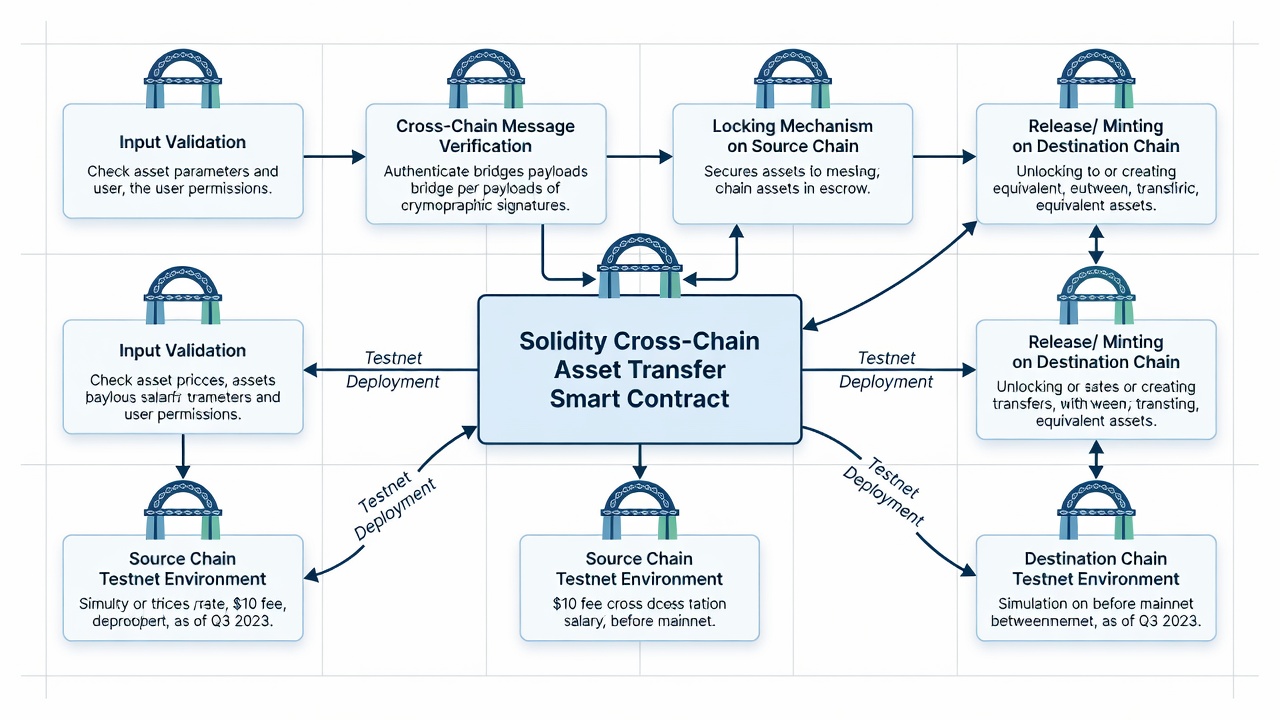
- Deploy the contract on Sepolia and a secondary testnet such as Base Sepolia using Hardhat or Foundry scripts.
- Register the contract addresses with your chosen messaging protocol dashboard and obtain the required endpoint IDs.
- Configure allowed source and destination chains in the contract constructor or initializer, including setting up role permissions.
- Test a round-trip transfer using the protocol's testnet relayer while monitoring gas usage and event logs.
- Verify events and state changes on both chains using block explorers and write automated tests that simulate malicious message attempts.
- Conduct a final security review focusing on access control modifiers and nonce handling before scaling to additional testnets.
Comparing Popular Bridge Options
- LayerZero: Lightweight messaging with configurable security stacks. Strong for custom applications requiring low latency and flexible oracle choices.
- Axelar: General message passing with built-in governance and high decentralization, suitable for applications needing robust cross-chain governance features.
- Chainlink CCIP: Oracle-based with robust risk management and widespread adoption across major DeFi protocols, offering additional features such as programmable token transfers.
Evaluate each option against your application's threat model and required throughput. Many teams begin with a single protocol and later implement abstraction layers to support multiple bridges for redundancy.
Common Risks and Mitigations
Replay attacks remain a top concern. Always track processed message nonces or hashes. Gas optimization can be achieved by batching validations and using efficient storage patterns such as mappings over arrays when possible. Additional risks include front-running of cross-chain messages and denial-of-service through spam transactions; these can be mitigated with rate limiting and commit-reveal schemes. Regular audits by firms experienced in cross-chain systems are strongly recommended.
Testing, Auditing, and Maintenance
Comprehensive testing should cover happy paths, edge cases, and adversarial scenarios. Use tools like Foundry's fuzz testing to simulate thousands of message variations. After deployment, establish a monitoring system that alerts on unexpected events or large transfers. Plan for contract upgrades through proxy patterns while ensuring that upgrade keys are stored securely and subject to multi-signature requirements.
FAQ
How do I prevent replay attacks in cross-chain contracts?
Implement a nonce or message hash mapping that marks each processed message as completed. Reject any duplicate submissions immediately. Combine this with source chain and sender verification for layered protection.
What are the best practices for gas optimization?
Use calldata instead of memory where possible, minimize storage writes, and cache protocol addresses in immutable variables. Batch multiple operations when the messaging protocol supports it and avoid unnecessary external calls during message processing.
Which bridge is safest for production in 2026?
No single bridge is universally safest. Conduct independent audits and prefer protocols with multiple independent security committees or light-client verification. Review recent audit reports and on-chain activity before committing significant value.
For further reference on Solidity best practices, consult the official documentation at soliditylang.org and core Ethereum resources at ethereum.org. Additional guidance on access control patterns is available at openzeppelin.com. Always test thoroughly on public testnets before mainnet deployment and maintain ongoing security monitoring.

No comments yet. Be the first!