 CryptoChain Blog

Introduction to Solidity Smart Contract Auditing in 2026
Smart contract vulnerabilities continue to pose significant risks in decentralized applications. As blockchain ecosystems evolve, developers need robust auditing tools to identify issues like reentrancy, integer overflows, and access control flaws before deployment. This guide examines the top security tools for auditing Solidity smart contracts in 2026, focusing on practical comparisons, setup instructions, and integration strategies that help teams build more secure protocols. Effective auditing combines static analysis, dynamic testing, and fuzzing to catch problems that manual reviews might miss. Leading options include open-source solutions that integrate seamlessly into developer workflows. Whether you manage small DeFi projects or large-scale protocols, selecting the right combination of tools enhances security without excessive overhead. In 2026, the complexity of smart contracts has grown with new Solidity features and cross-chain interactions, making automated tools essential for maintaining trust in the ecosystem.
Many high-profile incidents in previous years underscore the need for thorough testing. Developers who skip structured audits often face costly exploits that could have been prevented with the right tooling. This article goes beyond surface-level descriptions to provide actionable guidance on using Slither, Echidna, and Foundry effectively.
Comparing Leading Auditing Tools: Slither, Echidna, and Foundry
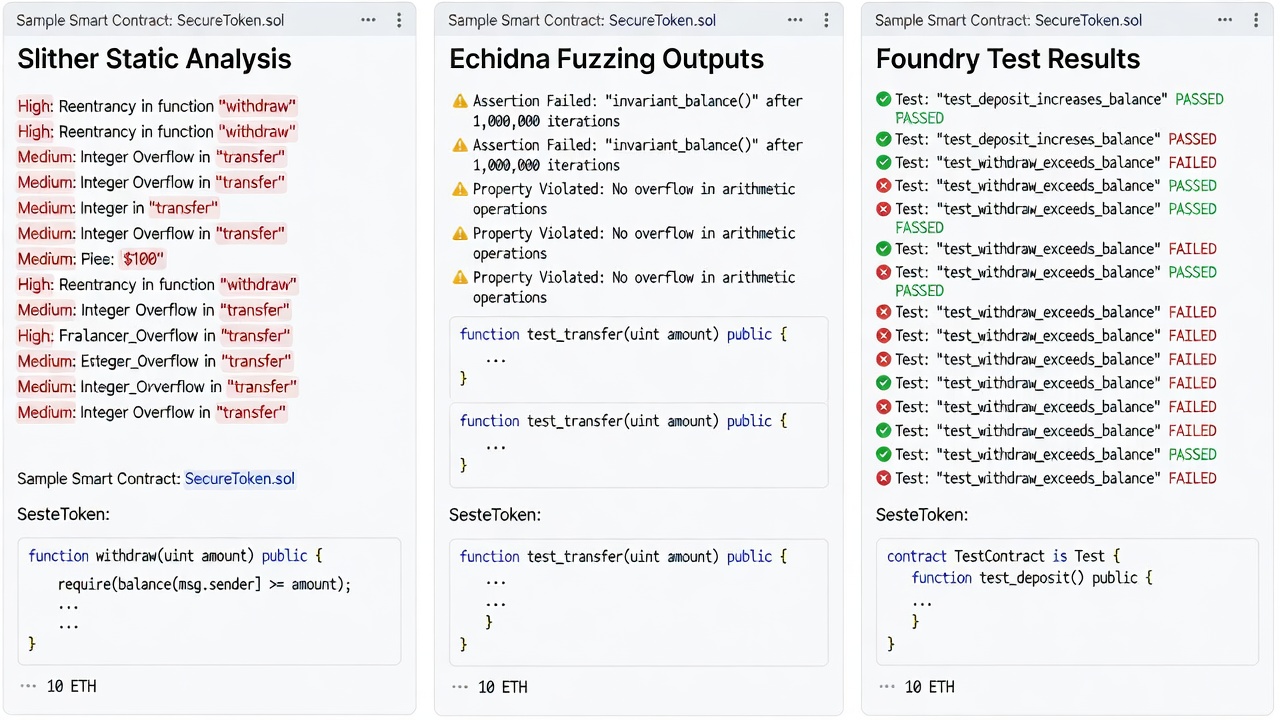
Slither provides static analysis for rapid vulnerability detection across large codebases. It excels at identifying structural issues such as uninitialized variables and dangerous delegate calls. Echidna excels at property-based fuzzing to uncover edge-case exploits that only appear under specific transaction sequences. Foundry offers a comprehensive framework with built-in testing and invariant checks, allowing developers to write tests in Solidity itself. In direct comparisons, Slither detects common patterns quickly but may miss runtime behaviors that Echidna reveals through mutation testing. Foundry balances both by supporting scripted tests alongside symbolic execution capabilities. Key metrics include detection accuracy, ease of use, and scalability. Slither requires minimal configuration for basic scans, while Echidna demands custom invariants for optimal results. Foundry's speed advantage stems from its Rust-based implementation, making it suitable for iterative development cycles. Teams often run Slither first for quick feedback, then layer Echidna and Foundry for deeper validation. This layered approach reduces the chance of missing subtle bugs that single-tool workflows frequently overlook.
Step-by-Step Setup for Slither on a Sample Vulnerable Contract
Consider this basic vulnerable contract with a reentrancy issue:
pragma solidity ^0.8.0;
contract Vulnerable {
    mapping(address => uint) public balances;
    function deposit() public payable { balances[msg.sender] += msg.value; }
    function withdraw(uint _amount) public {
        require(balances[msg.sender] >= _amount);
        (bool success, ) = msg.sender.call{value: _amount}("");
        require(success);
        balances[msg.sender] -= _amount;
    }
}
Install Slither via pip with the command pip install slither-analyzer. After installation, run the analysis using slither Vulnerable.sol. The tool outputs detected issues including reentrancy warnings and suggests remediation patterns such as using the checks-effects-interactions pattern. Developers can further customize detectors by creating configuration files that ignore low-priority findings or focus on specific vulnerability classes. This flexibility makes Slither valuable during early development stages when rapid iteration is required.
Setting Up Echidna for Fuzzing Tests
Echidna focuses on generating inputs to violate specified properties. After installing via Docker or source builds, create a configuration file defining invariants such as balance consistency after deposits and withdrawals. Execute tests with echidna-test Vulnerable.sol --contract Vulnerable. Review the corpus of failing tests to identify unexpected states that static tools might miss. Advanced users extend Echidna by writing custom property functions that model real-world usage scenarios, increasing the likelihood of discovering complex exploits involving multiple contract interactions.
Implementing Foundry for Comprehensive Testing
Foundry installation begins with curl -L https://foundry.paradigm.xyz | bash followed by foundryup. Initialize a project and write test cases in Solidity that cover both happy paths and adversarial scenarios. Use forge test to execute fuzzing campaigns that automatically explore contract states over thousands of iterations. Foundry also supports gas profiling and differential testing, giving developers insights into performance alongside security.
Integrating Tools into CI/CD Pipelines
Embed these auditors in GitHub Actions or GitLab CI by adding workflow steps that run scans on every pull request. For example, configure jobs to execute Slither and fail builds on high-severity findings. This automation catches issues early and maintains code quality across team contributions. Authoritative references like ethereum.org emphasize continuous verification practices. Extending the pipeline to include Echidna and Foundry runs ensures that both static and dynamic checks occur automatically. Teams can also archive reports for compliance audits and historical tracking of security posture over time.
Common False Positives and How to Avoid Them
Static tools often flag benign patterns as vulnerabilities, such as unused variables or safe arithmetic operations in newer Solidity versions. Mitigate by tuning detector severity levels and cross-verifying with dynamic tools. Maintain a suppression list for known safe constructs while documenting justifications. Regular review of false positive trends helps refine configurations and reduces alert fatigue among developers. Combining multiple tools typically lowers the overall false positive rate because dynamic confirmation eliminates many static-only warnings.
Other Notable Tools Worth Considering
Beyond the core three, tools like Mythril and Securify provide additional perspectives through symbolic execution and formal verification techniques. While they require more setup, they complement the primary stack for high-value contracts. Evaluating these options based on project needs prevents over-reliance on any single analyzer.
FAQ: Tool Selection Based on Project Size
- Small projects: Start with Slither for quick scans and Foundry for unit tests. This combination delivers fast results without heavy resource demands.
- Medium to large protocols: Combine Echidna fuzzing with Slither to cover both static and dynamic angles, ensuring broader attack surface coverage.
- Enterprise deployments: Layer all three plus external audits for maximum coverage, incorporating formal methods where regulatory requirements apply.
Quick Checklist for First-Time Users
- Clone the repository and install dependencies for each selected tool.
- Run initial static analysis with Slither and review all high-severity flags.
- Define invariants and execute Echidna campaigns on critical functions.
- Write Foundry tests covering critical paths and edge cases.
- Integrate results into CI/CD and review false positives systematically.
- Iterate based on findings before mainnet deployment and document all decisions.
Following this structured approach ensures thorough coverage of potential exploits. Additional resources are available at docs.soliditylang.org and docs.github.com for workflow automation. By investing time in proper tool configuration and pipeline integration, development teams significantly reduce the risk of costly vulnerabilities reaching production environments.

No comments yet. Be the first!