 CryptoChain Blog

Introduction to Gas Optimization in Secure Solidity Development
In 2026, Ethereum developers continue to face high transaction costs driven by network demand and L2 scaling patterns. Gas optimization remains essential for reducing deployment and execution expenses while preserving contract security. This guide focuses on techniques that maintain audit readiness, including storage packing, immutable variables, and efficient access control. Developers using Foundry can measure before-and-after results to validate savings without introducing reentrancy or overflow risks. Security and efficiency must be balanced. Premature optimization often creates vulnerabilities, so every change requires formal verification and testing. The following sections provide step-by-step examples, checklists, and tool recommendations drawn from current best practices. Understanding the EVM’s gas schedule helps developers prioritize changes that deliver meaningful savings without compromising the contract’s threat model.
Storage Packing Strategies
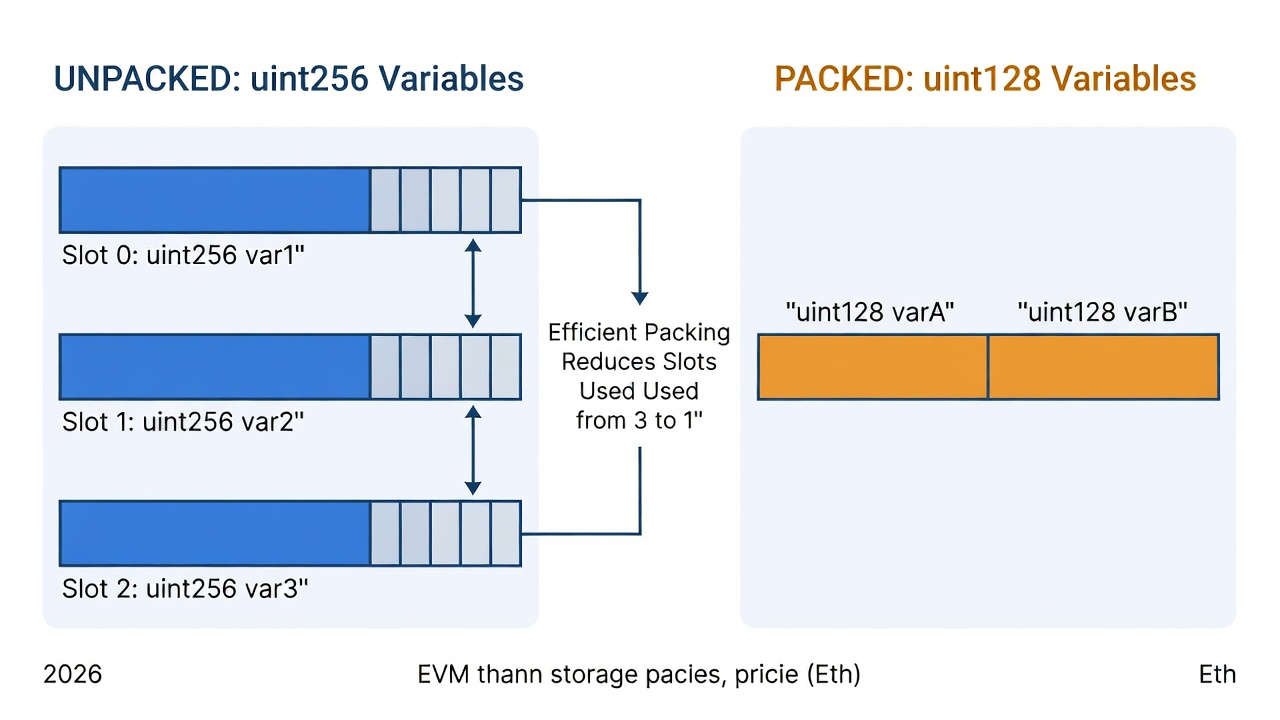
Storage slots in Solidity cost 20,000 gas for the first write and 5,000 gas for subsequent writes. Packing multiple variables into a single slot reduces these costs significantly. Consider a struct containing two uint128 values instead of two separate uint256 variables. Before packing, two storage writes consume 40,000 gas. After packing, a single write uses only 20,000 gas. Always verify slot alignment using Foundry’s gas reporter to confirm savings. Developers should also consider packing boolean flags with small integers when designing structs for user profiles or configuration data. A common pattern is to combine an address (160 bits) with two uint96 values to fill a 256-bit slot completely. This approach works especially well in token contracts where allowance mappings and balance tracking can share packed slots. However, developers must document the exact bit layout so auditors can verify that no unintended overwrites occur during upgrades.
Immutable and Constant Variables
Immutable variables are assigned once during construction and stored in the contract’s bytecode rather than storage. This eliminates repeated SLOAD operations. Declare configuration values such as owner addresses or fee percentages as immutable when possible. Constants are even cheaper because the compiler inlines their values directly. Use constants for values that never change after deployment. In practice, marking the contract owner as immutable can reduce every privileged function call by approximately 100 gas. When multiple constructors or factory patterns are involved, developers should pass immutable parameters through initializer functions on proxy deployments. This pattern maintains upgradeability while still benefiting from the gas savings of immutables. Testing should confirm that constructor arguments cannot be manipulated to bypass intended access restrictions.
Efficient Access Control Patterns
Traditional Ownable patterns can be optimized with custom modifiers that avoid unnecessary storage reads. Combine role-based checks with immutable owner variables to reduce gas while maintaining security guarantees. Always implement checks-effects-interactions to prevent reentrancy. Optimized access control should never bypass this order. A refined approach uses a single immutable admin address combined with a mapping for additional roles. This reduces the number of storage slots touched during common operations. Developers can further optimize by caching the result of access checks in memory within a single transaction when multiple privileged calls occur sequentially. Such caching must be carefully scoped so it does not create reentrancy vectors through external calls.
Additional Optimization Techniques
Beyond storage and access control, several other patterns deliver measurable savings. Using calldata instead of memory for function parameters that are not modified avoids unnecessary copying costs. Replacing dynamic arrays with fixed-size arrays when the maximum length is known reduces both deployment and runtime gas. Event emission can be streamlined by emitting only indexed parameters that are essential for off-chain indexing. Assembly-level snippets for tight loops should be used sparingly and only after thorough testing, as they increase audit complexity. Another useful technique is the use of transient storage opcodes introduced in recent EVM upgrades, which allow temporary data storage within a transaction without persistent state costs. When implementing these patterns, always compare gas usage across multiple compiler versions because optimizer settings can affect final bytecode size and execution cost.
Foundry Gas Benchmarking Workflow
Install Foundry and run gas snapshots before and after each optimization. The command forge test --gas-report produces detailed per-function metrics that highlight expensive operations. Compare results using the generated report. Typical savings from storage packing range between 15% and 30% on deployment costs, depending on contract complexity. Developers should maintain a dedicated test suite that asserts maximum gas limits for critical functions. This prevents regressions when new features are added. Integrating gas snapshots into CI pipelines ensures that any pull request exceeding predefined thresholds is flagged automatically. In addition, using forge coverage alongside gas reports provides insight into which code paths are most frequently executed and therefore most impactful to optimize.
Common Pitfalls and Security Checklists
Never pack variables across different types without explicit slot calculations. Always test for integer overflow using Solidity 0.8+ built-in checks. Run static analysis tools before mainnet deployment. Document every optimization for auditors. Additional pitfalls include assuming that smaller bytecode always means lower gas; sometimes larger but more optimized code executes cheaper. Another frequent mistake is removing redundant checks that auditors rely on for formal verification. The following checklist helps maintain security during optimization: review all state-changing functions for reentrancy vectors, verify that packed structs do not allow unintended value overwrites, confirm that immutable variables are set only in the constructor, ensure events still emit sufficient data for off-chain monitoring, and run differential tests comparing optimized and unoptimized contract behavior under identical inputs.
Recommended Tools and Resources
Developers should integrate Solidity documentation, Foundry book, and Ethereum developer resources into their workflow. These references provide up-to-date compiler behavior and EVM gas schedules. Additional useful tools include the OpenZeppelin Contracts library for battle-tested access control implementations and Slither for automated vulnerability detection. Combining these tools creates a robust development pipeline that catches both gas inefficiencies and security issues early.
FAQ
Does storage packing affect contract upgradability?
Storage packing requires careful layout management during upgrades. Use structured storage patterns and document slot assignments. Proxy contracts must preserve the exact storage layout across versions to avoid data corruption.
How do immutable variables impact formal verification?
Immutables simplify verification because their values are fixed after deployment, reducing state space for provers. Auditors can treat them as compile-time constants in many proofs.
Can assembly optimizations be safely combined with high-level Solidity code?
Yes, but only when the assembly block is small, well-tested, and reviewed by security experts. Inline assembly should be isolated in internal functions with clear interfaces.
What is the recommended frequency for gas benchmarking during development?
Run gas reports after every significant feature addition and before each audit. Continuous benchmarking prevents costly refactors late in the development cycle.
Conclusion
Gas optimization in Solidity is achievable without compromising security when developers follow disciplined patterns and thorough testing. Apply storage packing, immutable variables, and efficient access control while using Foundry for continuous benchmarking. These practices keep contracts both cost-effective and audit-ready throughout 2026 and beyond. By combining the techniques described above with comprehensive checklists and modern tooling, teams can deliver contracts that are both economical to operate and resilient against common attack vectors.


No comments yet. Be the first!