 CryptoChain Blog
Understanding Reentrancy Vulnerabilities in Solidity
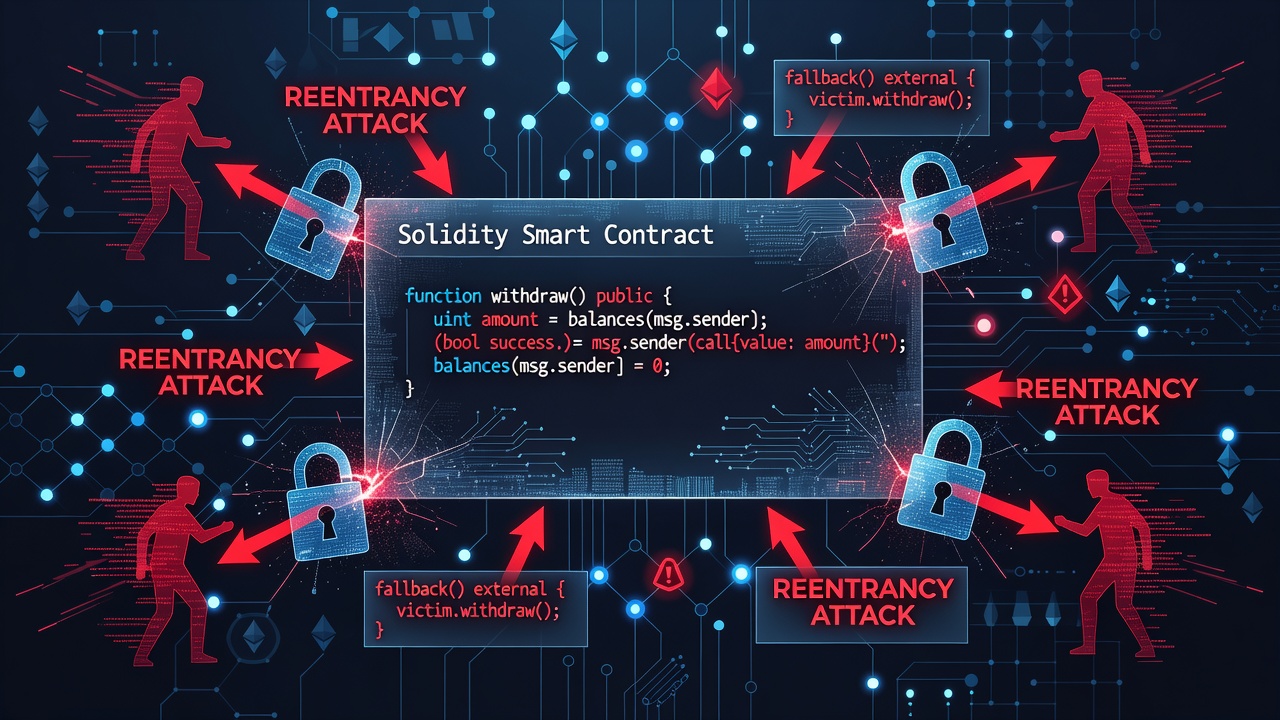
Reentrancy attacks remain one of the most critical threats to smart contract security in 2026. These exploits occur when an attacker repeatedly calls a vulnerable function before the initial execution completes, draining funds or manipulating state. The infamous DAO hack in 2016 highlighted this issue, and similar patterns continue to surface in recent DeFi incidents. Developers searching for smart contract tutorials on security must grasp both the mechanics and modern defenses to build resilient applications on Ethereum and compatible chains.
In essence, reentrancy exploits the asynchronous nature of external calls in Solidity. When a contract sends Ether or calls another contract, execution can return control to the caller before state updates finish. Attackers leverage fallback or receive functions to re-enter the original function, repeating the process until the contract's balance is exhausted or invariants are broken. This vulnerability is especially dangerous in financial protocols handling user deposits and withdrawals.
Mechanics of a Reentrancy Attack with Real-World Context
To understand the attack vector, consider a basic vulnerable withdrawal function that checks balance, sends Ether, then updates the balance. An attacker contract receives the Ether and immediately calls withdraw again during the transfer. Because the balance has not yet been reduced, the check passes repeatedly. This creates an infinite loop until gas is depleted or the contract is drained.
Recent incidents demonstrate the ongoing risk. Attackers have exploited poorly guarded withdrawal logic in lending protocols and token contracts, resulting in significant losses across multiple chains. Understanding the call stack, gas limits, and how external calls interact with fallback mechanisms helps developers identify weak points early in the development lifecycle. Comprehensive audits and static analysis tools are essential companions to manual code review.
The Checks-Effects-Interactions Pattern Explained in Depth
The foundational defense is the checks-effects-interactions pattern. Perform all validation first, update state variables next, and only then make external calls. This ordering prevents re-entry from affecting inconsistent state and ensures that every operation leaves the contract in a valid condition.
Applying this pattern to withdrawal functions eliminates the classic vulnerability window. Developers should audit every function that interacts with untrusted contracts for proper ordering. In practice, this means separating concerns: validation logic handles requirements, state changes adjust mappings and variables, and interaction code performs transfers only after the first two steps succeed. Additional considerations include handling return values from low-level calls and using require statements to enforce post-conditions.
Implementing Reentrancy Guards with Code Examples
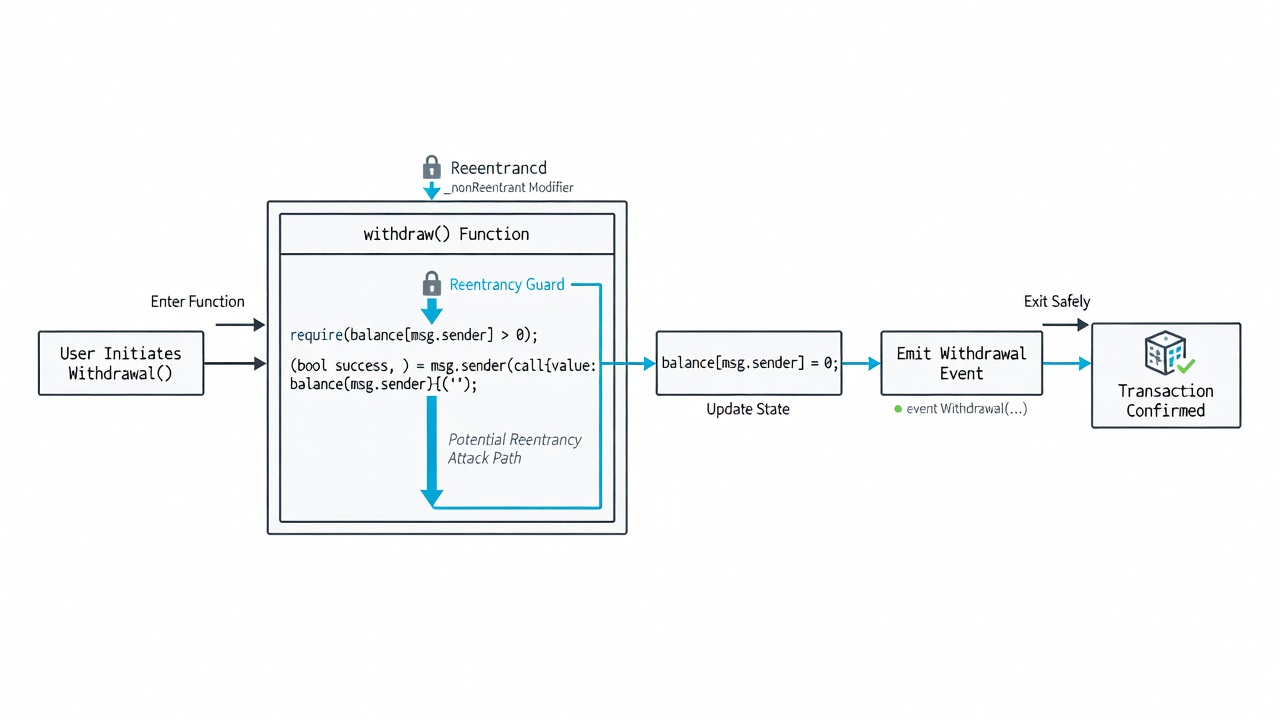
Reentrancy guards provide an additional runtime check. A simple boolean flag or mutex can block recursive calls. Modern implementations use modifiers that revert on re-entry attempts, offering a clean and reusable solution across multiple functions.
Here is a secure withdrawal function example using both the pattern and a guard:
function withdraw(uint256 amount) external nonReentrant {
    require(balances[msg.sender] >= amount, "Insufficient balance");
    balances[msg.sender] -= amount;
    (bool success, ) = msg.sender.call{value: amount}("");
    require(success, "Transfer failed");
}
Variations include using OpenZeppelin’s ReentrancyGuard or custom modifiers tailored to specific contract architectures. Guards can be applied selectively to functions that pose the highest risk, such as those involving value transfers or external interactions.
Leveraging OpenZeppelin for Modern Mitigation
The OpenZeppelin library offers battle-tested ReentrancyGuard and other security utilities. Importing these contracts reduces custom code risks and aligns with industry standards. Developers benefit from community-reviewed implementations that have withstood extensive testing and real-world usage.
Integrating OpenZeppelin also simplifies audits and upgrades. Teams should review the latest contract versions for compatibility with Solidity 0.8+ and emerging EVM features. The library provides additional helpers for access control, pausability, and safe math operations that complement reentrancy protection.
Step-by-Step Code Walkthrough for Securing a Sample Withdrawal Function
Start by identifying all functions that transfer Ether or call external contracts. Next, refactor the logic to follow checks-effects-interactions strictly. Introduce a reentrancy guard modifier from OpenZeppelin or a custom implementation. Finally, add events for transparency and implement proper error handling with custom errors where possible. This structured approach ensures the function remains secure even under adversarial conditions.
Testing Reentrancy Protections with Foundry
Foundry provides powerful fuzzing and invariant testing capabilities. Developers can simulate malicious reentrant calls to verify that guards function correctly under various conditions. Write tests that attempt recursive withdrawals and assert that balances remain consistent. Use cheat codes to manipulate call contexts and confirm reverts occur as expected. Advanced testing includes property-based tests that explore edge cases involving multiple users and concurrent operations.
Foundry’s forge tool also supports differential testing against reference implementations, helping teams validate that security measures do not introduce unintended side effects. Integrating these tests into CI/CD pipelines ensures ongoing protection as code evolves.
Common Pitfalls to Avoid
- Placing external calls before state updates, which reopens the reentrancy window
- Omitting guards on payable functions that receive Ether directly
- Ignoring fallback and receive functions in attacker contracts during testing
- Neglecting cross-contract interactions in complex DeFi systems with multiple external dependencies
- Skipping comprehensive test coverage for edge cases such as zero-value transfers and gas exhaustion scenarios
- Overlooking the impact of delegatecall and proxy patterns on reentrancy protection
Additional Best Practices and Modern Tools
Beyond core patterns, developers should adopt static analysis tools like Slither and Mythril early in the workflow. Formal verification techniques can provide mathematical guarantees for critical invariants. Regular security audits by reputable firms remain a best practice, especially before mainnet deployments. Staying updated with Solidity language improvements and EVM changes helps maintain robust defenses over time.
Conclusion
Reentrancy prevention requires disciplined application of established patterns, reliable libraries, and rigorous testing. By following the guidance in this article, Solidity developers can build more resilient contracts in 2026 and beyond while meeting the expectations of users and auditors alike.
FAQ
What is a reentrancy attack in smart contracts?
A reentrancy attack exploits functions that make external calls before updating state, allowing repeated execution within a single transaction and potentially draining contract funds.
How does the checks-effects-interactions pattern help?
It ensures validations and state changes occur before any external interactions, closing the window for recursive calls and maintaining contract consistency.
Should I always use OpenZeppelin ReentrancyGuard?
Yes for most contracts handling value transfers, as it provides a standardized and audited solution that integrates seamlessly with other security modules.
Can Foundry detect reentrancy vulnerabilities?
Foundry's fuzzing and invariant testing can effectively surface reentrancy issues when proper test scenarios are written and executed thoroughly.
What other tools complement reentrancy protection?
Static analyzers, formal verification frameworks, and regular audits provide layered defense when combined with code-level mitigations.


No comments yet. Be the first!