 CryptoChain Blog

Introduction to Inline Assembly in Solidity
Inline assembly, commonly implemented through Yul within Solidity smart contracts, empowers developers to execute low-level Ethereum Virtual Machine operations directly. As of 2026, this technique delivers substantial performance improvements in gas efficiency and operational speed, yet it carries notable security risks when implemented without rigorous safeguards. This comprehensive guide targets experienced Solidity developers who aim to harness these benefits while upholding contract integrity and audit readiness.
High-level Solidity code provides abstraction and safety features that reduce human error, but certain scenarios demand the precision of assembly. These include custom memory layouts for complex data structures, optimized cryptographic primitives, or intricate storage interactions that exceed standard language capabilities. Missteps in these areas frequently result in vulnerabilities such as unauthorized state modifications or memory corruption that attackers can exploit. Understanding when to transition from pure Solidity to assembly is critical for maintaining both performance and security in production environments.
Understanding EVM Fundamentals for Safe Assembly Use
Before writing any assembly code, developers must grasp core EVM concepts including the stack, memory, and storage. The stack holds temporary values with a strict 1024-item limit, while memory serves as temporary byte-addressable space reset per call. Storage persists across transactions and incurs the highest gas costs. Inline assembly bypasses Solidity's compiler protections, requiring explicit management of these elements to prevent overflows or collisions.
Yul syntax in 2026 offers structured control flow with if, switch, and for loops, making code more maintainable than raw opcode sequences. Always wrap assembly blocks in functions that include clear documentation of expected inputs and outputs. This foundational knowledge helps prevent common runtime errors that pure Solidity abstracts away.
Comparing Pure Solidity and Assembly Implementations
Pure Solidity excels in readability and automatic safety mechanisms such as bounds checking. Assembly versions, however, allow fine-tuned control that can eliminate unnecessary operations. For instance, a loop iterating over an array in Solidity may generate extra checks, whereas assembly can streamline the process by directly manipulating pointers.
Comparative analysis reveals that assembly implementations often reduce gas consumption by avoiding redundant compiler-generated code. Developers should prototype both versions and measure results using tools like Foundry to quantify differences across various contract sizes and operation types. In many cases, the trade-off favors assembly only for frequently executed functions where savings accumulate over thousands of transactions.
Common Pitfalls and How to Avoid Them
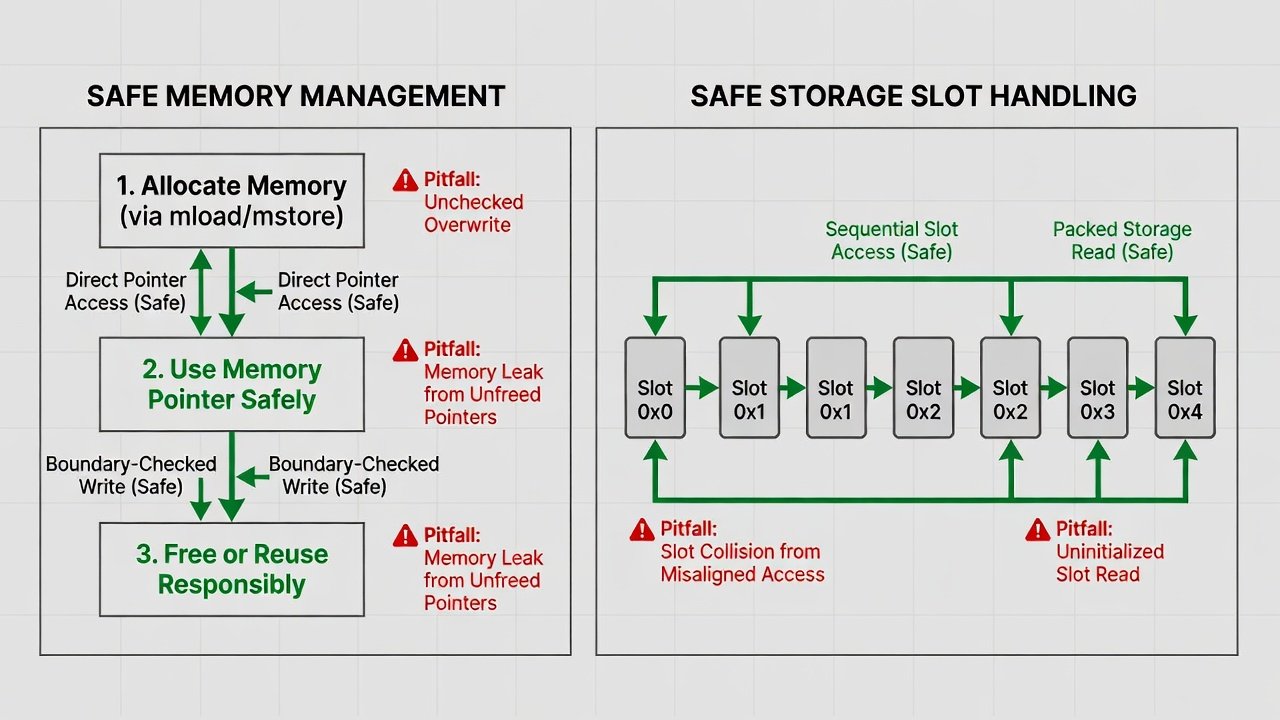
Memory management errors arise when offsets are miscalculated, leading to overwrites of critical data. Storage slot collisions occur if assembly code accesses slots without respecting Solidity's inheritance and variable ordering rules. Additional risks include improper handling of return data from calls and failure to account for gas stipends in nested operations.
To mitigate these, adopt a defensive coding style: initialize all variables, validate every offset, and isolate assembly logic in dedicated helper functions that undergo extensive unit testing. Reviewing opcode sequences manually before deployment further reduces exposure to subtle bugs.
Step-by-Step Safe Patterns for Memory and Storage Operations
Begin every assembly block by reserving memory explicitly. Calculate required space using known sizes of variables and data structures. Use the following sequence for safe memory writes:
- Load the free memory pointer.
- Compute the target offset.
- Perform mstore operations only within allocated bounds.
- Update the free memory pointer accordingly.
For storage, always derive slot numbers via Solidity's .slot syntax rather than hardcoding values. This prevents collisions when contracts are upgraded or inherit from multiple parents. Testing these patterns in isolated environments ensures they behave consistently under varying gas limits.
Secure Delegatecall Wrappers and Practical Code Examples
Delegatecall enables proxy patterns but exposes contracts to severe risks if the target address or calldata is not sanitized. A robust wrapper includes pre- and post-execution checks:
function safeDelegatecall(address target, bytes memory data) internal returns (bool success, bytes memory returndata) {
    assembly {
        let size := mload(data)
        let ptr := add(data, 0x20)
        success := delegatecall(gas(), target, ptr, size, 0, 0)
        let rdsize := returndatasize()
        returndata := mload(0x40)
        mstore(returndata, rdsize)
        returndatacopy(add(returndata, 0x20), 0, rdsize)
    }
}
Extend this pattern with reentrancy guards and access control modifiers before invoking the assembly section. Test the wrapper against malicious targets to confirm it reverts gracefully on failure. Additional examples can demonstrate batch delegatecalls with aggregated return data validation for multi-contract interactions.
Gas Savings Benchmarks and Optimization Strategies
Empirical testing on current Ethereum networks demonstrates meaningful reductions when replacing high-level loops or data packing routines with assembly equivalents. Focus optimizations on hot paths such as batch processing or repeated hashing. Combine assembly with compiler settings like via-ir for additional gains while monitoring for unexpected behavior in edge cases. Regular benchmarking against updated EVM implementations ensures optimizations remain effective as the network evolves.
Integration with Modern Security Tools and Auditing Practices
Static analysis tools like Slither can flag unsafe assembly patterns when configured with custom detectors. Dynamic testing frameworks allow simulation of low-gas environments to expose hidden vulnerabilities. Formal verification suites provide mathematical guarantees for critical functions when assembly is involved.
Link your development workflow to continuous integration pipelines that automatically run these tools on every commit. Reference official resources such as Solidity documentation for the latest Yul grammar and Ethereum developer resources for EVM opcode updates. Incorporating Consensys best practices further strengthens review processes.
Audit Readiness Checklist
- Provide line-by-line comments explaining every assembly instruction.
- Include both assembly and equivalent Solidity implementations for comparison.
- Conduct differential fuzzing to verify behavioral equivalence.
- Verify storage layout consistency across contract versions.
- Document all external call assumptions and gas limits.
- Run full test suites under multiple compiler versions.
Mistakes to Avoid and Decision Framework
Never use assembly for simple arithmetic or control flow that Solidity handles efficiently. Reserve it for measurable performance bottlenecks. When evaluating a new optimization, create a decision matrix weighing gas savings against added code complexity and audit scope.
Conclusion
Mastering safe inline assembly in 2026 requires disciplined application of EVM knowledge, thorough testing, and integration with security tooling. By following the patterns and checklists outlined above, developers can achieve meaningful optimizations without sacrificing contract security. Continue exploring authoritative sources including Ethereum Improvement Proposals to stay current with evolving standards.


No comments yet. Be the first!