 CryptoChain Blog

Introduction to Secure Cryptography in Solidity
As blockchain ecosystems evolve in 2026, Solidity developers must prioritize robust cryptographic implementations to safeguard smart contracts against sophisticated attacks. This tutorial explores production-ready patterns for hashing, signature verification, and library usage that bridge basic knowledge with advanced security practices. Secure cryptography ensures data integrity, authenticity, and confidentiality within decentralized applications. Poor implementations often lead to exploits such as signature malleability or replay attacks, which have historically drained funds from vulnerable contracts. Developers transitioning from basic tutorials will find detailed guidance here on avoiding common pitfalls while optimizing for gas efficiency and maintainability.
Throughout this guide we reference established resources including Solidity documentation and industry standards for cryptographic primitives. By the end readers will understand how to implement secure patterns that withstand both current and emerging threats in Ethereum-based environments.
Safe Usage of Hashing Functions
Hashing forms the backbone of many smart contract operations. In Solidity, keccak256 remains the standard due to its efficiency and security properties. Developers should always use it for generating unique identifiers or commitments rather than weaker alternatives like sha256 unless specific compatibility requirements exist. Best practices include salting inputs to prevent rainbow table attacks and avoiding direct exposure of sensitive data in logs or events. For example, a secure commit-reveal scheme might look like this:
bytes32 commitment = keccak256(abi.encodePacked(userSecret, salt, block.timestamp));Compare this to less secure patterns that reuse the same hash without additional entropy, which can enable preimage attacks in certain scenarios. Always encode parameters explicitly with abi.encode rather than abi.encodePacked when dealing with dynamic types to prevent collision vulnerabilities. Another practical example involves storing hashed user data for privacy-preserving access control, where multiple inputs are combined into a single hash to reduce storage costs while maintaining verifiability.
Mistakes to avoid include using block variables like blockhash as the sole source of randomness, which miners can influence. Instead, combine multiple on-chain and off-chain sources for stronger entropy in production systems.
ECDSA Signature Verification with OpenZeppelin
Signature verification is critical for off-chain message authentication in scenarios such as meta-transactions and access control lists. The OpenZeppelin library provides battle-tested ECDSA utilities that mitigate common pitfalls like malleability. Integrate the library via npm and import it directly into your contracts for reliable recovery logic.
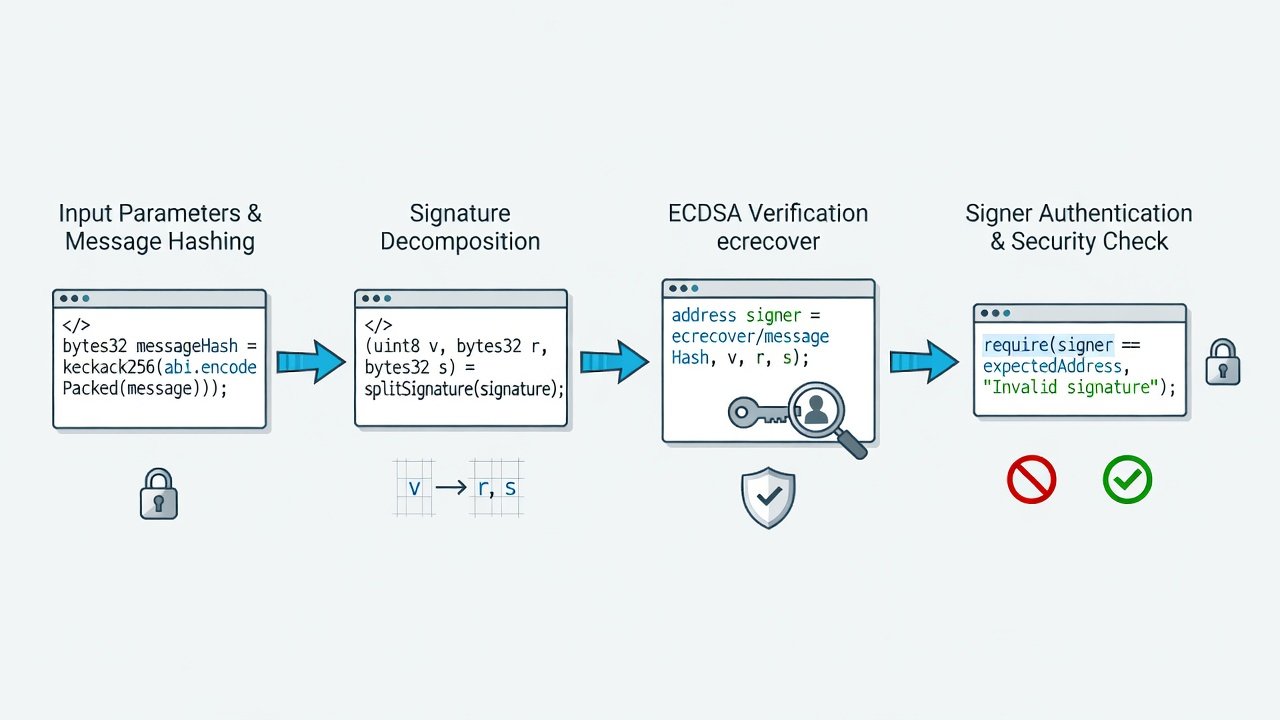
A step-by-step example for secure message signing and recovery begins with defining the message hash using EIP-712 for structured data to prevent cross-contract replay issues. Next, sign the message off-chain using tools like ethers.js or web3.js. Finally, recover the signer address on-chain with ECDSA.recover while validating the recovered address against an expected owner. Sample code illustrates a complete flow:
import "@openzeppelin/contracts/utils/cryptography/ECDSA.sol";
function verifySignature(bytes32 messageHash, bytes memory signature) public view returns (bool) {
    address signer = ECDSA.recover(messageHash, signature);
    return signer == expectedOwner;
}
This pattern prevents unauthorized actions by verifying that only the intended party authorized the transaction. Additional safeguards include checking for zero address recoveries and implementing deadline parameters to limit signature validity windows.
Preventing Replay Attacks
Replay attacks occur when a valid signature is reused maliciously across different contexts or time periods. Countermeasures include nonces, timestamps, and domain separators in EIP-712 structured data. Implement a nonce mapping per user to ensure each signature can only be used once, updating the nonce after each successful verification to invalidate previous signatures. A full implementation might combine user-specific nonces with contract-specific domain separators for layered protection.
Real-world code snippets demonstrate how to embed nonces directly into the signed message payload, ensuring that even if an attacker intercepts a signature it cannot be replayed on the same contract or a forked network. Testing these flows on testnets reveals edge cases such as nonce overflows or concurrent transaction submissions.
Gas-Efficient Cryptographic Patterns
Optimizing gas usage without sacrificing security is essential for scalable applications. Use assembly for low-level operations where appropriate, but prefer audited libraries for complex logic. Common comparisons show that certain precompile calls outperform pure Solidity implementations for repeated hash operations. A practical list of recommendations includes:
- Batch multiple signature verifications in a single transaction to amortize base costs.
- Store only keccak256 commitments instead of full public keys when possible.
- Leverage immutable variables for frequently accessed cryptographic constants.
- Avoid redundant hashing by caching intermediate results in memory.
Developers should benchmark patterns using tools like Hardhat gas reporter before mainnet deployment to quantify savings accurately.
Practical Testing Strategies
Thorough testing involves fuzzing with tools like Foundry and simulating attack vectors in testnets. Write unit tests for edge cases including invalid signatures, expired nonces, and malformed message encodings. Integration tests should cover interactions with external signers and multi-signature schemes. Always audit contracts with formal verification where possible before mainnet deployment, and incorporate static analysis tools to catch cryptographic misuses early in the development cycle.
Addressing Edge Cases: Malleability and Quantum Threats
Signature malleability can allow multiple valid signatures for the same message, potentially enabling double-spend scenarios in poorly designed systems. OpenZeppelin's ECDSA library normalizes signatures to prevent this issue automatically. Quantum threats remain emerging concerns; while current curves like secp256k1 are vulnerable in theory to future quantum computers, hybrid approaches combining classical and post-quantum schemes are under exploration for future-proofing. Reference materials from NIST cryptographic standards provide ongoing guidance on migration paths as quantum-resistant algorithms mature.
Additional considerations involve handling signature malleability in legacy contracts through upgradeable proxy patterns that allow seamless migration to newer verification logic without disrupting user funds.
FAQ
How do I handle signature malleability in older contracts?
Upgrade to OpenZeppelin v5+ which includes built-in recovery safeguards, and consider a phased migration using proxy contracts to minimize downtime.
What libraries are recommended beyond OpenZeppelin?
Consider audited alternatives like Solady for gas-optimized cryptography when benchmarks justify the switch, while always verifying recent audit reports.
Are quantum-resistant algorithms ready for Solidity in 2026?
Experimental implementations exist in research repositories, but full adoption depends on Ethereum protocol upgrades and community consensus on new precompiles.
What common mistakes lead to replay vulnerabilities?
Omitting nonces or domain separators is the primary cause; always include both in EIP-712 typed data structures for cross-chain safety.
Conclusion
Implementing these cryptographic patterns elevates your Solidity contracts to production standards. Start by auditing existing code against the guidelines above and gradually integrate secure libraries for long-term resilience. Continued reference to Ethereum developer resources will help stay current with evolving best practices through 2026 and beyond.

No comments yet. Be the first!