 CryptoChain Blog
Introduction to ZK-Proofs in Solidity Development
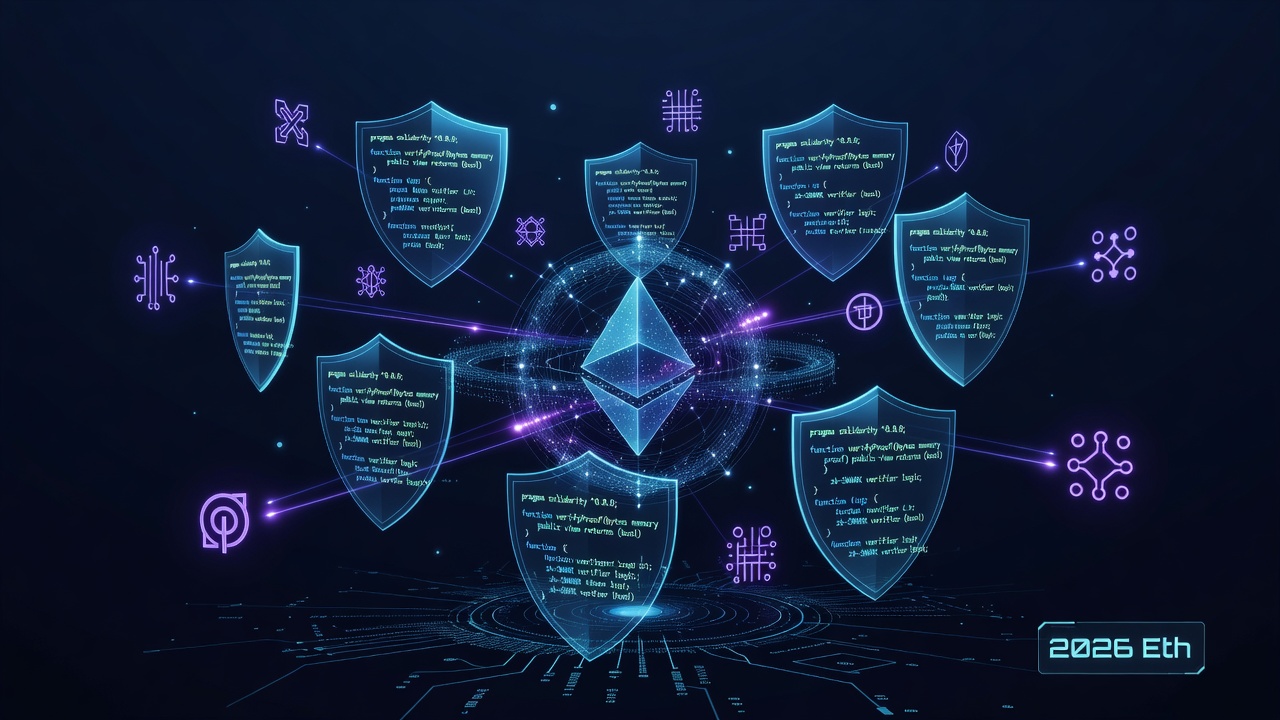
Zero-knowledge proofs (ZK-proofs) enable developers to verify computations without revealing underlying data, making them essential for secure Solidity contracts in 2026. This guide explores integrating ZK techniques to mitigate vulnerabilities like unauthorized access and data leaks while preserving privacy on Ethereum. Developers targeting advanced security often face challenges with public blockchain transparency. ZK-proofs address this by allowing verifiable private operations, such as confidential voting or balance checks. As Ethereum continues to evolve with layer-2 scaling solutions and account abstraction features, incorporating ZK technology becomes a strategic advantage for building trustworthy decentralized applications.
The core promise of ZK lies in its mathematical foundation: a prover can convince a verifier of a statement's truth without disclosing any additional information. This property directly combats issues such as front-running and data exposure that plague many smart contracts today. In practice, off-chain proof generation paired with on-chain verification allows contracts to remain lightweight while benefiting from cryptographic guarantees.
ZK Fundamentals and Vulnerability Mitigation
ZK-proofs rely on cryptographic protocols where a prover demonstrates knowledge of a secret without exposing it. In Solidity, this integrates via off-chain proof generation and on-chain verification using verifier contracts. Common vulnerabilities like reentrancy or front-running are reduced because sensitive inputs remain hidden from public view. By embedding ZK circuits, contracts can validate state transitions privately, enhancing overall resilience against exploits prevalent in public ledgers. For instance, a contract handling user balances can confirm sufficient funds for a transfer without broadcasting exact amounts, thereby preventing targeted attacks.
Understanding the two primary roles—prover and verifier—is crucial. The prover generates a succinct proof attesting to correct execution of a computation. The verifier, implemented in Solidity, checks this proof efficiently. This separation minimizes on-chain computation costs while maximizing privacy. In 2026 environments, with increased adoption of zero-knowledge rollups, these fundamentals enable more sophisticated use cases including private DeFi positions and anonymous governance participation.
Selecting ZK Libraries: Circom vs Halo2
Choosing the right library is critical for successful integration. Ethereum.org developer resources provide foundational context on smart contract security that complements ZK tooling. Circom offers mature tooling for arithmetic circuits and pairs well with Solidity verifiers. Halo2 provides recursive proof capabilities and better scalability for complex computations. Evaluate based on circuit complexity, gas costs for verification, and community support in 2026 Ethereum environments. Circom suits beginners due to its straightforward syntax and extensive documentation, while Halo2 excels in production-grade applications requiring aggregation of multiple proofs.
Additional considerations include language familiarity—Circom uses its own domain-specific language, whereas Halo2 integrates with Rust for greater flexibility. Performance benchmarks show Circom generating proofs faster for small circuits, but Halo2 reduces verification overhead in recursive scenarios. Developers should prototype with both to determine fit before committing to a full implementation.
Tools and Environment Setup for 2026 Development
Before coding, establish a robust development environment. Install Node.js, the Circom compiler, and snarkjs for proof generation. Use Hardhat or Foundry for Solidity testing. Ensure compatibility with the latest Ethereum protocol upgrades expected in 2026, including further enhancements to data availability layers. Version control your circuits alongside contract code to track changes and facilitate audits.
Step-by-Step: Implementing a Private Voting Contract
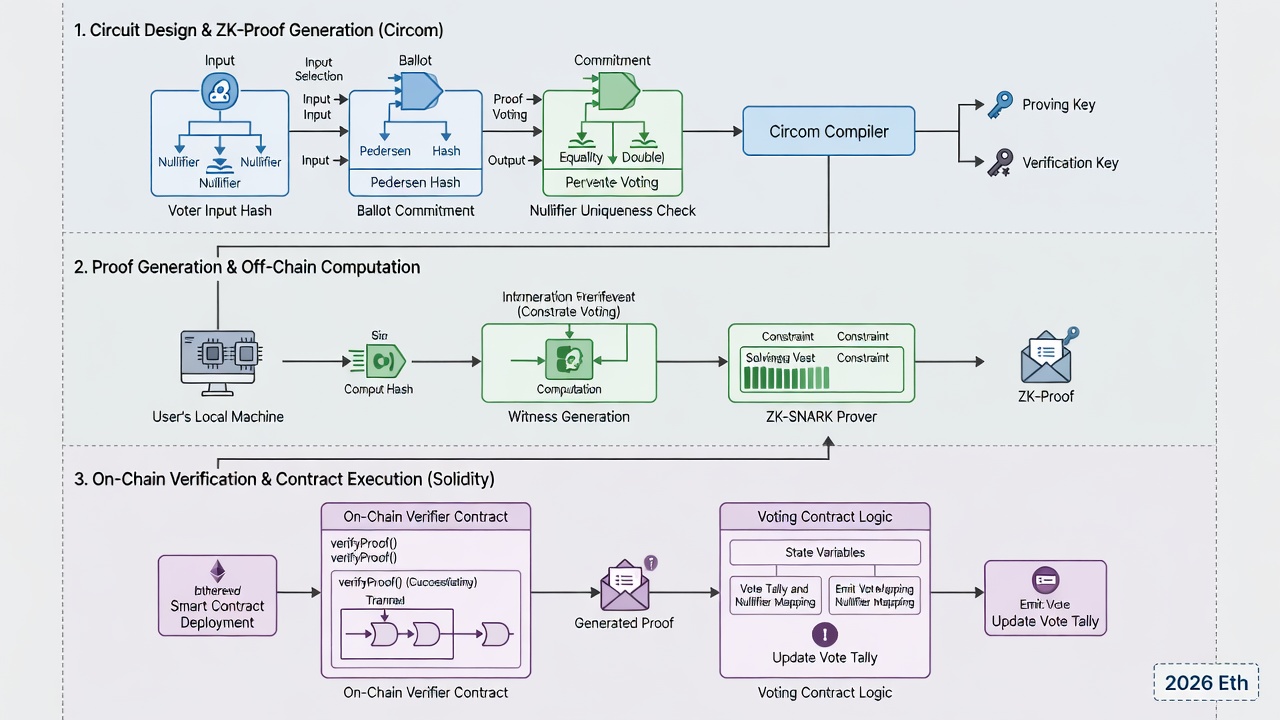
Building a basic private voting contract demonstrates ZK integration. First, define the circuit in Circom to prove a valid vote without revealing choices. The circuit below illustrates a minimal example enforcing vote validity through a nullifier mechanism.
pragma circom 2.0.0;
template PrivateVote() {
    signal input vote;
    signal input nullifier;
    signal output isValid;
    isValid <== vote * nullifier;
}
Compile the circuit using the Circom command-line tool, then generate a witness file from input data. Next, employ snarkjs to create the proving and verification keys. Deploy a Solidity verifier contract that accepts the proof and updates the tally privately. The verifier contract typically includes a verifyProof function that returns true only for valid submissions.
Handle nullifiers to prevent double-voting while keeping voter anonymity intact. Store commitments on-chain in a mapping and check against them during verification. Extend the contract with events for off-chain indexing and integrate with frontend libraries like zk-SNARK.js for user-friendly proof creation. Thorough unit tests should cover edge cases such as invalid nullifiers and malformed proofs.
Gas Optimization Strategies for ZK Circuits
Verification on-chain consumes significant gas. Optimize by minimizing circuit constraints and using efficient pairing-friendly curves. Batch multiple proofs where possible and leverage precompiled contracts on Ethereum for elliptic curve operations. Testing with tools like Hardhat reveals bottlenecks early; profile gas usage across different proof sizes. Focus on reducing public inputs and employing lookup tables in Halo2 for further savings. Additional techniques include splitting large circuits into smaller sub-circuits and reusing verification keys across similar contract instances. In 2026, with potential gas optimizations from protocol upgrades, these strategies can lower deployment costs substantially while maintaining security.
Security Audits Specific to ZK Circuits
Audits must cover both the circuit soundness and Solidity verifier integrity. Common issues include underconstrained signals or trusted setup vulnerabilities. Engage specialized auditors familiar with ZK libraries and simulate adversarial proofs during review. Always verify the trusted setup ceremony participants and use deterministic verification keys to avoid backdoors. Conduct formal verification of the circuit constraints and perform differential testing between multiple proof systems. Documentation of all assumptions made during circuit design is essential for long-term maintainability.
Comparison of Proof Systems
- Groth16: Fast verification but requires trusted setup; ideal for simple contracts with static circuits.
- PLONK: Universal setup, flexible for evolving circuits and easier upgrades.
- STARKs: Transparent and post-quantum resistant, though larger proof sizes increase on-chain costs.
- SNARK variants with recursion: Enable proof aggregation for high-throughput applications like private voting at scale.
Select based on your contract's scale and threat model for 2026 deployments. Consider trade-offs between proof size, verification time, and setup requirements when making the final decision.
Common Pitfalls to Avoid
Overlooking nullifier management leads to replay attacks. Ignoring gas limits during verification causes failed transactions. Developers often underestimate circuit debugging time—use visualization tools early. Another frequent mistake is failing to account for changes in Solidity compiler versions, which can break verifier compatibility. Always maintain comprehensive test suites that include both positive and negative test cases for proofs.
FAQ: ZK Integration Challenges in 2026 Ethereum
How do ZK-proofs interact with EIP-4844 blobs?
Blobs reduce data costs for proof submission, enabling cheaper on-chain verification without altering core logic. This makes larger circuits more economically viable.
What Ethereum upgrades affect ZK tooling?
Continued improvements in account abstraction simplify prover-wallet integrations for seamless user experiences. Developers should monitor EIP proposals related to precompiles for elliptic curve operations.
Are ZK circuits upgradeable post-deployment?
Yes, via proxy patterns, but require careful migration of verification keys to maintain security guarantees. Testing upgrade flows thoroughly prevents loss of state or proof validity.
What are typical development timelines for a production-ready ZK contract?
Teams report spending several weeks on circuit design and optimization, followed by one to two weeks of auditing and testing before mainnet deployment in current 2026 conditions.
Conclusion
Integrating ZK-proofs transforms Solidity contract security by enabling private, verifiable logic. With careful library selection, detailed implementation steps, gas optimizations, and rigorous auditing, developers can build robust 2026 Ethereum applications resistant to modern threats. Continuous learning and experimentation with emerging tools will keep projects at the forefront of secure decentralized development.


No comments yet. Be the first!