 CryptoChain Blog

Introduction to Quantum-Resistant Tokenomics
Quantum computing poses an existential risk to current blockchain token models by potentially breaking widely used cryptographic primitives. In 2026, forward-thinking projects are redesigning tokenomics to incorporate post-quantum security while maintaining economic incentives that support network growth. Onchain analytics play a pivotal role in verifying these resilient designs, allowing analysts to track supply dynamics, validator behavior, and security parameters in real time. As quantum hardware advances, the urgency to future-proof token economies grows, because traditional elliptic curve signatures could be compromised within the next decade according to expert projections. This comprehensive guide examines the intersection of quantum threats and token economics, providing actionable frameworks for developers, analysts, and token holders who seek to build sustainable networks.
Readers will gain insight into how supply mechanics must adapt, how validator incentives shift under new cryptographic requirements, and how to leverage analytics platforms for ongoing verification. The discussion extends beyond theory to include concrete auditing workflows, comparisons of vulnerable versus resilient models, and real protocol case studies that illustrate successful transitions.
Quantum Computing Threats to Blockchain Security
Shor's algorithm threatens elliptic curve cryptography that underpins most token signatures and address generation. As quantum machines scale beyond current noisy intermediate-scale quantum devices, attackers could derive private keys from public data, compromising wallets and smart contracts at scale. Tokenomics must evolve to mitigate single points of failure where large token holders or validators rely on vulnerable keys. The threat extends to multi-signature schemes and threshold cryptography commonly used in decentralized governance, potentially allowing an adversary to forge approvals for treasury movements or protocol upgrades.
Post-Quantum Cryptographic Impacts on Token Security
Post-quantum algorithms such as lattice-based and hash-based signatures are emerging as replacements. These introduce larger key and signature sizes that affect transaction fees and storage costs within token models. Projects integrating these schemes early gain a security premium that influences staking yields and governance participation. For instance, lattice-based approaches like CRYSTALS-Dilithium require signatures several kilobytes in size, which increases block space consumption and may necessitate fee market adjustments to maintain validator profitability. Analysts monitoring onchain data can observe these shifts through changes in average transaction costs and gas usage patterns after upgrades.
Learn more about standardized approaches at NIST.
Reshaping Supply Mechanics for Quantum Resistance
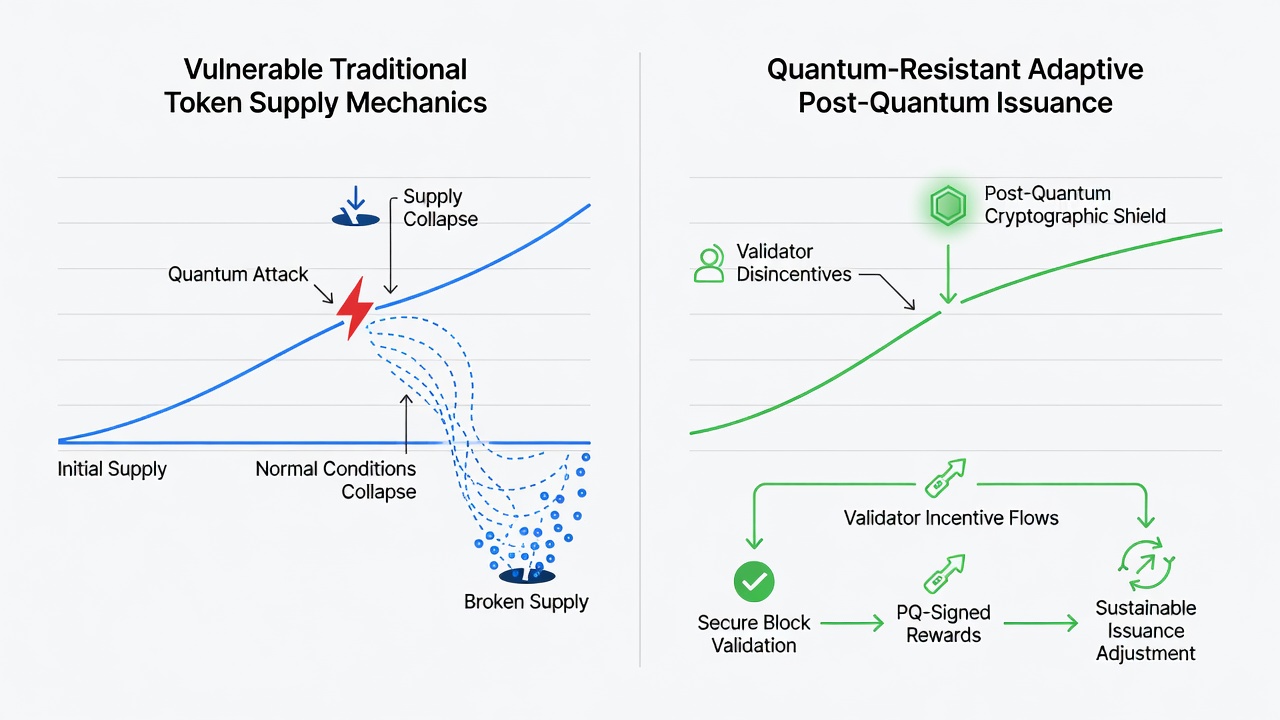
Token supply schedules traditionally rely on predictable issuance via proof-of-work or proof-of-stake. Quantum-resistant designs incorporate dynamic adjustment mechanisms that respond to detected cryptographic migrations. Analysts use onchain data to monitor circulating supply against quantum-safe issuance curves, identifying deviations that signal potential vulnerabilities. Additional layers include time-locked release schedules that only activate once a majority of validators have migrated to post-quantum keys, creating natural checkpoints visible through explorer queries. This prevents sudden supply shocks while ensuring the network does not remain exposed during the transition period.
Validator Incentives in a Post-Quantum Era
Validator rewards must balance security upgrades with economic sustainability. Quantum-resistant protocols often allocate a portion of fees to fund cryptographic audits and hardware upgrades. Onchain dashboards reveal whether these incentives sufficiently attract participants who adopt new signature schemes. In practice, some networks introduce bonus multipliers for validators demonstrating quantum-safe key usage, which can be verified through signature metadata embedded in blocks. These changes alter the economic equilibrium, favoring operators willing to invest in specialized hardware capable of handling larger signature computations efficiently.
Practical Auditing with Blockchain Analytics Tools
Step 1: Map all token contracts and validator addresses to identify legacy cryptographic usage by exporting address lists from block explorers and cross-referencing with known vulnerable curve identifiers.
Step 2: Query transaction histories for signature sizes and types using tools like Dune Analytics or Arkham Intelligence to establish baseline metrics before any upgrades.
Step 3: Simulate quantum attack scenarios by stress-testing key rotation patterns visible onchain, measuring how quickly large holders can migrate funds to new addresses.
Step 4: Compare incentive distributions before and after quantum-resistant upgrades to measure participation shifts, including staking concentration ratios and reward payout frequencies.
Step 5: Set up automated alerts for anomalies such as unexpected increases in transaction size or validator downtime correlated with signature verification failures.
Step 6: Integrate data from multiple chains to benchmark progress against industry standards, creating comparative reports that highlight leaders in quantum readiness.
Real-World Examples from Emerging Protocols
Protocols such as those building on lattice-based signatures demonstrate reduced validator centralization risks. Their onchain metrics show steadier staking distributions compared to earlier vulnerable models. Ethereum's ongoing research into post-quantum upgrades provides a benchmark, visible at ethereum.org. Additional examples include Layer-2 solutions experimenting with hybrid signature schemes that allow gradual migration without disrupting user experience. One protocol recently published onchain governance proposals detailing a phased rollout where 30 percent of validators adopted new keys within the first quarter, resulting in measurable improvements in network resilience scores tracked by independent analytics firms.
Comparing Vulnerabilities and Future-Proof Designs
- Vulnerable models: Fixed supply curves without migration paths, exposing large holders to key theft and lacking mechanisms for rapid response to cryptographic breakthroughs.
- Future-proof designs: Adaptive issuance with built-in key rollover incentives and transparent onchain audit trails that allow continuous monitoring of cryptographic health.
- Key difference: Quantum-resistant versions maintain validator diversity even under simulated attack conditions tracked via analytics platforms, reducing the risk of cascading failures during mass migrations.
- Additional contrast: Legacy systems often suffer from opaque treasury management, whereas quantum-safe models publish detailed cryptographic status reports directly onchain for community scrutiny.
Implementation Timelines and Integration FAQs
When should projects begin migrating to quantum-resistant tokenomics?
Leading analysts recommend starting cryptographic audits in 2026, with full migration targeted within 24-36 months depending on network scale. Early movers gain competitive advantages in attracting institutional capital that prioritizes long-term security. Detailed roadmaps typically include pilot testing on testnets, followed by mainnet opt-in periods where users can voluntarily migrate assets before mandatory enforcement.
How do existing analytics platforms integrate post-quantum metrics?
Platforms are adding support for new signature verification endpoints. Developers can extend queries to include signature length and algorithm identifiers for seamless monitoring. Custom dashboards now track metrics such as the percentage of active addresses using post-quantum keys and average block propagation times after signature size increases.
What governance changes support these transitions?
Token holders increasingly vote on treasury allocations for quantum research, with onchain proposals making these decisions transparent and verifiable. Successful implementations feature multi-stage voting where initial research funding is approved, followed by separate votes on specific algorithm selections and incentive parameter adjustments.
Challenges and Mitigation Strategies
One major challenge involves the increased computational overhead of post-quantum algorithms, which can slow block finality times if not addressed through optimized implementations. Mitigation includes hardware acceleration and selective use of hybrid schemes during the transition. Another issue is user education, as wallet providers must update interfaces to handle larger keys without confusing end users. Onchain analytics help surface adoption rates, allowing teams to target education campaigns where migration lags. Storage costs also rise, prompting some protocols to explore data availability solutions that offload signature data while preserving verifiability.
Conclusion
Quantum-resistant tokenomics represents a necessary evolution for blockchain sustainability. By leveraging onchain analytics, teams can design, audit, and refine models that withstand emerging computational threats while preserving economic vitality. Continued collaboration with standards bodies ensures these adaptations remain aligned with global cryptographic progress, positioning networks for secure operation well into the future.
No comments yet. Be the first!