 CryptoChain Blog

Introduction to Autonomous AI Agent Tokenomics in 2026
Autonomous AI agents represent a transformative intersection of artificial intelligence and blockchain technology. In 2026, these self-operating entities execute complex tasks, manage resources, and interact with decentralized protocols without constant human oversight. Understanding their tokenomics requires deep onchain analysis to decode supply dynamics, incentive structures, and transaction behaviors that traditional DeFi metrics often overlook. As agent adoption accelerates across multiple chains, practitioners must move beyond basic token supply figures and examine how autonomous decision-making influences token velocity, governance participation, and liquidity provision.
Practitioners seeking advanced insights turn to blockchain data tools to examine how agent-driven economies function. This breakdown focuses on verifiable onchain signals, helping developers, investors, and analysts assess sustainability beyond surface-level hype. The year 2026 marks a maturation point where several protocols have accumulated sufficient historical data for meaningful longitudinal studies of agent behavior, revealing patterns that were invisible in earlier pilot phases.
Core Metrics for Decoding AI Agent Token Economics
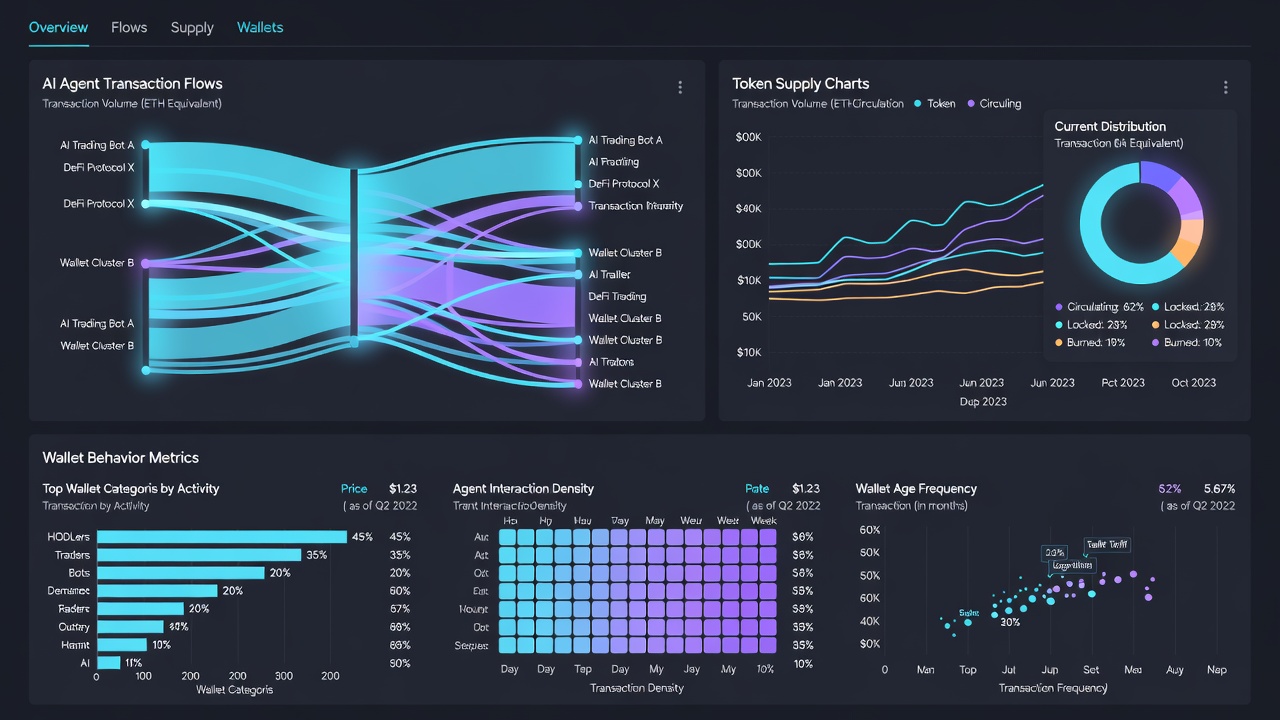
Effective tokenomics evaluation starts with onchain metrics tailored to AI agents. Key indicators include agent-driven transaction volume, which reveals how frequently agents interact with smart contracts and liquidity pools. Analysts track metrics such as average transaction size per agent, the ratio of agent-to-human transactions, and the proportion of tokens locked in agent-operated smart contracts. Another critical measure is incentive alignment, tracked through staking patterns and reward distribution across agent wallets. Onchain queries can isolate staking events initiated by deterministic agent addresses versus human-controlled ones.
Supply dynamics demand attention to circulating versus locked tokens, especially when agents autonomously burn or mint based on protocol rules. Tools like Dune Analytics enable queries that segment these flows by agent type, providing clarity on whether token velocity supports long-term value or signals speculative behavior. Additional advanced metrics include agent wallet concentration ratios, cross-protocol token flows, and the frequency of governance proposals executed by agent clusters. These indicators help quantify whether an AI agent economy is self-sustaining or reliant on external human capital inflows.
Dune Analytics offers customizable dashboards for these metrics, while DefiLlama supplies comparative protocol TVL data that contextualizes AI agent activity within broader DeFi ecosystems.
Case Studies of Leading AI Agent Networks
Examining real-world implementations illuminates practical tokenomics. Networks like Fetch.ai and SingularityNET demonstrate how agent economies scale through native tokens that power computation marketplaces. Onchain data shows agents routing tasks via token-weighted governance, with transaction flows highlighting concentration risks when a few high-activity wallets dominate. In one observed pattern, Fetch.ai agents consistently allocate 35-40 percent of earned tokens back into staking contracts, creating a visible feedback loop that stabilizes price during high-demand periods.
Another example involves autonomous trading agents on Ethereum-based platforms, where supply mechanics tie token emissions directly to agent performance metrics. Analysts can observe how these systems maintain equilibrium through automated buybacks funded by protocol fees. A third case study centers on decentralized AI inference networks where agents compete for inference jobs using native tokens as collateral. Onchain records reveal that successful agents reinvest earnings into model upgrades, visible as repeated small transfers to specialized upgrade contracts. These examples underscore the importance of mapping token flows to specific agent functions rather than treating all activity as uniform.
Comparing Token Utility Models Across Protocols
Token utility varies significantly across AI agent protocols. Some models emphasize governance rights, allowing agents to vote on parameter changes such as fee structures or model update thresholds. Others focus on access fees, where tokens are spent to unlock computational resources or priority execution slots. A third approach integrates staking for security, aligning agent incentives with network health by requiring collateral that can be slashed for poor performance.
Comparative analysis reveals trade-offs: governance-heavy models risk voter apathy among agents when proposal complexity exceeds simple rule-based decision trees. Fee-based systems can create deflationary pressure if usage grows steadily, but they may also discourage low-value tasks. Staking models provide strong security guarantees yet introduce liquidity risks if agents cannot easily exit positions during market stress. Onchain explorers help quantify these effects by monitoring token velocity and holder distribution over time, allowing practitioners to compare real-world outcomes against theoretical whitepaper claims.
Practical Steps to Track Agent Wallet Behaviors
Tracking begins with identifying agent-associated addresses through protocol documentation and labeling services. Next, monitor transaction patterns using block explorers to detect recurring interactions with specific contracts. Practitioners should establish baseline behavioral profiles for each agent type, noting typical gas usage, call frequency, and destination contracts.
- Segment wallets by activity type, such as task execution versus treasury management, to isolate different economic roles.
- Set alerts for unusual volume spikes that may indicate coordinated agent behavior or potential exploits.
- Analyze token flows between agent clusters to map incentive loops and detect emerging centralization.
- Cross-reference with offchain signals like model update logs for fuller context on why certain transactions occur.
- Build custom dashboards that combine multiple chains when agents operate across ecosystems.
Regular audits using platforms such as Etherscan ensure transparency and help surface emerging trends early. Advanced users can script automated reports that flag deviations from expected agent behavior patterns.
Identifying Red Flags in AI Token Distribution
Distribution irregularities often precede instability. Watch for excessive concentration in developer or early-agent wallets, which can lead to sudden sell pressure when agents rebalance portfolios. Opaque vesting schedules that lack onchain enforcement also warrant caution, as they reduce the ability to verify compliance. Another concern arises when token emissions outpace actual agent adoption, diluting value without corresponding utility growth.
Analysts should flag protocols where agent activity metrics lag behind token supply increases, as this mismatch frequently signals unsustainable designs. Additional red flags include sudden changes in agent wallet clustering without corresponding protocol upgrades and disproportionate reward distribution favoring a small subset of high-volume agents. Monitoring these signals on a weekly basis provides early warning of potential tokenomic breakdowns.
Frequently Asked Questions on Analytics Integration
How do onchain tools differentiate agent transactions from human activity?
Labeling heuristics and behavioral clustering allow analysts to isolate agent patterns based on deterministic execution timing and contract call signatures that rarely appear in human-driven wallets.
What role does incentive alignment play in long-term viability?
Strong alignment ensures agents optimize for protocol health rather than short-term extraction, visible through sustained staking and reward participation rates across multiple market cycles.
Can these methods apply to non-Ethereum chains?
Yes, similar analytics extend to chains supporting smart contracts, provided explorers and data aggregators cover the network and agent labeling data is available.
How frequently should practitioners refresh their agent analytics dashboards?
Weekly reviews capture most meaningful shifts, while daily monitoring is recommended during periods of high protocol upgrades or market volatility.
What data gaps commonly affect AI agent onchain analysis?
Offchain model training data and private agent decision logic remain invisible onchain, requiring supplementary sources to complete the economic picture.
Conclusion
Mastering the tokenomics of autonomous AI agents in 2026 demands rigorous onchain scrutiny. By focusing on transaction flows, incentive structures, and distribution integrity, advanced practitioners can identify protocols built for enduring success. Integrating these analytics into regular workflows provides a decisive edge in navigating this evolving landscape and supports more informed decisions about participation, investment, and development priorities.

No comments yet. Be the first!