 CryptoChain Blog

Introduction to Account Abstraction in Web3
Account abstraction represents one of the most significant advancements in blockchain technology as we move into 2026. By decoupling user accounts from traditional externally owned accounts (EOAs), it enables programmable, user-friendly experiences that mirror familiar web2 interactions while preserving decentralization. This shift is critical for mass adoption, addressing long-standing pain points like seed phrase management, high gas fees, and complex transaction flows that have historically limited blockchain to early adopters and technical users.
Traditional EOAs require users to manage private keys directly, creating friction that deters newcomers. Account abstraction, powered primarily by ERC-4337, introduces smart accounts that support features such as social recovery, batched transactions, and sponsored gas payments. These improvements position Web3 for broader accessibility across dApps, wallets, and enterprise solutions. In practice, this means users can interact with decentralized applications using familiar login methods rather than memorizing 12- or 24-word seed phrases, dramatically lowering the barrier to entry for mainstream audiences.
Understanding ERC-4337 and Smart Accounts vs EOAs
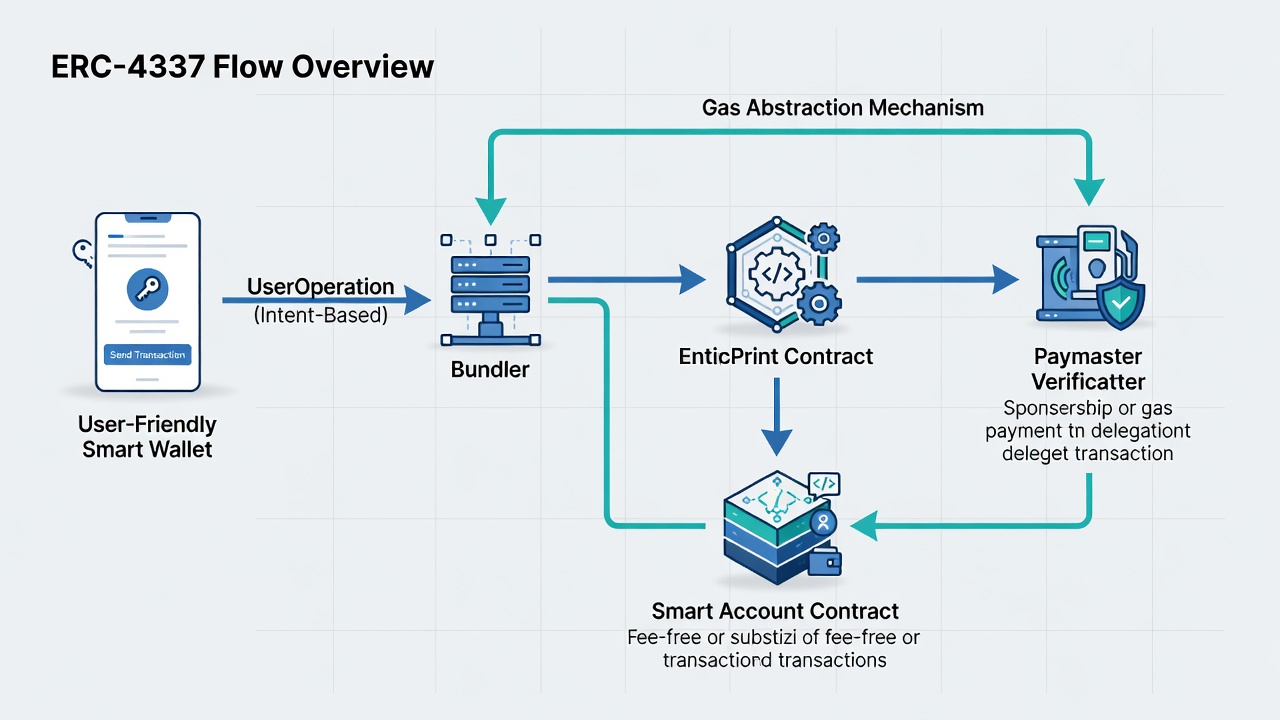
ERC-4337, standardized on Ethereum, allows users to interact with the blockchain through smart contract wallets without modifying the core protocol. Unlike EOAs, which rely on ECDSA signatures and sequential nonces, smart accounts can incorporate custom logic for authentication and execution. This standard introduces an entrypoint contract that handles user operations as a separate mempool, enabling validators to process them efficiently alongside regular transactions.
Key differences include flexible authentication where multi-signature schemes, passkeys, or biometric methods replace single private keys. Gas abstraction allows paymasters to cover fees in stablecoins or even sponsor transactions entirely. Atomic operations bundle multiple actions into one transaction for improved UX. Developers benefit from enhanced composability, while end-users enjoy seamless onboarding similar to centralized apps. As of mid-2026, adoption metrics show smart accounts handling an increasing share of Ethereum activity, driven by improved tooling and infrastructure from major layer-2 networks.
Smart accounts also enable programmable security policies, such as spending limits or time-locked approvals, which EOAs cannot natively support without additional layers. This flexibility opens new design patterns for applications ranging from decentralized finance to gaming and social platforms.
Real-World Examples: Safe and Argent Wallets
Leading wallets demonstrate practical implementations. Safe offers modular smart accounts with extensive governance features, widely used in DeFi for treasury management. Argent provides social recovery and gasless experiences, simplifying mobile-first interactions. Both platforms integrate ERC-4337 natively, allowing users to create accounts via email or social credentials while maintaining full self-custody.
These platforms highlight how account abstraction reduces onboarding time from minutes to seconds, fostering retention in competitive Web3 environments. Additional examples include emerging wallets that combine account abstraction with hardware security modules for institutional users, demonstrating versatility across consumer and enterprise segments.
Gas Abstraction Benefits and Security Trade-offs
Gas abstraction eliminates the need for users to hold native tokens solely for fees. Paymaster contracts enable flexible payment models, lowering barriers in volatile markets. Users can pay transaction costs in any supported token or have fees covered by dApps seeking to onboard new participants. This model also supports subscription-style payments where recurring actions occur without repeated user approvals.
However, this introduces new considerations around paymaster reliability and potential centralization risks if not decentralized properly. Security trade-offs involve smart contract vulnerabilities versus EOA simplicity. Audits, formal verification, and upgradeable designs mitigate risks. Best practices include using established libraries and limiting contract permissions during initial deployments. Developers should also implement rate limiting and emergency pause mechanisms to protect users during unexpected events.
Developer Implementation Steps
Integrating account abstraction involves several practical steps that ensure robust and user-friendly deployments:
- Select a compatible wallet SDK such as those supporting ERC-4337 entrypoints from providers focused on developer tooling.
- Deploy or configure a smart account factory contract to allow users to create accounts on demand without high upfront costs.
- Implement paymasters for gas sponsorship where needed, including logic for verifying sponsorship rules and handling token conversions.
- Test user flows including recovery and batching on testnets before mainnet launch, covering edge cases like network congestion and failed operations.
- Monitor on-chain metrics to optimize for gas efficiency and user experience, using analytics dashboards to track drop-off points.
- Integrate with existing dApp frontends by replacing traditional wallet connection libraries with abstraction-aware alternatives.
Resources from Ethereum.org provide detailed specifications and reference implementations that accelerate development timelines.
Adoption Metrics and dApp Case Studies
Forward-looking 2026 innovations include deeper integration with account abstraction across layer-2 solutions and emerging standards for cross-chain smart accounts. Case studies from gaming and social dApps reveal higher conversion rates when using abstracted flows, with reduced drop-off during wallet creation. Projects in decentralized social media have reported doubling user retention after implementing social login combined with gas sponsorship.
Adoption metrics indicate steady growth in smart account usage, particularly on scaling solutions where transaction costs remain low. Gaming platforms utilizing account abstraction have seen increased daily active users due to seamless in-game purchases and asset management without requiring users to understand blockchain mechanics.
Short FAQ on User Onboarding
How does account abstraction simplify wallet creation? Users can sign up with email or social logins, with smart accounts handling key management behind the scenes through secure cryptographic methods.
Are gasless transactions secure? Yes, when implemented with audited paymasters and user consent mechanisms that clearly display sponsorship terms before execution.
What happens if I lose access to my smart account? Recovery options like guardians or passkeys provide multiple paths, unlike traditional seed phrases that offer no recovery flexibility once lost.
Can I migrate from an EOA to a smart account? Migration tools exist that allow transferring assets and permissions gradually while maintaining control throughout the process.
2026 Innovations and Future Outlook
Looking ahead, 2026 promises further standardization around account abstraction interfaces, enabling seamless interoperability between wallets and dApps across multiple chains. Innovations in zero-knowledge proofs may enhance privacy within smart accounts, while AI-assisted transaction simulation could prevent user errors before signing. These developments will continue pushing Web3 toward the seamless experiences users expect from modern digital services.
Conclusion
Account abstraction is set to redefine Web3 accessibility in 2026. By focusing on ERC-4337 capabilities, real-world wallet examples, and thoughtful security practices, developers and users alike can accelerate mainstream adoption. Staying informed about evolving standards ensures projects remain competitive in the decentralized landscape.


No comments yet. Be the first!