 CryptoChain Blog

Introduction to Modular Blockchains in 2026
As Web3 continues to evolve rapidly, developers and innovators are increasingly turning away from traditional monolithic blockchain architectures toward modular designs. These systems separate core functions to deliver superior scalability, flexibility, and customization. In 2026, modular blockchains stand at the forefront of decentralized innovation, enabling new applications that monolithic chains struggle to support efficiently. The shift is driven by growing demand for high-throughput decentralized applications in areas such as decentralized finance, gaming, and supply chain tracking. Monolithic chains often face congestion and high operational costs when transaction volumes spike, whereas modular approaches allow independent optimization of each component.
This approach addresses long-standing limitations in throughput and adaptability. By decoupling responsibilities across specialized layers, projects can optimize each component independently while maintaining security and decentralization. The result is a more resilient ecosystem that supports broader Web3 adoption among both enterprises and individual developers seeking alternatives to rigid, all-in-one platforms.
Understanding the Four Core Layers
Modular blockchains typically divide operations into four distinct layers: execution, settlement, consensus, and data availability. This separation allows teams to select best-in-class solutions for each without compromising the overall stack. Understanding these layers in depth is essential for anyone building or evaluating next-generation decentralized systems.
- Execution Layer: Handles transaction processing and smart contract execution. It focuses on speed and programmability, often using virtual machines optimized for specific languages or workloads. Developers can choose environments that support parallel processing to handle complex computations efficiently.
- Settlement Layer: Provides finality and dispute resolution, often leveraging secure base layers. This layer ensures that transactions reach irreversible states and handles any necessary fraud proofs or challenges from other components.
- Consensus Layer: Ensures agreement on the order and validity of transactions across the network. It can employ various mechanisms such as proof-of-stake variants tailored to the specific security requirements of the application.
- Data Availability Layer: Guarantees that transaction data remains accessible for verification without requiring every node to store everything. This is critical for rollups and light clients that need to confirm data existence without downloading full blocks.
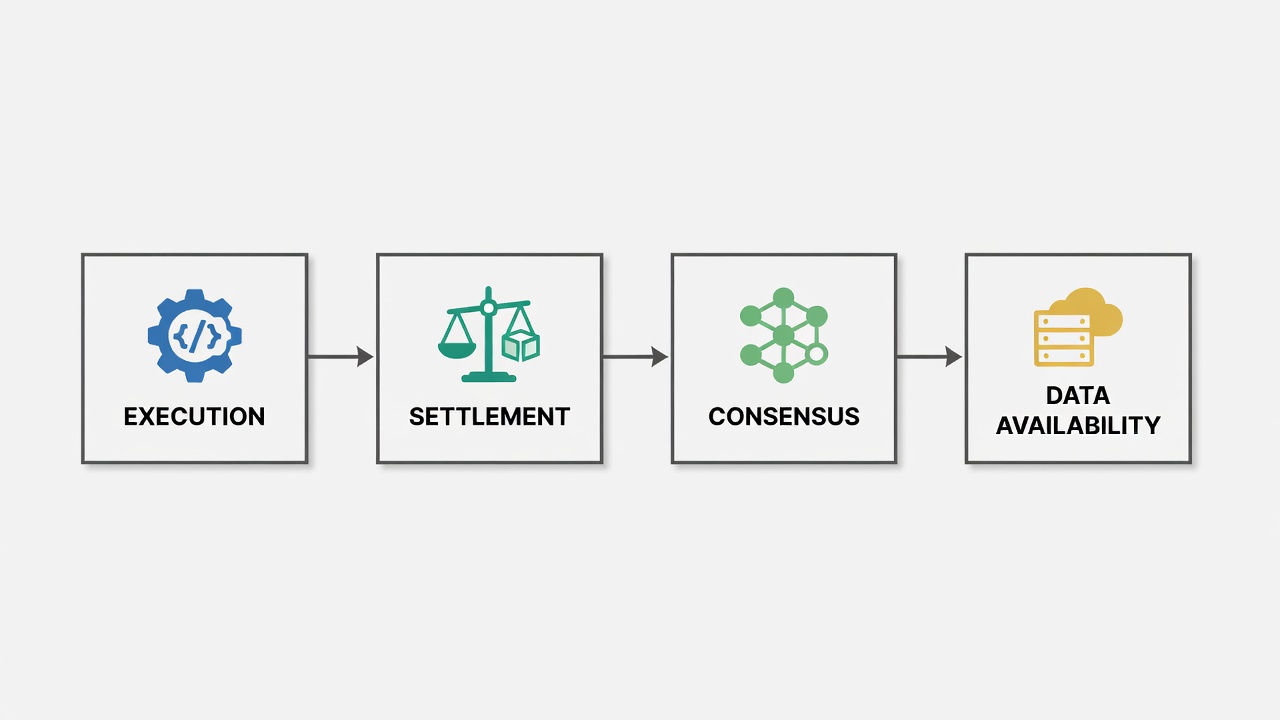
This modular structure contrasts sharply with monolithic chains where all functions occur on a single layer, creating bottlenecks as demand grows. Each layer can be upgraded or replaced independently, allowing continuous improvement without network-wide hard forks.
Monolithic vs Modular Architectures Compared
Traditional monolithic blockchains bundle execution, settlement, consensus, and data availability together. While this simplifies initial development, it limits scalability. For example, increasing transaction volume directly impacts every function, leading to higher fees and slower confirmations during peaks. Monolithic designs also make it difficult to experiment with new consensus algorithms or data sampling techniques without affecting the entire system.
Modular designs mitigate these issues by allowing independent scaling. A developer might pair a high-performance execution environment with a dedicated data availability solution. This flexibility supports diverse Web3 use cases, from DeFi protocols to gaming ecosystems. Additional benefits include easier debugging, as issues can be isolated to a single layer, and better resource allocation since nodes no longer need to perform every function simultaneously.
Key advantages include reduced resource overhead and easier upgrades. Projects can swap one layer for an improved version without rebuilding the entire chain. In practice, this leads to faster innovation cycles and lower barriers for new entrants experimenting with novel Web3 applications.
Key Benefits for Web3 Innovations
Modular blockchains unlock several practical benefits that drive adoption among developers. These advantages become especially apparent when building applications that require both high performance and frequent updates.
- Enhanced Scalability: Specialized layers handle specific tasks more efficiently, supporting thousands of transactions per second. This is achieved through techniques such as data availability sampling that reduce the load on individual nodes while preserving security guarantees.
- Greater Customization: Teams choose optimal components tailored to their application's needs. For instance, a gaming project might prioritize an execution layer optimized for low-latency interactions while selecting a settlement layer focused on economic finality.
- Improved Cost Efficiency: Offloading data availability reduces on-chain storage costs over time. Projects only pay for the resources they actually use rather than maintaining redundant copies of all data across every validator.
- Faster Iteration: Independent layer development accelerates innovation cycles. Teams can adopt improvements in one area, such as a new consensus mechanism, without waiting for coordinated upgrades across the full stack.
These improvements position modular architectures as a foundation for the next wave of decentralized applications across industries.
Real-World Examples: Celestia and EigenLayer
Leading projects illustrate the modular approach in action. Celestia focuses on providing a dedicated data availability layer that any execution environment can leverage. Its design separates data sampling from consensus, enabling lightweight verification for rollups and app-chains. Teams building on Celestia can focus exclusively on execution logic while inheriting robust data guarantees.
Similarly, EigenLayer extends Ethereum's security through restaking mechanisms, acting primarily in the settlement and consensus domains. This allows developers to build modular stacks that inherit robust security guarantees without deploying new validators. The approach reduces the capital requirements typically associated with launching independent networks.
Both examples demonstrate how modular components integrate with existing ecosystems like Ethereum, fostering interoperability and reducing fragmentation. Additional projects in the space continue to emerge, each specializing in one or two layers to create a composable ecosystem of infrastructure providers.
Step-by-Step Guide to Evaluating Modular Stacks
Developers evaluating modular solutions should follow a structured process to ensure the chosen components work harmoniously. This evaluation helps prevent costly mistakes during mainnet deployment.
- Define Requirements: Assess your application's needs for throughput, security, and customization. Consider factors such as expected user volume, regulatory considerations, and integration with existing tools.
- Map Layers: Identify providers for execution, settlement, consensus, and data availability that align with those needs. Create a compatibility matrix to visualize potential combinations and their trade-offs.
- Test Interoperability: Verify seamless communication between chosen layers using testnets. Run simulated workloads that mimic real user behavior to uncover hidden latency or data mismatch issues.
- Evaluate Security Models: Review how each layer inherits or establishes trust assumptions. Pay special attention to any additional trust requirements introduced when combining layers from different providers.
- Measure Performance: Run benchmarks on transaction speed and finality under realistic loads. Include stress tests that simulate network partitions or sudden spikes in activity.
- Consider Ecosystem Support: Check for tooling, documentation, and community resources. Strong developer tooling often determines long-term success more than raw technical specifications.
This methodical evaluation helps avoid common pitfalls like mismatched security assumptions or poor developer experience.
Potential Challenges and Mitigation Strategies
While modular blockchains offer clear advantages, they also introduce new complexities. Coordinating multiple independent layers can increase operational overhead and require deeper technical expertise. Mitigation involves thorough documentation reviews and participation in community governance forums to stay ahead of protocol changes. Another challenge is ensuring consistent user experience across layers, which can be addressed by building abstraction layers that hide underlying complexity from end users.
Frequently Asked Questions
What are the main adoption challenges for modular blockchains?
Primary hurdles include increased complexity in stack coordination and the need for robust cross-layer communication standards. Developers must also navigate evolving security models across multiple providers while educating users about the benefits of the new architecture.
How will modular blockchains evolve by 2027?
Expect deeper integration with restaking protocols and standardized interfaces that simplify assembly of custom stacks. Broader adoption will likely drive more specialized data availability and execution solutions, leading to even greater composability across the Web3 landscape.
Are modular designs suitable for all Web3 projects?
They excel for high-throughput or highly customizable applications but may introduce unnecessary overhead for simple, low-volume use cases where monolithic chains remain sufficient. Careful requirement analysis is essential before committing to a modular approach.
Conclusion
Modular blockchains represent a pivotal shift toward more scalable and adaptable Web3 infrastructure in 2026. By understanding the four layers, comparing architectures, and following evaluation best practices, developers can harness these innovations effectively. Projects like Celestia and EigenLayer provide proven starting points for building the decentralized future, paving the way for broader adoption and more sophisticated decentralized applications across industries.


No comments yet. Be the first!