 CryptoChain Blog
Introduction to Web3 IoT Integration in 2026
The fusion of Web3 and Internet of Things (IoT) technologies represents one of the most transformative trends for 2026. As enterprises seek decentralized alternatives to centralized cloud models, Web3 IoT enables secure, peer-to-peer device communication powered by blockchain. This integration addresses critical challenges like data silos, ownership disputes, and scalability bottlenecks while unlocking real-time automation across industries from manufacturing to healthcare and smart cities.
Readers looking for practical insights beyond basic overviews will find actionable strategies, platform comparisons, and enterprise case studies here. By 2026, decentralized IoT networks are projected to handle billions of connected devices with enhanced privacy and efficiency. The shift empowers organizations to move away from vendor lock-in and toward open, incentive-driven ecosystems where devices contribute to and benefit from shared networks.
Decentralized Device Networks: The Foundation of Web3 IoT
Decentralized device networks eliminate single points of failure common in traditional IoT setups. Devices communicate directly via blockchain protocols, using consensus mechanisms to validate transactions and data exchanges. This approach fosters resilience, as seen in wireless sensor networks for smart cities and industrial monitoring where outages in one area do not cascade across the entire system.
Key benefits include reduced latency through edge computing and token incentives that encourage participation. Enterprises can deploy these networks to manage fleets of sensors without relying on centralized servers, improving uptime and security. For example, agricultural operations use distributed soil moisture sensors that autonomously report conditions to a shared ledger, enabling precise irrigation without intermediary platforms.
Data Ownership via Blockchain in IoT Ecosystems
Blockchain ensures immutable records of IoT data, granting users true ownership. Smart contracts automate permissions, allowing devices to share data only with authorized parties. This model prevents unauthorized access and supports compliance with regulations like GDPR by creating transparent audit trails that users control.
In practice, manufacturers can tokenize sensor data, creating verifiable audit trails. This shifts control from corporations to individuals and businesses, fostering new revenue streams through data marketplaces. A logistics company might tokenize shipment tracking data, selling anonymized insights to partners while retaining full sovereignty over sensitive information.
Real-Time Automation Protocols for Decentralized Systems
Protocols like those enabling oracles and decentralized identifiers facilitate instant automation. IoT devices trigger smart contract executions based on real-world events, such as adjusting supply chain logistics when sensors detect delays or temperature anomalies in perishable goods transport.
These protocols integrate with AI for predictive actions, optimizing energy use in smart grids or predictive maintenance in manufacturing. Adoption requires careful protocol selection to balance speed and decentralization. Real-time capabilities are further enhanced by edge nodes that process data locally before committing to the blockchain, minimizing delays in time-sensitive applications like autonomous vehicle coordination.
Comparing Leading Platforms: Helium vs IOTA
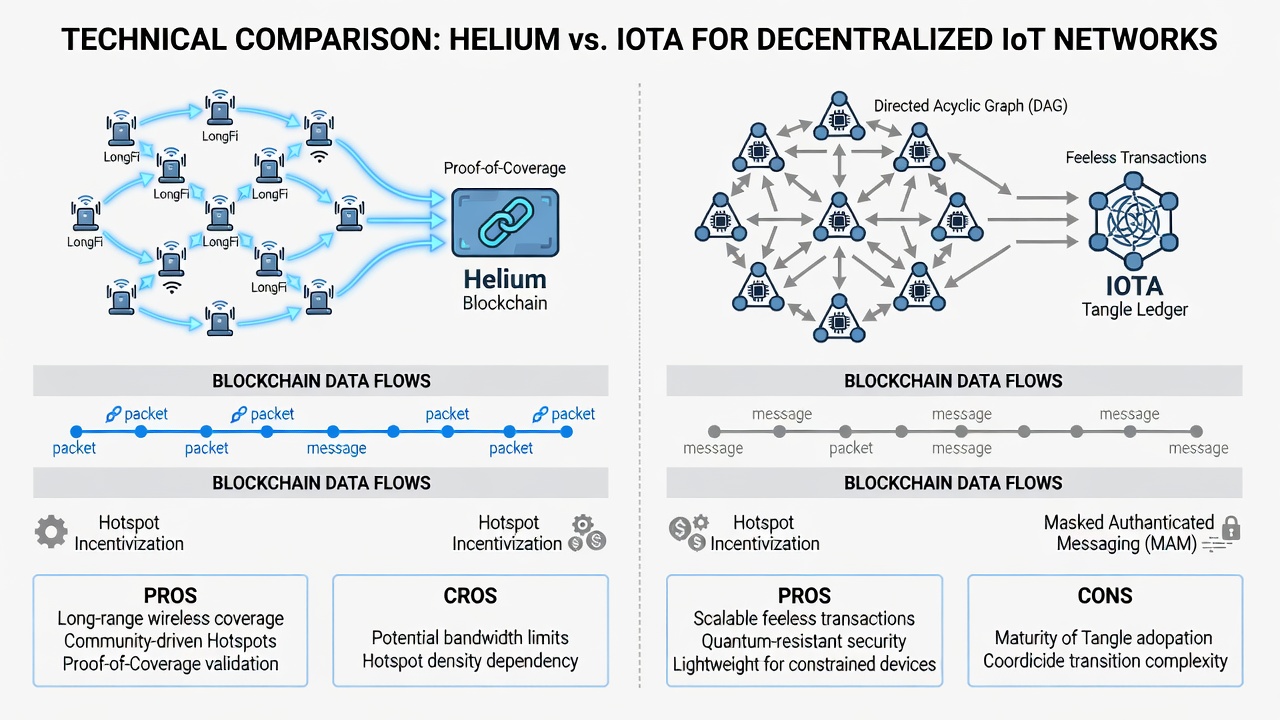
Two prominent platforms stand out for Web3 IoT: Helium and IOTA. Below is a detailed pros/cons comparison to guide selection based on specific enterprise needs such as coverage requirements or data volume.
| Aspect | Helium | IOTA |
|---|---|---|
| Pros | Strong wireless coverage via community hotspots; token incentives drive rapid expansion; ideal for LoRaWAN-based IoT deployments across urban and rural areas. | Feeless transactions via Tangle technology; high scalability for data streams; strong focus on enterprise data integrity and machine-to-machine micropayments. |
| Cons | Dependency on physical hotspot density; potential coverage gaps in remote areas; higher initial setup for hardware procurement and maintenance. | Less mature ecosystem for consumer devices; requires integration with additional oracles for full automation; steeper learning curve for developers new to directed acyclic graph structures. |
Choose Helium for broad geographic networks and IOTA for high-volume data applications. Visit Helium's official site for deployment resources and IOTA's official site for technical documentation.
Step-by-Step Enterprise Integration Examples
Implementing Web3 IoT involves phased approaches tailored to industry requirements. For supply chain use cases: 1) Assess device compatibility with blockchain nodes and select sensors supporting standard protocols. 2) Choose a platform like IOTA for its data-centric design. 3) Deploy smart contracts for automated alerts on shipment conditions. 4) Integrate oracles for external data feeds such as weather or traffic. 5) Test scalability with pilot sensors before full rollout, monitoring for network congestion. 6) Train teams on interpreting on-chain analytics dashboards.
Another example in healthcare: Secure patient monitoring devices using decentralized identifiers. Start with permissioned blockchain layers for compliance, then expand to token-based incentives for data sharing among providers while ensuring HIPAA alignment through encrypted channels.
Technical Architecture Deep Dive
A robust Web3 IoT architecture typically layers device hardware with edge gateways, blockchain nodes, and application interfaces. Devices collect raw data and sign transactions locally. Edge gateways aggregate and validate before broadcasting to the distributed ledger. Smart contracts handle logic for automation, while decentralized storage solutions like IPFS keep large files off-chain for cost efficiency. Security layers include hardware security modules and zero-knowledge proofs to protect sensitive payloads without sacrificing verifiability.
Emerging Case Studies and Actionable Strategies
Recent enterprise pilots demonstrate success. A European logistics firm used Helium for real-time tracking, reducing delays by 25 percent through community-powered coverage. In energy, IOTA-powered grids optimized distribution through peer-validated sensor data, improving efficiency in renewable integration. Actionable strategies include starting with open-source SDKs, prioritizing security audits by third parties, and forming industry consortia for shared infrastructure. Monitor emerging standards from bodies like the World Wide Web Consortium to stay aligned with evolving specifications.
Challenges, Solutions, and Best Practices
Common challenges include interoperability between legacy systems and new blockchain layers, as well as energy consumption concerns in proof-of-work variants. Solutions involve hybrid consensus models and middleware adapters. Best practices encompass:
- Conduct thorough risk assessments before scaling pilots.
- Prioritize user-friendly dashboards for non-technical stakeholders.
- Implement continuous monitoring for anomaly detection on the ledger.
- Establish clear governance frameworks for network upgrades.
- Avoid over-centralizing control points during early deployment phases.
Mistakes to avoid include neglecting firmware update mechanisms and underestimating the importance of community incentives in sustaining network growth.
Future Outlook for Web3 IoT in 2026 and Beyond
Looking ahead, convergence with 5G and AI will accelerate adoption. Expect more standardized cross-chain protocols and regulatory frameworks that recognize decentralized data ownership. Enterprises investing now in modular architectures will be positioned to capitalize on these advancements, creating competitive advantages through enhanced operational transparency and resilience.
FAQ: Addressing Security and Scalability Concerns
- How secure is Web3 IoT against hacks? Blockchain's distributed ledger resists tampering, but always implement multi-factor authentication and regular firmware updates across all nodes.
- What about scalability for millions of devices? Platforms like IOTA's Tangle scale horizontally without fees, while Helium leverages off-chain processing for efficiency in large deployments.
- Can legacy IoT systems integrate easily? Yes, via middleware bridges that translate protocols to blockchain standards, allowing gradual migration without full replacement.
- Are there risks with data ownership? Smart contracts enforce rules, but legal frameworks must evolve to recognize tokenized data rights across jurisdictions.
- How do these networks handle regulatory compliance? Built-in audit trails and permissioned access controls simplify reporting for standards such as GDPR and industry-specific mandates.
- What training is needed for implementation teams? Focus on blockchain fundamentals, smart contract development, and IoT security best practices through targeted workshops and certifications.
Conclusion
Web3 IoT integration in 2026 offers enterprises a path to decentralized, ownership-centric systems. By leveraging platforms like Helium and IOTA, organizations can implement secure automation while addressing security and scalability head-on. Begin with targeted pilots to realize these innovations and build toward comprehensive, future-proof deployments.


No comments yet. Be the first!